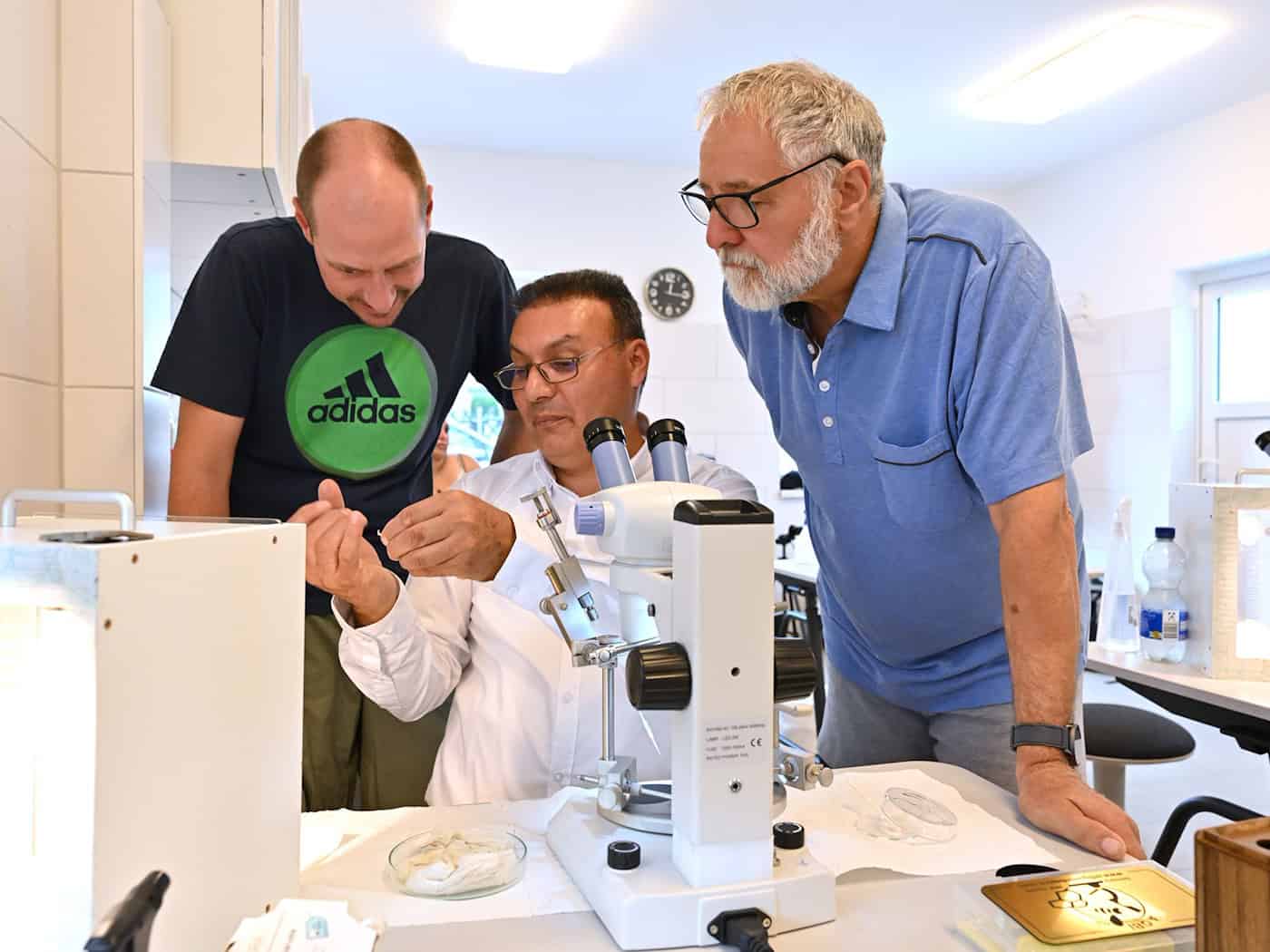
A loud buzzing serves as the background noise in this professionally equipped laboratory. That’s because in this building in the small Thuringian town of Elgersburg (Ilm District), the groundwork is being laid for high-quality honeybees. On this warm July day, five participants in a special training course are learning exactly how this works. They are seated at lab tables topped with large boxes fitted with glass panels. Inside, male bees are producing the loud, deep buzzing sound. With a tiny pipette in one hand and a male bee in the other, they are all pursuing the same goal: to bring the drones to orgasm. To do this, they press against the insects’ chests and carefully roll their abdomens back and forth between their fingers until the animals’ genitalia—which are remarkably large in proportion to the rest of their bodies—practically shoot out, and a large white drop forms at the tip. Then the pipette comes into play: it must be positioned with the utmost care and precision to collect the sperm from the drop. “The apprentices have been busy collecting sperm all morning—sperm collection is painstaking work,” explains Ali Ataeian. As the managing director of a company that specializes in the instrumental insemination of queen bees, the engineer—who holds a degree with a focus on honeybee selection—knows what he’s talking about. He has already trained around 670 people from all over the world to instrumentally inseminate queen bees using a device he developed himself. The drones used for this come from Ataeian’s own colonies. In the large garden behind the lab stand dozens of hives containing a docile species of bee. Without protective gear, Ataeian approaches a hive and carefully removes a queen. Meanwhile, a few meters away, his trainees are collecting the stingless drones. With their bare hands, they pick out particularly vigorous-looking specimens from the hive and place them in a wooden box with air holes. Then it’s back to the lab. The fact that collecting sperm from drones is a skill that must be learned becomes evident when a loud curse suddenly echoes through the room. “It all came out! The whole morning was for nothing!” laments one participant. A clumsy movement with the pipette cost him the sperm he’d painstakingly collected throughout the day. “The frustration level must be high, especially at the beginning—it takes practice,” says participant Maria Corpataux. Together with two other breeders, she traveled all the way from Switzerland specifically for the course and already has a bit more experience. This is also evident from the trash can on her lab table, which is well-filled with dead drones. Just as in nature, the drones die after reaching the peak of their lives with ejaculation. Finally, Ataeian once again demonstrates the course’s concluding step: First, the previously selected queen bee is anesthetized with CO₂ in a digitally adjustable device. “I developed that, too,” says Ataeian, securing the anesthetized queen in the delicate-looking insemination device. On a screen, viewers can then watch as the expert, working under a microscope and using a tiny loop, opens the opening at the queen’s rear end and then, with millimeter precision, injects a measured amount of the previously collected drone sperm. He then attaches a marker to the queen and removes her from the restraint. A few minutes later, the insect is moving again. Ataeian isn’t the only provider of equipment and training courses for bee insemination. In fact, the technique is older than the specialist himself, who was born in 1972: “Artificial insemination has been established and proven for decades and is a very good method for achieving specific breeding goals,” explains Elke Genersch, director of the State Institute for Apiculture in Hohen Neuendorf. The research institute is funded by the states of Brandenburg, Saxony-Anhalt, Saxony, Thuringia, and Berlin. One goal, for example, is to develop honeybees’ tolerance to the disease transmitted by the Varroa mite. “Here at the institute, we have bred a Varroa-tolerant selection line over the past few decades in which mite pressure does not become as severe. Another goal is to breed for an improved immune response in the bees so that they become more tolerant to various pathogens,” explains Genersch. The expert summarizes why breeding bees is particularly challenging: “Unlike cattle or horses, bees are free-flying insects. Their natural mating takes place at drone gathering sites in the air. The bees know where these are and fly there. How they know that, however, we do not know.” After mating, the queen bees fly back to their colony, and their special sperm storage sac must be filled sufficiently to last for the rest of their lives—which can be as long as three to four years—as Genersch explains. Alternatives to artificial insemination are so-called mating stations. These are special, often remote mating sites where only selected drone colonies are present. Beekeepers can specifically bring their queen bees there in the hope that they will mate with the drones found there. However, this approach also involves a significant time and logistical investment for the beekeepers, as participants in Ataeian’s insemination course report. Queens can also be inseminated by multiple drones, and bees can sometimes fly several kilometers to mate. “Mating stations offer a certain degree of certainty regarding the genetic material with which the queen mates. But if you want to be 100 percent certain that your queen receives only sperm of the desired genetic origin, artificial insemination is the only option,” says Genersch. She admits: “Artificial insemination, however, is a specialty for breeders, and an artificially inseminated queen is expensive.” Yet the commitment of breeders cannot be overestimated. This is because the queens’ drone offspring then spread the breeding goal widely. Ataeian also sees the benefit of breeding in the fact that fewer chemicals need to be used for pest control in the hive: According to his theory, healthy colonies bred to exhibit specific cleaning behaviors can be left to fend for themselves to a greater extent. The expert also notes that honey production is not the honeybee’s primary function. “The bee’s first and most important product is pollination.” And it is precisely for this work that the bees need to be strong. Copyright 2026, dpa (www.dpa.de). All rights reserved“Sperm collection is painstaking work”
“The frustration level must be high”
And why all this fiddly work?
Special Locations for Bee Mating
“Pollination is the most important thing”