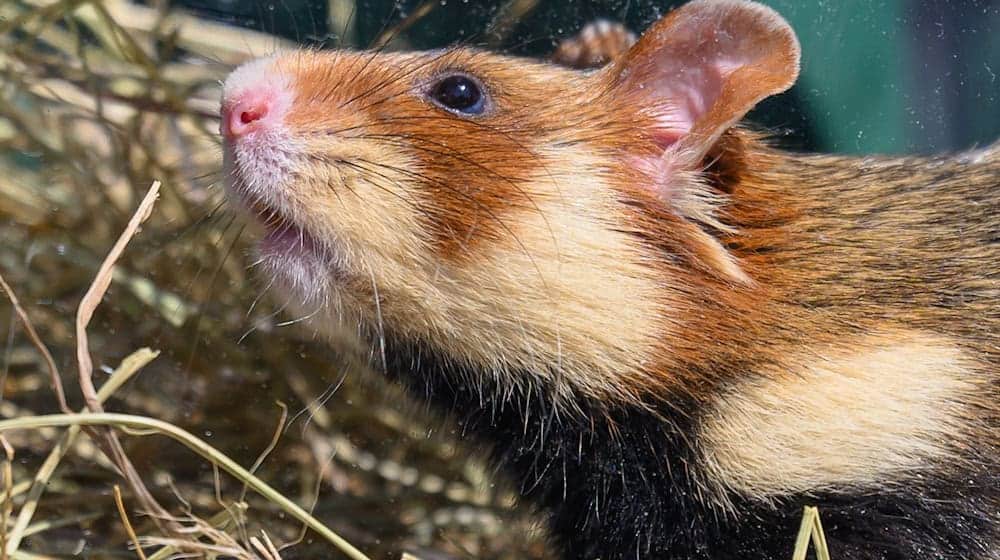
Volunteer conservationists in Saxony want to focus on the European hamster at their annual meeting next Saturday. According to the Saxony Foundation for the Environment and Nature Conservation (Lanu), the keynote speech will be dedicated to this protected species. A project to reintroduce the European hamster is currently underway in the district of North Saxony under the motto "LIFE4HamsterSaxony". It extends over a period of six years. 12.2 million euros are being invested in the project. 75 percent of this is being funded by the European Union, with the remainder being shared by the state of Saxony, Leipzig Zoo and the district of North Saxony.


Field hamsters are regarded as "architects underground"
Field hamsters (Cricetus cricetus) are regarded as "architects underground" and live in a widely ramified burrow. They grow up to 35 centimetres in size and can weigh up to 500 grams. They hibernate from October to April. With their hamster cheeks, the animals have natural "shopping bags". The cheeks are extremely flexible and are used to transport seeds and grains for the larder in the burrow. The field hamsters are threatened by intensive agriculture and pesticides, for example.
Nature conservation with the help of volunteers in Saxony is dedicated to fauna and flora in a variety of ways. This will also become clear at the meeting on Saturday, which is not taking place in Neschwitz (Bautzen district) by chance. The small village on the edge of the Upper Lusatian Pond Landscape Biosphere Reserve is considered the cradle of Saxon ornithology. Today, it is home to the state bird observatory, among other things.