


The ice is melting: Saxon researchers measure glacier retreat in Patagonia
The ice at the end of the world is disappearing. Patagonia, in the very south of Argentina, is home to the largest ice masses in the southern hemisphere outside of Antarctica. But here, too, climate change is eating away.
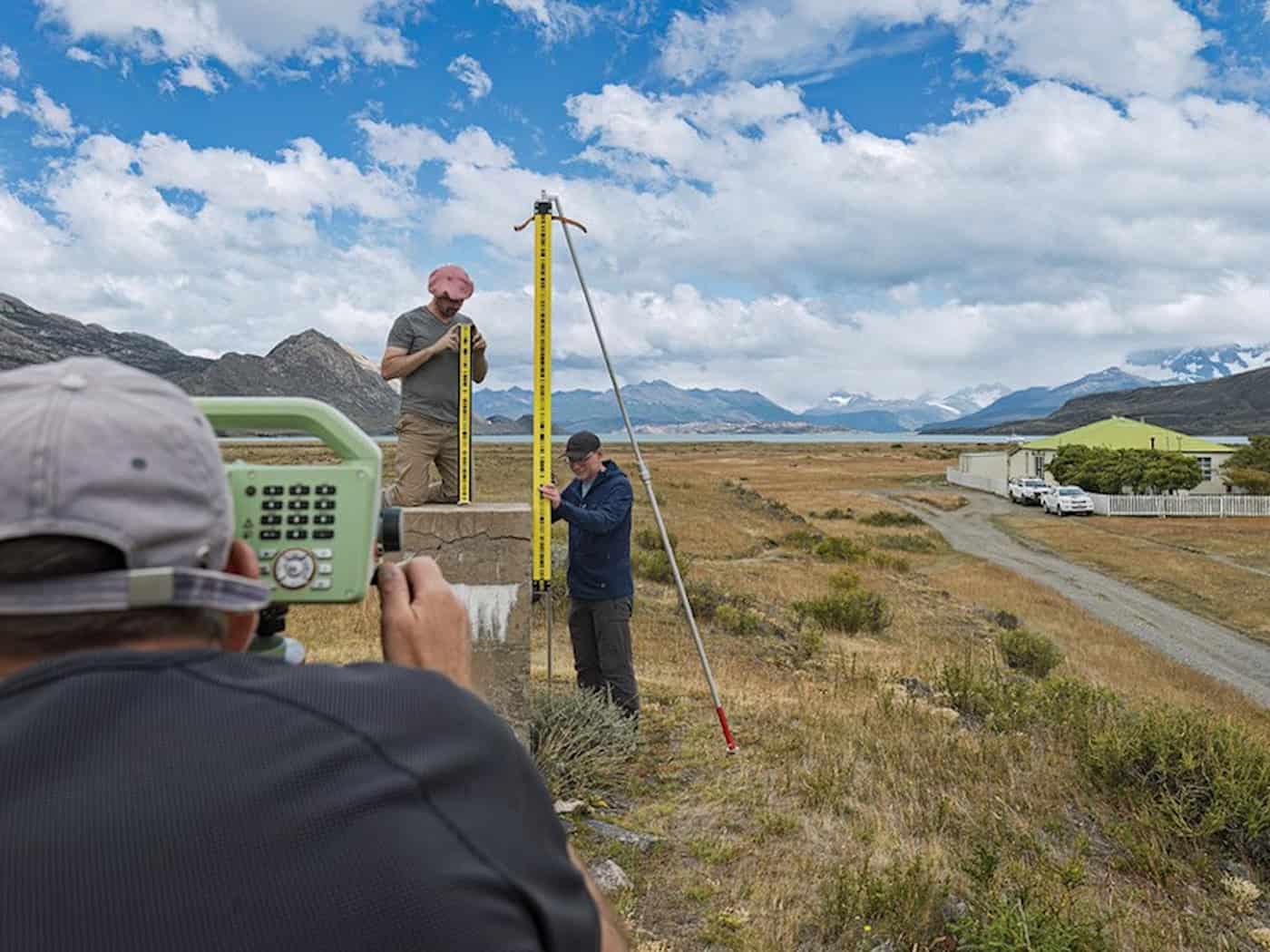
In early March 2026, scientists from Dresden University of Technology (TUD) and the Federal Agency for Cartography and Geodesy (BKG) in Leipzig returned from a four-week expedition. In their luggage, they had new measurement data from the eastern edge of the southern Patagonian Ice Field to the Atlantic coast.
Gravity as a precise measuring instrument
In order to measure this change in ice mass, Mirko Scheinert from the Chair of Geodetic Earth System Research at TUD and Axel Rülke from BKG Leipzig are carrying out a joint research project funded by the German Research Foundation (DFG). The researchers are using an unusual tool for their work: absolute gravimetry. It measures how strongly the earth pulls at a particular location. Where there is ice, the earth pulls more strongly. Where ice melts, this attraction decreases.
"The FG-5 absolute gravimeter used here is able to measure the smallest changes in gravity. The gravitational acceleration of around 9.8 m/s² can be measured to the eighth decimal place," explains project manager Rülke. Put simply, this means a measurement accuracy that makes even the tiniest ice mass losses visible. In addition, the scientists use satellite navigation systems (GNSS) to record changes in height in the ground. This is because when ice disappears, the Earth's crust slowly rises beneath it.
Three plates, three campaigns, one goal
The region is particularly challenging geologically. Three tectonic plates meet: the Nazca Plate, the South American Plate and the Antarctic Plate. This makes measurements and their evaluation more complicated. The DFG-funded GravPatagonia project has now completed its third measurement campaign in 2026, after 2020 and 2022.
In addition to researchers from Dresden and Leipzig, colleagues from Argentina were also involved. The evaluation of all three campaigns should show how the ice field reacts to climate change. International studies already show that between 2000 and 2012, the two Patagonian ice fields together lost 24.4 gigatons of ice per year. A quantity that has continued to increase since then. The new Dresden measurement data should help to understand this loss even more precisely.

