


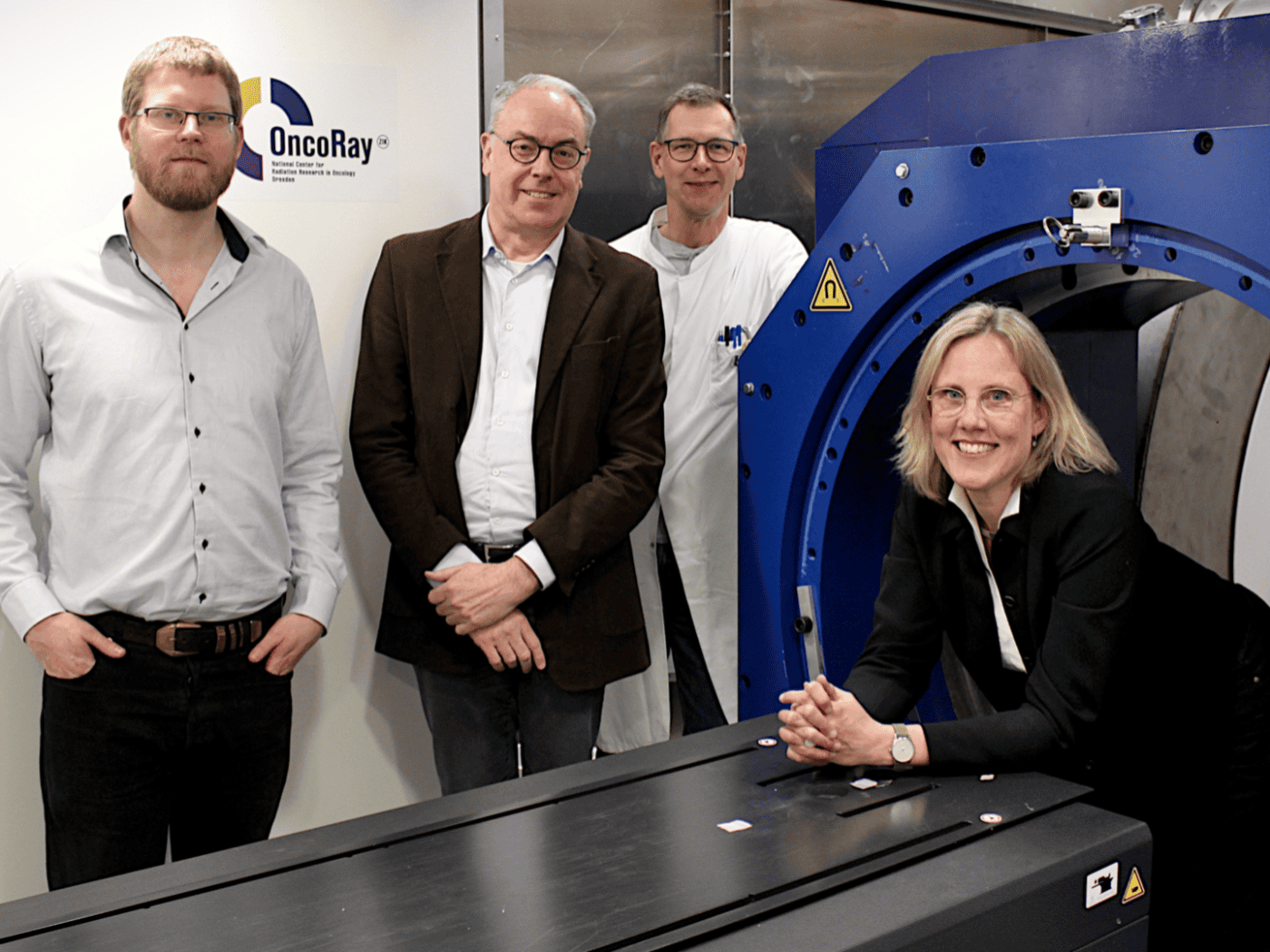
A tumor in the abdomen moves with every breath. Treating it with radiation means tracking it in real time while still hitting it with pinpoint accuracy. That is exactly what researchers in Dresden are working on. They aim to combine two technologies that have so far been used together mainly in experimental settings: magnetic resonance imaging (MRI) and proton therapy.
OncoRay in Dresden is receiving around €1.1 million in funding from Germany’s Federal Ministry of Education and Research. The funding will support the four-year MEDABIS-PRO project, involving the Helmholtz-Zentrum Dresden-Rossendorf and the Faculty of Medicine at Technische Universität Dresden.
What is behind the new method?
Proton therapy is a specialized form of radiation treatment. Instead of X-rays, tiny particles known as protons are directed precisely at the tumor. They deposit their energy very accurately inside the tumor while sparing surrounding healthy tissue. MRI, meanwhile, provides detailed images of soft tissue such as organs without exposing patients to additional radiation. Combining the two technologies could allow doctors to observe tumors in real time during treatment and adjust the radiation more precisely.
That is technically challenging because the magnetic field generated by the MRI scanner slightly deflects the protons. As a result, the energy is distributed differently inside the body. Researchers therefore need to understand and calculate these effects very precisely in order to maintain the accuracy of the treatment.
A unique research device in Dresden
Since 2024, OncoRay has housed a research prototype unlike any other in the world: a whole-body MRI system with a rotatable magnet. This allows scientists to test how different magnetic field orientations influence proton beams. The team plans to carry out computer simulations, experiments using specialized body models, and, for the first time, biological experiments directly inside the MRI scanner. One key question is how magnetic fields affect living cells during proton irradiation. MEDABIS-PRO aims to provide answers to this as well.
The work in Dresden is part of an international effort to develop more precise cancer treatments. Research centers worldwide are exploring ways to combine imaging technologies directly with proton therapy in order to track tumors in real time during radiation treatment. This is considered especially important for tumors that move during breathing, such as those in the lungs or abdomen. However, combining MRI with proton beams remains technically difficult because magnetic fields influence charged particles. The rotatable MRI prototype at OncoRay is therefore regarded as a unique piece of research infrastructure in this still emerging field.
“The findings from MEDABIS-PRO will contribute to the further development of MR-guided proton therapy and its future use in clinical studies,” says Prof. Esther Troost, Director of the Department of Radiotherapy and Radiation Oncology at TU Dresden. The goal is to make cancer treatment more precise, more effective, and gentler for patients in the future.

