


Tobias Heldt in Stresa: A Love Story Between Upper Lusatia and Asia
When Stresa—which has always been quite successful riding the fine-dining wave—introduced its new executive chef a year ago, there was some buzz in the culinary scene: With Tobias Heldt at the helm, the restaurant now has someone who had previously earned a Michelin star (in Kirschau at Restaurant Juwel in the “Bei Schumann” Hotel). I never asked the calm and collected chef whether he’d like to earn another star at Stresa—because, first of all, I don’t know of any chef—female chef in fine dining who wouldn’t want to—and second, you don’t necessarily have to come clean with the whole truth when asked such a question: tactical evasion is often the choice to avoid coming across as a show-off (m/f/d), or alternatively as snobbish, arrogant, or conceited. Either way: those who can cook do so well, with or without a star. In that sense, the (brief) period leading up to such an award is usually the best anyway, purely in terms of the pleasure of the meal.

To mark his first anniversary, the two of us visited Stresa to try the regular menu (our previous visit had been as part of a special event during the “Kochsternstunden” series). There’s a seasonal menu that you can order in three to six courses (for 59 €/75 €/89 €/105 €)—one option features fish and meat, while the other offers vegetarian and sometimes vegan courses. We ordered a non-traditional mix, had the soup as an appetizer, and glanced twice at the vegetarian/vegan section—everything was doable. Of course, there was no extra charge, which is worth mentioning because in some places you get ripped off even for equivalent side dish substitutions. So we ended up with four-course meals for 75 euros each. In addition to the set menus, there are two à la carte options. One features the components of the set menu as individual items (feel free to add them up: it’ll cost more!), while the other offers the classics (pasta, schnitzel, etc.—which, by the way, you can also include in the set menu if you like). But for all our love of schnitzel: it doesn’t really fit well into the overall structure of the dedicated set menu.
The restaurant manager, Mariana Hübner, accompanied us throughout the evening—we made a politically completely incorrect remark at the start of the evening about her “Berlin sass” and left Stresa at the end of the evening praising the “great service” —though those two things don’t have to be mutually exclusive; we’re open to all dialects, as long as we can understand them reasonably well. What definitely fit the bill (and perhaps it’s an advantage that she left Kreuzberg to bring a touch of cosmopolitan flair to Stresa) was the drink pairing: wines on one hand, non-alcoholic drinks on the other: neither run-of-the-mill, but full of flavor and—and that’s perfectly fine—occasionally something to work through (more so with the fermented options in the non-alcoholic selection than with the wine).
The menu was still the one from the summer menu; the next seasonal change is scheduled for October. We liked that, because there’s plenty of time left for autumn and then winter—after all, the seasons in the kitchen don’t arrive on the meteorological cut-off dates—spring vegetables need time to grow if they’re going to taste good. Which brings us to the key word for the evening: taste. And so—admittedly, as expected—we found ourselves in a love story that began with freshly baked bread and ended with two desserts (only one per person, but we can always sneak a bite or two!). What ran through it all was the interplay of flavors, the balance between tradition and modernity, and the wide range of culinary influences stretching from Upper Lusatia to the Far East. Diversity—not just culinary diversity—certainly creates a positive tension; flavor notes that seem opposite at first glance come together in the most wonderful way to form a symphony of flavors.
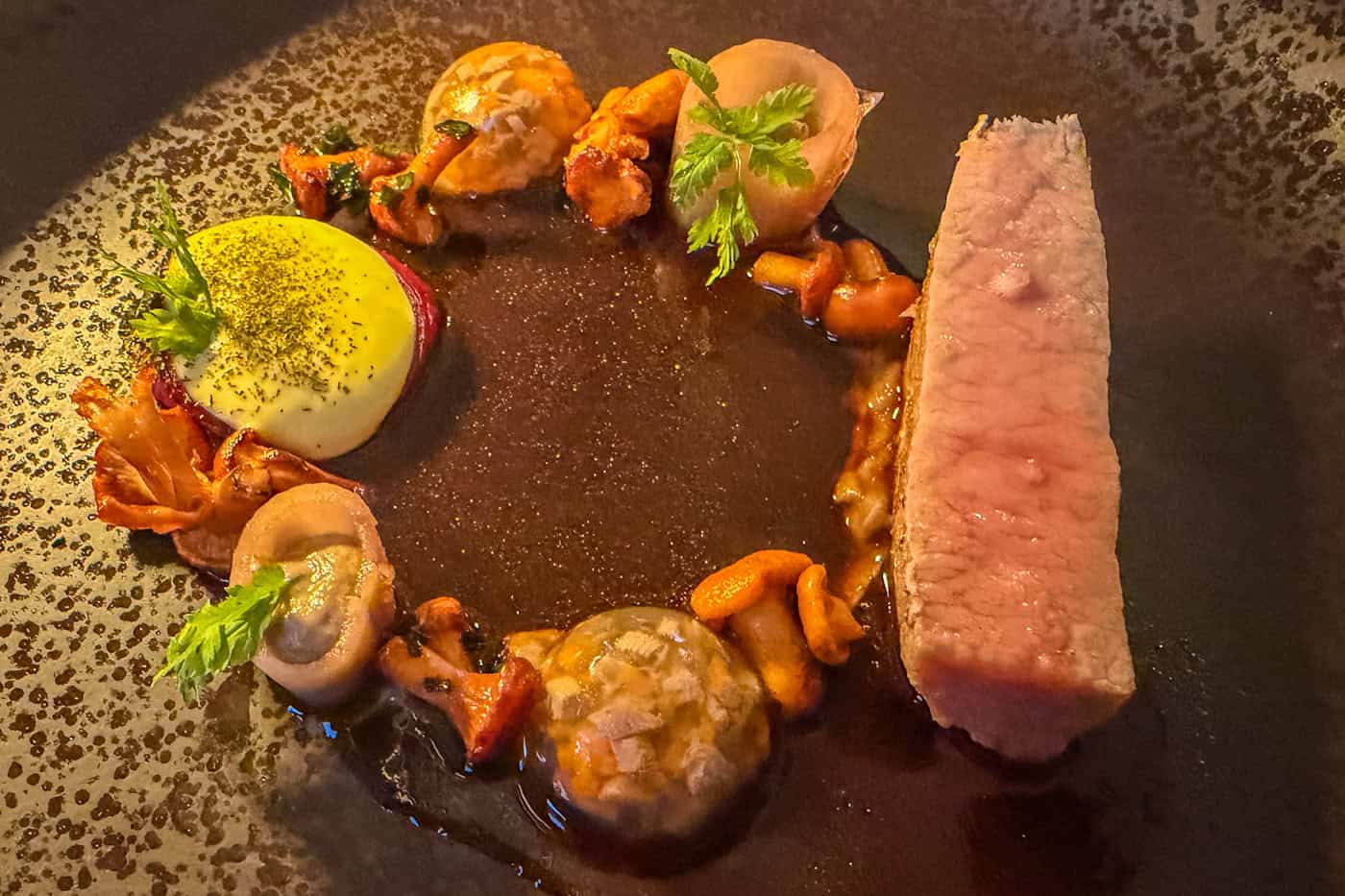
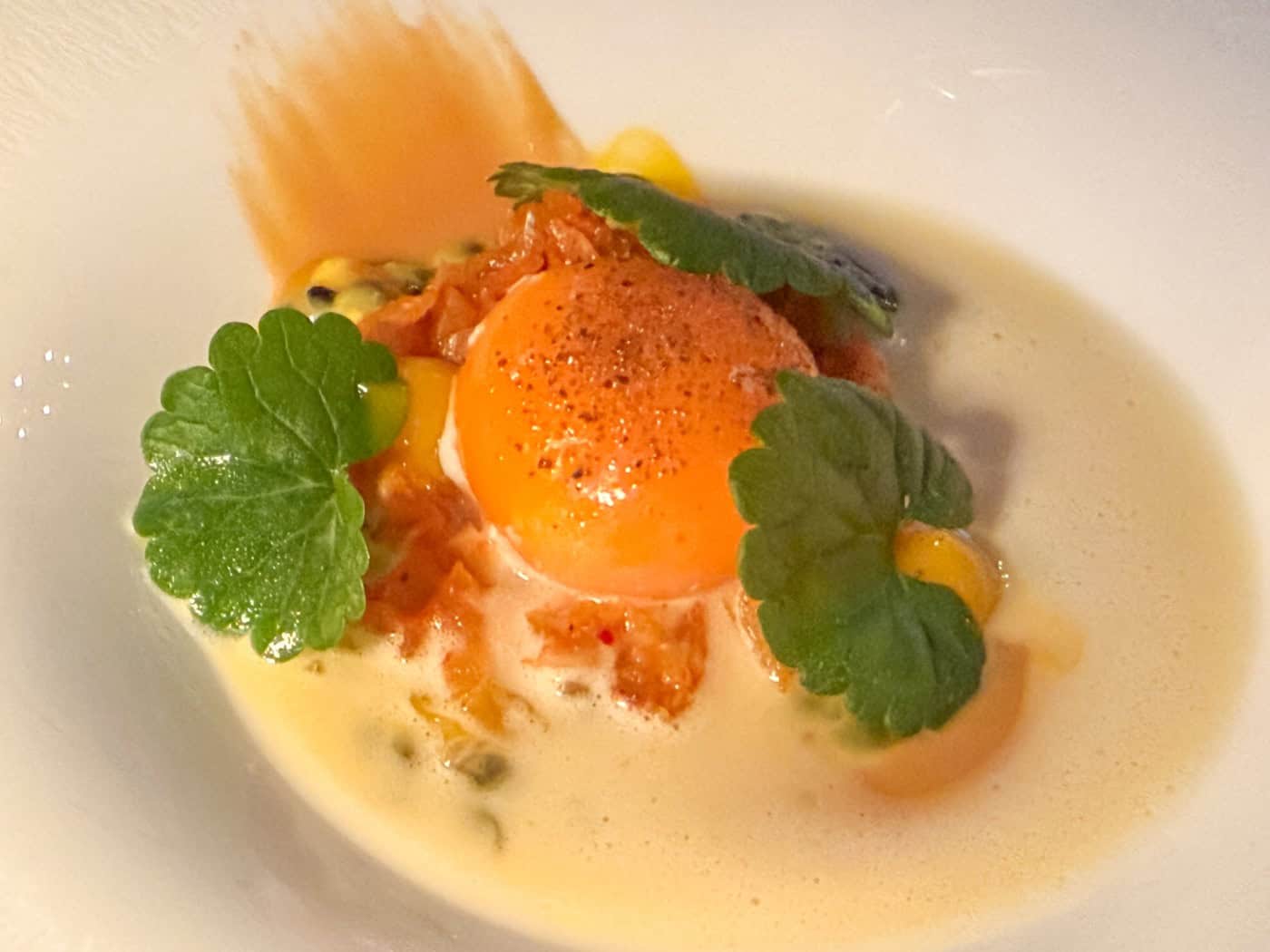
It’s hard to pick a favorite course, but there doesn’t always have to be a winner. What really stuck in my memory, however, was the perfect egg yolk from the Berghäuserhof in Kemnitz, swimming in a sweet-and-spicy honey-garlic beurre blanc and given an extra kick by kimchi, passion fruit, and miso. The sauce spoon, which was set on the table from the start, ensured a spotlessly clean plate (alternatively, you can of course mop up the sauce with bread, if you haven’t already snacked on it…). I have to highlight the main course for several reasons. First: anyone who shrugs their shoulders in mild disgust at the thought of pork—and has no plausible reasons to back it up, but simply argues that it’s “watery stuff”—will be proven wrong by the Iberico trio. This is partly due to the Iberian pig, which (at least in its native Spain and Portugal) is usually allowed to roam freely and feeds on tasty acorns before delighting us with ham & other delicacies; but of course, it’s also due to the trio skillfully served from the small kitchen: a juicy cut of loin, a lovingly prepared small aspic made with Iberico tongue, and—served separately—the incomparably melt-in-your-mouth ham.
Our Menu
- Appetizer:
Mackerel “Escabeche” – cucumber / Granny Smith / green shiso - Soup as an appetizer:
Gazpacho – shrimp / bell pepper / jalapeño - Intermezzo A:
Confit brook trout – caviar / leek / potato / dill - Intermezzo B:
Egg yolk from Berghäuserhof in Kemnitz – kimchi / passion fruit / miso / honey-garlic beurre blanc - Main Course:
Three-course Iberico selection (loin, aspic with tongue, ham) – chanterelles / onion / tarragon - Cheese for dessert:
Brillat-Savarin – green tomato / Thai basil - Dessert:
Valrhona Amatika – raspberry / hazelnut / verbena
Restaurant Stresa
Augsburger Straße 85
01277 Dresden
Tel.: 0351 – 656 157 30
restaurant-stresa.de
[Visited on September 3, 2026]

