

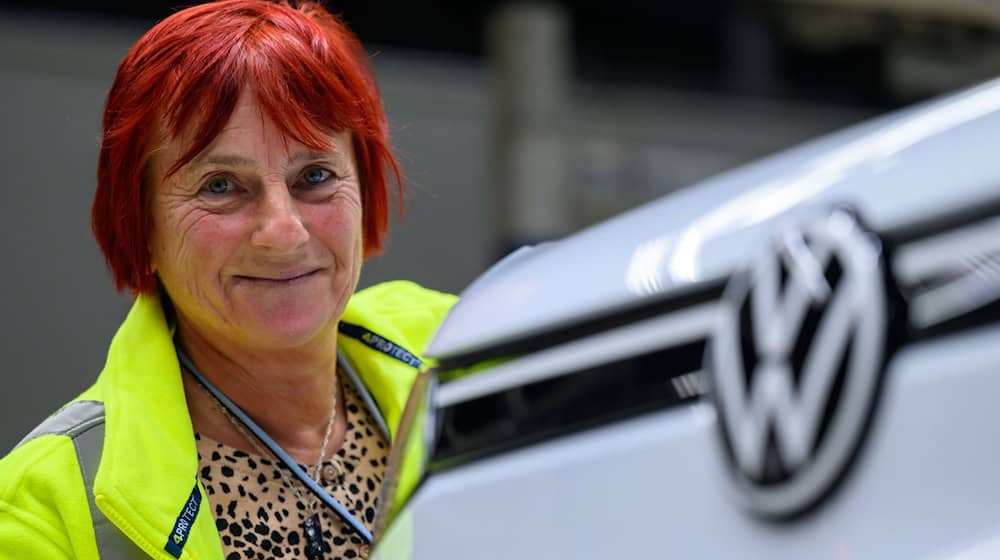
Proud. When long-standing Volkswagen employees in Zwickau talk about the past, this one word comes up again and again. She was proud when she started here in 1990, says Silke Novotny. At that time, the GDR small car Trabant and the VW Polo were still being built here in parallel. "It was our incentive to be better than Wolfsburg," says the 59-year-old from the quality assurance department. And when it came down to it, everyone "clenched their jaws". Volkswagen Sachsen is celebrating its 35th anniversary this Friday in Zwickau. And Novotny has been there from the start. "It's like a dream what has been created here." She talks about the immense noise in production at the time and how everything around the plant was a construction site. But it's not just the car factory itself that has developed, but also the surrounding infrastructure. "Compared to back then, it's a quantum leap today." What began comparatively small with a few hundred employees was considered a success story for many years, despite some lean periods. But this has started to crack. While the site was celebrated as a pioneer of electromobility in the Volkswagen Group a few years ago, it is now struggling with weak sales on the car market. Staff have been cut and the night shift at both production lines has been canceled. In future, models are to be transferred to other VW locations. Last year, there was great concern when VW announced job security and threatened to make massive savings. "Plant closures were on the cards," says Works Council Chairman Mario Albert, explaining the dramatic situation. A new situation for many employees. There is now a new contract that secures the sites. "Our colleagues are proud to work at Volkswagen," adds his deputy Mike Rösler. "There have always been ups and downs over the past 35 years," recalls VW Saxony boss Danny Auerswald. "But the team has mastered all of this with Saxon creativity and fishiness." The aim was to show that cars can be built competitively in Germany. This requires lower factory and production costs. Good progress is being made, Auerswald said. "But this is a marathon, not a sprint." In addition to the car factory in Zwickau, Volkswagen Saxony also includes the engine plant in Chemnitz and the Transparent Factory in Dresden. The number of employees in Zwickau has fallen from 9,200 at the beginning of the year to around 8,500 and production has picked up again. At around 212,000 vehicles, production will be around 4 percent up on the previous year, says Auerswald. Car manufacturers are also hoping for a tailwind from the new state purchase incentive for e-cars announced by the German government. According to reports, the Cupra and ID.3 models could run longer in Zwickau. When asked about this, Auerswald referred to the decisions still to be made by the Supervisory Board as part of the current planning round. And in future, Zwickau will once again become a pioneer in the Group with the dismantling and reconditioning of vehicles. Preparations are underway and applications for funding have been submitted. After the new start in 1990 and the transformation into the first all-electric car factory in Europe from 2018, the site is now "facing its third reinvention", according to Chemnitz-based automotive expert Werner Olle. "As a modern production and logistics location, Zwickau has the ideal prerequisites to become a European disassembly and diagnostics center for electric vehicles." However, the circular economy can only be an additional business area, emphasizes Works Council member Mike Rösler. "New cars must continue to be produced in the long term." After all, this has been a tradition in Zwickau for more than 120 years. "And many jobs at suppliers also depend on it. The people here are passionate about car manufacturing." Silke Novotny could sit back and relax. After all, she only has a few months left to work and can then retire thanks to partial retirement. But she remains fierce: "We have to keep going here." Her colleague Holger Simon agrees. The 57-year-old has also been here from the start. "Back then, I was euphoric about helping to build something new," he recalls. And unlike many other people in East Germany, he wasn't unemployed for a single day after reunification - thanks to his secure job at VW. All of this fills him with pride, he says. Copyright 2025, dpa (www.dpa.de). All rights reserved


