Logo Die Sachsen News
Nachrichten / Health

How cancer cells learn to survive

It is not only genes that determine whether a tumor grows: connective tissue and fibroblasts play an active role from the very beginning.
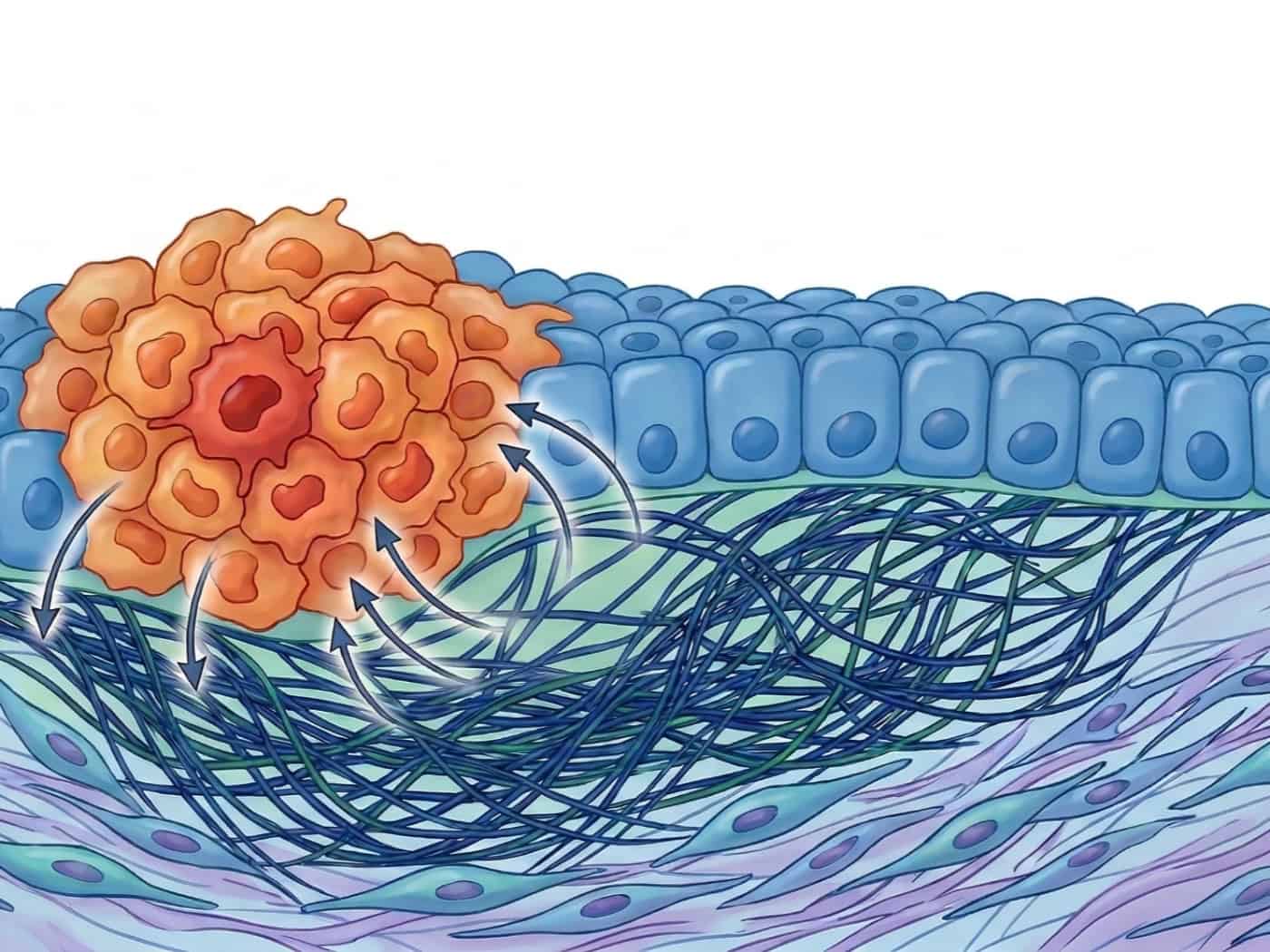
Early tumor cells actively reshape their environment: fibroblasts and immune cells help them to build a protective niche. © Skrupskelyte, G. et al, Nature
Von: Wissensland
Why do some tiny tumors survive while others disappear? Researchers from Dresden and Cambridge have a surprising answer: cancer cells build their own protective zone.

Every person carries altered cells in the course of their life. Most of them die or are eliminated by the body. But some manage to survive and grow. Why is that? This is what an international research team involving researchers from Dresden has now discovered and published in the journal Nature.

Tumor cells send distress signals

The University of Cambridge, the Faculty of Medicine at Technische Universität Dresden (TUD) and the Max Planck Institute of Molecular Cell Biology and Genetics (MPI-CBG) in Dresden are involved. The researchers investigated early stages of esophageal cancer in mice. Their findings are surprisingly clear.
As soon as an early tumor cell develops, it sends stress signals to the surrounding tissue.

These signals activate certain connective tissue cells, known as fibroblasts. They react in a similar way to a wound: they build a supporting scaffold made of the protein fibronectin around the tiny tumor. This creates a kind of protective zone, which the researchers refer to as a "precancerous niche". Tumors with this niche survive. Tumors without it disappear. It has been known in cancer research for years that it is not only genes that determine whether a tumor grows, but also its environment. What is new is that this mechanism starts so early, even before the tumor leaves the first cell layer.

Mehr aus dieser Kategorie

Results also confirmed in human tissue

Prof. József Jászai and Prof. Mirko HH Schmidt from the Institute of Anatomy and Prof. Daniela Aust from the Institute of Pathology at Dresden University Hospital provided human tissue samples from patients with esophageal cancer. The samples showed the same structures as in the mouse model. This strengthens the significance of the result for humans.

"The identification of precancerous niches as a prerequisite for the survival of early tumor cells is an important finding for future cancer therapies," explains Prof. Esther Troost, Dean of the Faculty of Medicine at TUD. Oesophageal cancer is one of the most dangerous types of cancer worldwide because it is often detected late. This is precisely where the discovery could help. In future, precancerous niches could serve as early biological markers and improve diagnosis. Until then, however, more research is needed.


Original publication:
Skrupskelyte, G. et al. Precancerous niche remodelling dictates nascent tumour persistence. Nature; 4 March 2026.

Die Übersetzungen werden mithilfe von KI automatisiert. Wir freuen uns über Ihr Feedback und Ihre Hilfe bei der Verbesserung unseres mehrsprachigen Dienstes. Schreiben Sie uns an: language@diesachsen.com.
Wissensland
Artikel von

Wissensland

Wissensland ist für die Inhalte selbst verantwortlich. Es gilt der Kodex der Plattform. Die Plattform prüft und behandelt Inhalte gemäß den gesetzlichen Vorgaben, insbesondere nach dem NetzDG.

METIS