


Research center for sustainable textiles opens in Zwickau
Jeans, T-shirts, sports jackets – textiles are part of our everyday lives. But what if, one day, the fabric of our clothing were spun from pine needles or made from mushrooms? Researchers at the West Saxon University of Applied Sciences in Zwickau are working on such materials for sustainable textiles. They now have a new technical facility at their disposal for this purpose. It is the largest research and teaching building in the university’s history.
Saxony’s Minister of Science, Sebastian Gemkow (CDU), has now officially handed over the 27-meter-tall building to Rector Prof. Stephan Kassel. The striking building on Dr.-Friedrichs-Ring is one of the tallest structures in downtown Zwickau. With 4,000 square meters of usable space spread across five floors, laboratories, practical training rooms, and research areas are now available. These facilities serve the fields of textile engineering, mechanical engineering, chemistry, and environmental and process engineering.
A Machine Hall at the Heart of the Complex
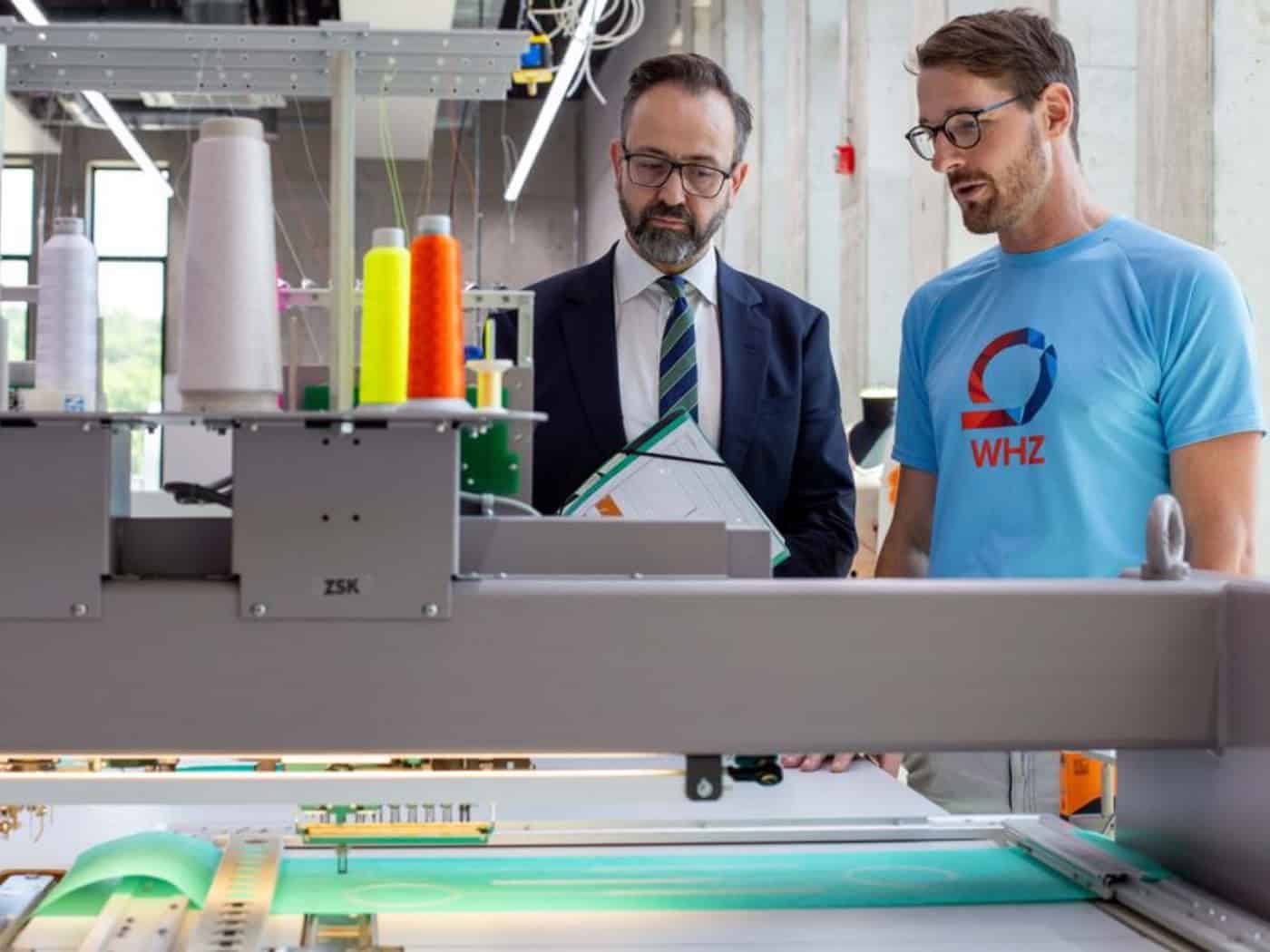
The WHZ’s Institute for Textile and Leather Technology, which was previously located in Reichenbach, has now fully relocated to the new building. At the center is a large machine hall equipped with modern textile machinery. This includes a new rapier loom with approximately 6,000 warp threads and weighing five metric tons. It is one of the largest machines of its kind at the university and is expected to open up new opportunities for research and development.
The façade also reflects the textile theme. Approximately 300,000 clinker bricks were arranged to create a woven relief, alluding to the structure of fabric.
To kick things off, 18 research projects with a total budget of 10.6 million euros are underway at the new technical center. Many of these projects focus on the question of which materials can be used to produce sustainable textiles in the future. This is an issue of growing importance. The textile industry is one of the most resource-intensive sectors worldwide. Researchers are therefore seeking alternatives to petroleum-based synthetic fibers and ways to use raw materials more efficiently.
Mushrooms, Pine Needles, and the Forest as Sources of Raw Materials
Two projects in particular are quite unusual and offer a glimpse into the future of research at the technical center. In the Confitex project, researchers are investigating whether textile fibers for sustainable textiles can be extracted from pine needles. This raw material is produced in large quantities in forestry and has hardly been used to date. In the long term, it could be turned into yarn for technical textiles or other applications.
The FungiMat project focuses on materials derived from fungi. Researchers are using fungal mycelium – a fine network of fungal threads that normally grows in the soil – for this purpose. Combined with biopolymers – that is, biodegradable plastics – this is intended to create new composite materials. In the future, these could replace packaging, insulation materials, or certain plastic products, for example.
With the new technical center, the university is bringing together its expertise in textile research at a single location for the first time. The researchers hope this will foster new collaborations between materials science, mechanical engineering, chemistry, and textile engineering. The total project cost 46.2 million euros. About half of the funding comes from the European Regional Development Fund (ERDF).

