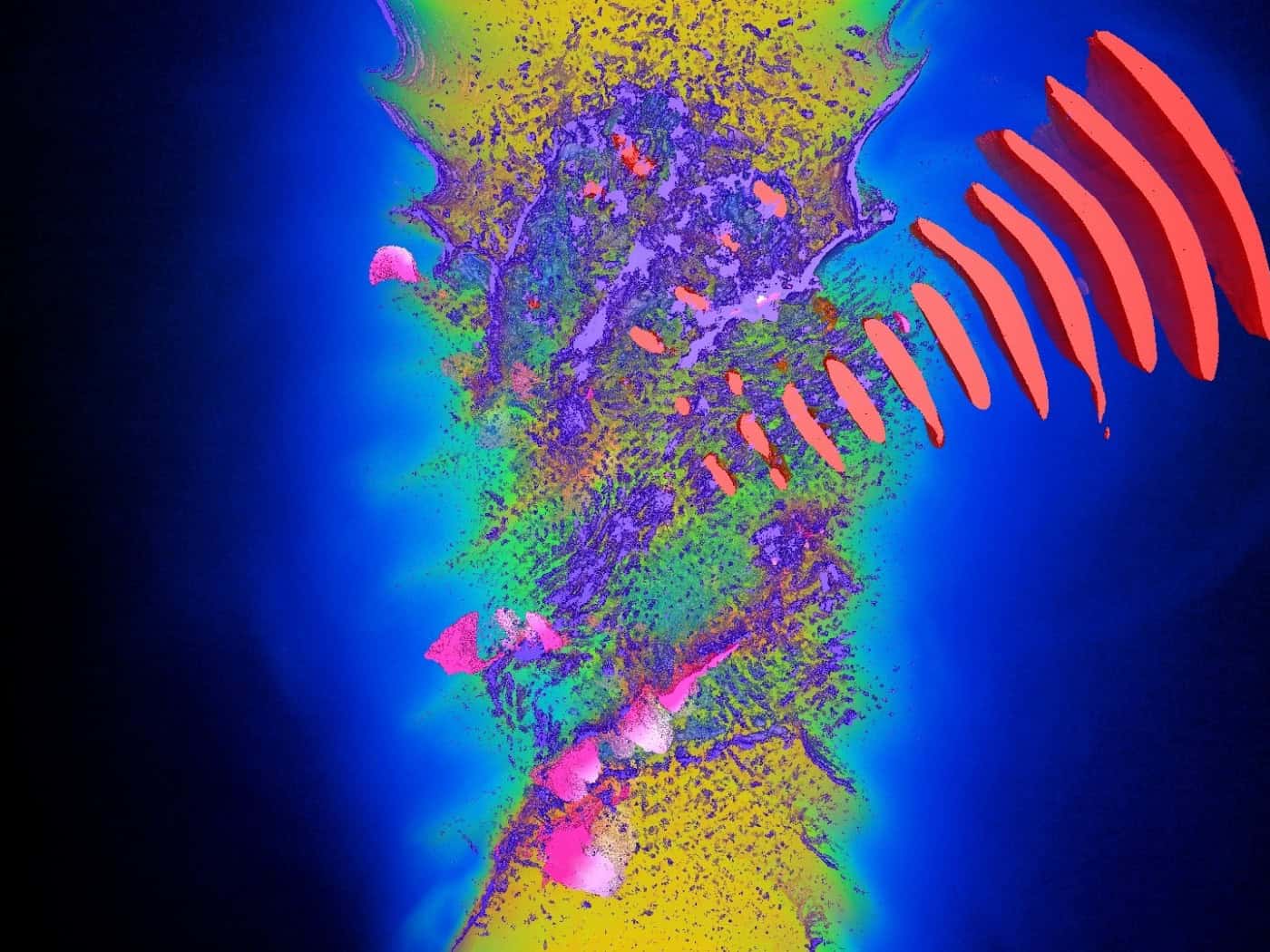
Nine projects from around the world will soon be able to conduct research on the future U.S. supercomputer Discovery. Among them is a team from the Helmholtz-Zentrum Dresden-Rossendorf (HZDR). Together with the University of Delaware (USA), the team prevailed over competitors such as NASA and General Electric. It is the only international project to do so.
Behind this success is a program called PIConGPU. It uses computer simulations to model how laser beams interact with plasma. Plasma is an extremely hot, electrically charged gas. Such simulations help develop new technologies. These include compact particle accelerators for cancer treatment and systems for laser-driven nuclear fusion, which could one day provide climate-friendly energy.


From Görlitz and Dresden to the World’s Top
The Discovery supercomputer is scheduled to be delivered by 2028 at the latest and to go into operation in 2029. It will be significantly more powerful than its predecessor, “Frontier,” which is currently one of the fastest supercomputers in the world. PIConGPU was already running on “Frontier.” With “Discovery,” even larger and more precise simulations will be possible in the future. At the HZDR, the Center for Advanced Systems Understanding (CASUS) in Görlitz and the Institute of Radiation Physics in Dresden are jointly leading the project.
Bussmann also emphasizes the European perspective. The HZDR is part of a European research network that provides access to Europe’s most powerful supercomputers. JUPITER, located at the Jülich Research Center, is one of Europe’s most powerful computers. "It is important that the HZDR is part of the EuroHPC Center of Excellence PlasmaPEPSC. Access to European exascale computers like JUPITER ensures that we remain at the forefront of research."
PIConGPU has been under continuous development for more than ten years. The simulation software is available free of charge to researchers worldwide.