


Science fiction made in Dresden: TU Dresden opens a holodeck
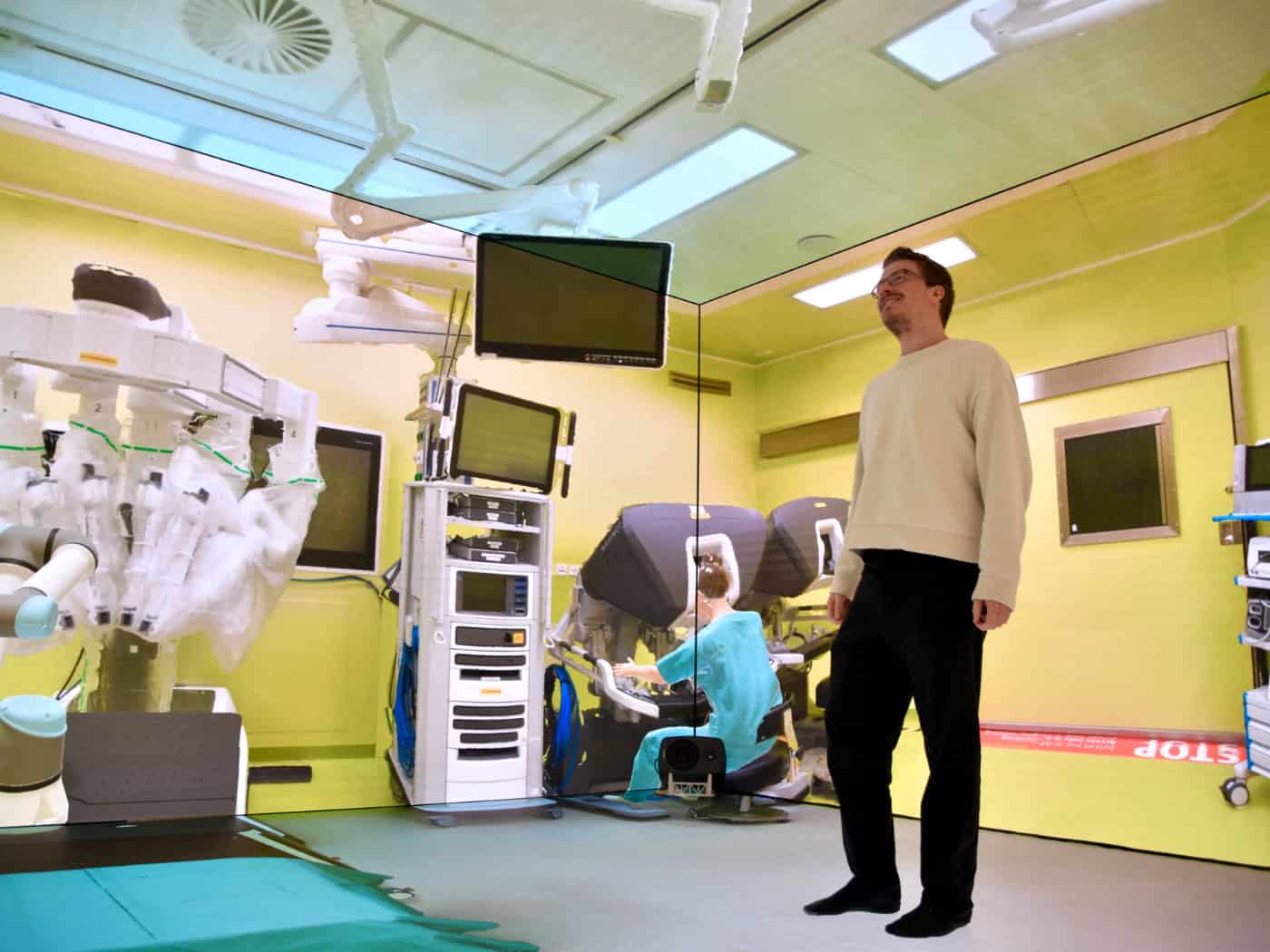
A group of people stands in the middle of a factory hall. Around them are machines, conveyor belts and workpieces. The people are real, but nothing around them is. In Star Trek, the holodeck was still a distant vision of the future. Now Technische Universität Dresden has presented its own holodeck to the public for the first time.
TU Dresden opened this unusual research space together with a second new laboratory — a lab for quantum technology. Both facilities are intended to help researchers better understand future communication and working environments and develop new technologies.
A room that redefines reality
The holodeck is a room whose walls consist entirely of LED surfaces. They display images in real time — so convincingly that visitors get the feeling of actually being there. Unlike VR headsets, which isolate users individually, several people inside the room can experience the same digital world simultaneously. Researchers at the Centre for Tactile Internet with Human-in-the-Loop (CeTI), a Cluster of Excellence at TU Dresden, want to investigate how people make decisions and interact with one another in digital environments. Companies could test products as virtual prototypes before building them. The system also allows researchers to study how people react when digital worlds become increasingly realistic and the boundaries between physical and virtual environments begin to blur.
Immersive research spaces such as the holodeck are currently being developed at universities and in industry around the world. Dresden has also experimented with similar environments in the past. At the Max Planck Institute of Molecular Cell Biology and Genetics, for example, researchers created a room in which visitors can walk through cell structures using 3D glasses. At HTW Dresden, scientists are working on immersive environments that can be built comparatively cheaply using screens and projectors. The special feature of the TU Dresden approach is the use of large LED walls and the fact that human-machine interaction, digital working environments and communication research are being studied together in one system..
When quantum physics changes communication
At the same time, TU Dresden opened the “Quantum Communication, Computing, and Sensing Lab”, a laboratory dedicated to quantum technology. Quantum technologies rely on physical effects that behave very differently from the rules governing everyday objects. This is precisely why they are considered promising for future communication and computing technologies. “Our goal is to go beyond isolated quantum applications and instead create integrated systems in which communication, computing and sensor technology work together to enable real commercial applications,” says Riccardo Bassoli, who researches future communication networks and quantum technologies at TU Dresden. According to Bassoli, this approach could redefine what future networks such as 6G are capable of.
While this may sound highly technical, it could eventually have direct consequences for everyday life. Quantum communication is considered particularly secure because attempts to tamper with or intercept data would become physically detectable. Researchers therefore hope these technologies could establish new standards for secure communication and data protection. Both laboratories were funded by the Federal Ministry of Research, Technology and Space, the German Research Foundation and the Free State of Saxony.

