


Top-Notch Cuisine in Saxony: Eight Stars, Eight Distinct Styles
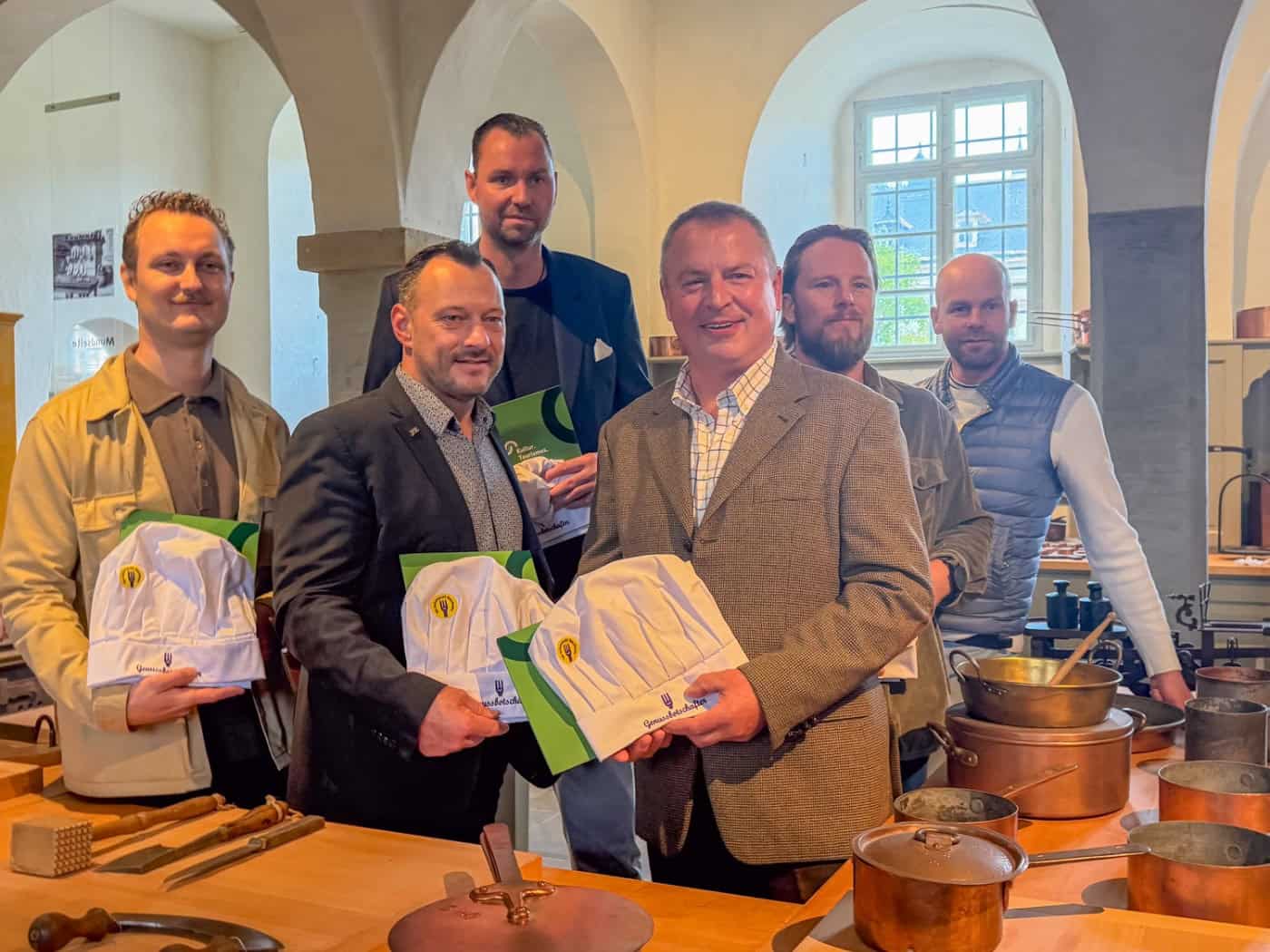
In 2026, Saxony’s Michelin-starred cuisine is as diverse as the landscape in which it is created. Eight restaurants in the Free State hold a Michelin star—from Leipzig and Dresden to Radebeul and all the way to the Ore Mountains. Behind these award-winning kitchens are eight chefs with different visions of what constitutes contemporary haute cuisine. At a gathering in the Royal Court Kitchen of Pillnitz Palace, Saxony’s Minister of Culture and Tourism, Barbara Klepsch, honored them for their work (not everyone was able to attend—which is why not everyone is in the photo).
Michelin-Starred Cuisine in Leipzig
There is no single, unified style. Lisa Angermann and Andreas Reinke represent a modern, creative, and strongly ingredient-driven cuisine at FRIEDA in Leipzig. The focus is on high-quality ingredients and a distinctive culinary signature. Also in Leipzig, Detlef Schlegel works at Stadtpfeiffer in the Gewandhaus. His cuisine combines classic French influences with modern ideas, relying on precise craftsmanship.
At Kuultivo, Klaus Schunack takes a different approach. Seasonal ingredients and creative preparations form the foundation of his contemporary cuisine. What these Leipzig restaurants have in common above all is their commitment not merely to prepare ingredients, but to pair them with their own culinary vision.
Michelin-Starred Cuisine in Dresden
Dresden is represented by three Michelin stars. Martin Walther presents modern cuisine at Heiderand, where high-quality ingredients and artisanal precision take center stage. At elements, Stephan Mießner combines diverse international influences and flavors. His cuisine thrives on the combination of various culinary traditions.
Marcus Blonkowski focuses on creative, seasonal cuisine and regional products at the Genuss-Atelier. For him, careful preparation is key. This makes the restaurant one of those establishments that view regionality not as a retreat to tradition, but as a starting point for modern cuisine.
Michelin-Starred Chefs in Radebeul and Aue
Two more stars shine outside the major cities. In Radebeul, Joe Andrich works at the Atelier Sanssouci with a high standard of culinary craftsmanship and a modern approach. The culinary concept was expanded in 2026: In addition to the existing cuisine, there is now a more flexible bistronomy offering featuring à la carte dishes.
At Restaurant St. Andreas in Aue-Bad Schlema, Benjamin Unger combines regional products with Erzgebirge traditions and a contemporary interpretation. This demonstrates particularly clearly that top-tier cuisine does not necessarily mean an international focus. Regional identity, too, can serve as the starting point for ambitious cuisine.
Incidentally, the Michelin star is formally awarded to the restaurant and not to the individual chef. But the head chefs play a decisive role in shaping the culinary identity of their establishments. Their names thus also stand for the development of Saxony’s haute cuisine.
Minister of Tourism Barbara Klepsch sees these award-winning establishments as an important part of the Free State’s culinary identity. The “So schmeckt Sachsen” initiative aims to strengthen the link between the restaurant industry and tourism and to showcase its full range. This explicitly includes not only Michelin-starred cuisine, but also traditional inns, regional specialties, and restaurants that combine time-honored recipes with new ideas.
For Axel Klein, CEO of DEHOGA Saxony, Michelin-starred chefs also serve as role models for the next generation. Top-tier cuisine begins with training and curiosity and develops through craftsmanship, passion, and perseverance. Saxony therefore wants to showcase the career opportunities the culinary industry offers—from junior chefs to Michelin-starred chefs.
The history of the culinary arts is also an integral part of this look at the present. The German Culinary Archive, supported by SLUB Dresden and TU Dresden, collects menus, cookbooks, and culinary manuscripts, thereby documenting the development of food culture. Today’s haute cuisine also becomes part of this culinary tradition there (provided the chefs dutifully submit their menus…).

