


Heiderand (Dresden): A journey through the cosmos of taste
Goal achieved! After our visit to Heiderand a year ago, I wrote: "The fact that there are petit fours at Heiderand - together with the kitchen greetings on the menu as an appetizer and bread - is a hint as to where the journey should take us: a Michelin star, that would be great!" The Michelin inspectors were also enthusiastic about this idea and awarded the restaurant the coveted accolade, making the Heiderand the youngest Michelin-starred restaurant in Dresden. What has changed for guests since then? Nothing! The same smile from the chef, who brings the courses to the table whenever the time is right, the same creativity and quality on the plates, the same prices for the menu. Isn't that fabulous?
Telling the story of the evening is easy on the one hand, because if the whole team is in a good mood, communicates with the guests in a relaxed manner, pours the water attentively and, in an emergency, prefers to check quickly when questions are asked about the wine or the non-alcoholic accompaniment instead of talking nonsense, then it's simply fun. If the food is commented on with unprofessional comments such as "Hmm", "Wow" or barely audible tongue over lip strips in between the stories, a more in-depth look could destroy the magic of the evening.
But who dares to simply write: "Was good. Or wait, no: it was very good!"
So let's start at the very beginning. With the choice of fish and meat ("water & pasture") or vegetarian ("field & bed"), with the decision on drinks, whether "with" or "without" - our somm of the evening Till Kiehle prepared both options and selected them to match the courses. Nothing 08/15 off the shelf and with the wines with special attention to organic (dynamic) cultivation and as natural as possible - without spontaneous fermentation, nothing works with the winegrowers he loves. We had something with water, pasture and a little bit of field for dinner, because the wife has an aversion to Jerusalem artichokes and found an adequate substitute in the vegetarian menu. The wife's husband doesn't like Jerusalem artichokes either and simply left them after a cautious could-be-yes-that test because he didn't want to miss out on the quail.
The set-up is a three plus one. So there's a beef broth that smells soothingly of power as soon as you arrive, baked tartelettes with smoked halibut cream, finger limes and ginger, and a crispy meringue made from kombu seaweed with veal tartare. Plus three types of bread, all homemade (focaccia, sourdough bread with various grains, pea crispbread with sesame seeds). Freshly baked bread often means that reason has a break and you can munch on it with relish, although salty sour cream butter as a spread unfortunately also tickles the palate and disappears completely. And no, we hadn't starved all day just because we had eaten everything without crumbs...
What was already foreshadowed in the prelude was revealed in all its glory during the starter with char as the main hero: with sea buckthorn and coriander, there were two big players from the flavor cosmos - whereby the coriander with the strong stems on the char and the oil on the slightly sweet carrot broth gave all coriander lovers great pleasure and char caviar provided additional light bite. The fact that the coriander oil is finally added to the broth by the chef at the table is part of the overall choreography: Martin Walther takes care of everything and is always with the guest for a moment - but also always leaves quickly ("I still have to cook!"). Meanwhile, his wife Viviane, who runs the service, announces the course and explains the details.
One of the classics at Heiderand is a course with pirogue - "Mom is involved", reveals Martin Walther at the table. Why? Mother Elzbieta came to Dresden from Wrocław in Poland in 1985, only to fall in love with Martin's father Joachim straight away. Both parents have been working here ever since they handed over the former Café Heiderand to Martin in 2020 - that's what you call a successful generational transition. Every time the menu changes at Heiderand, there's a new type of pierogi, so there are eight to ten variations. The pierogi in our menu was one from the sour side of the force: filled with Polish grainy cheese, placed on a buttermilk foam sauce and lime and soy reduction, topped with roasted kohlrabi, Granny Smith, dill, elderberry capers and fermented ginger. Keeping the balance between fruitiness and acidity is certainly the most difficult exercise here - but if you also accept flavor peaks such as acidity or bitterness and not everything has to be either far too salty or even more far too sugary, then this was a good exercise for the tongue and palate. What I hadn't expected was that a dry Riesling would go well with it. But it did (Hahnemann, the old homeopath, wanted to heal like with like, so this was the translation of similia similibus curentur into food pairing).
How experimental can you get in the kitchen? Don't ask: there was hay in the next course. And quite inappropriately, a codfish was nestled on top of the hay. Of course, the kitchen acted as a mediator between the hay and the cod, because the hay had been processed into a foam that tasted of everything good, but not of hay (just as my brain had written it in the prejudice roll - in fact, I have never eaten hay pure). Three kinds of cauliflower (wafer-thin raw slices, as a mousse and a deep-fried - or grilled? - cabbage floret leaf) went surprisingly well with the fish, which was of course as perfectly cooked as you could wish for - perfectionist craftsmen work in the kitchen, after all. It comes as no surprise that this hay sauce goes well with a wine that also smells of hay and lets the palate play with the idea. Zillinger Herbert from the Weinviertel region has achieved this feat with his popcorn cuvée (Pinot Blanc Grüner Veltliner and Welschriesling)...
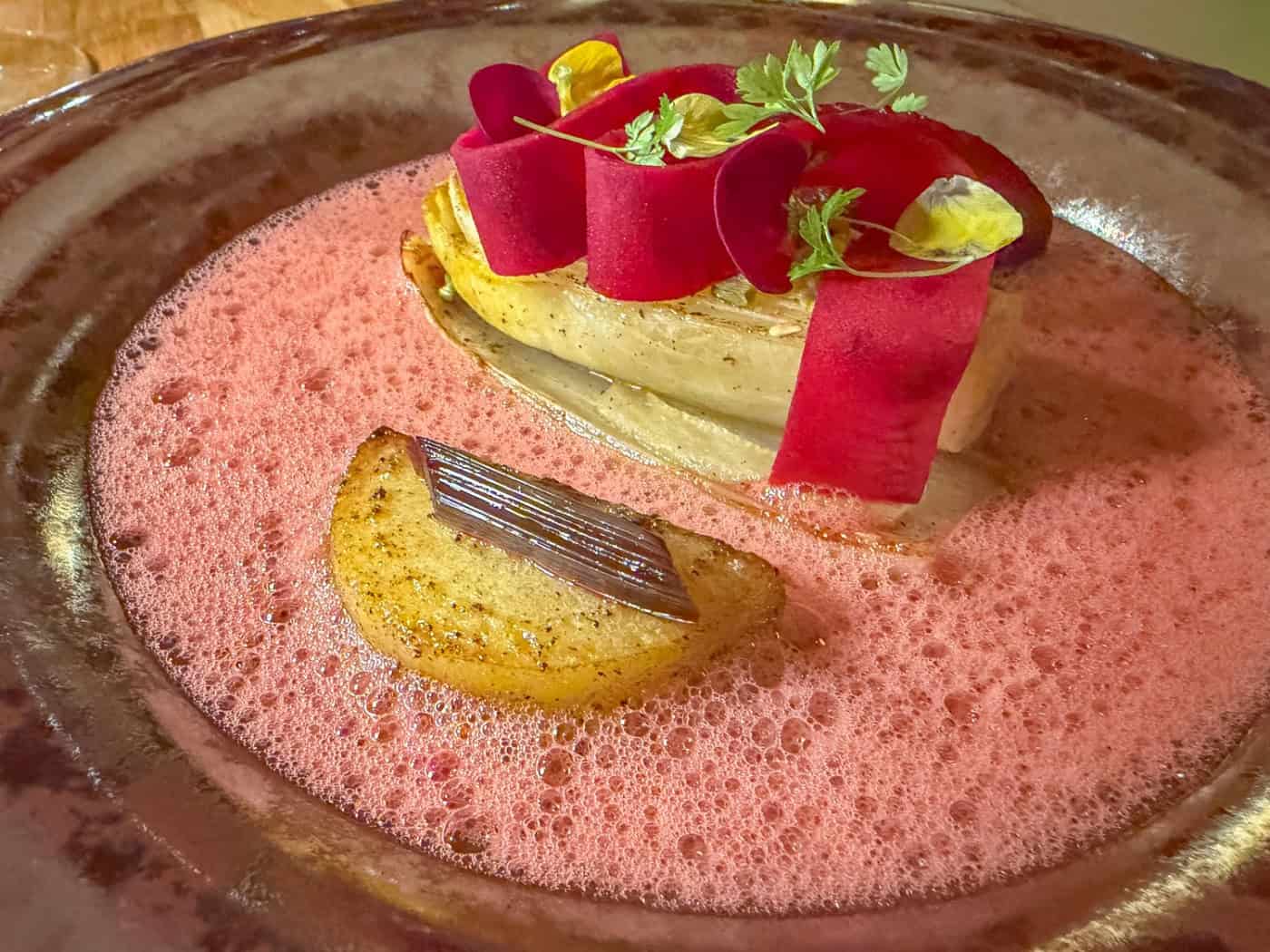
Quail in variations is standard at Heiderand, and those who like quail should not be put off even if they are intolerant to Jerusalem artichokes - they can also be served on their own or with the otherwise minimalist (but not inconspicuous in taste) side dishes of onions and pears. The sauce with tonka bean could also be served effortlessly with the quail without mashing anything... The vegetarian version of the main course, with marinated and then fried chicory and a beet ribbon on top, was also visually superior and tasty. The sauce with the pepper was cooked on a beet base and whipped until frothy. We also had to rethink beet - especially as the non-alcoholic accompaniment fit like a glove: the proxy with the imaginative name The Four Horsemen consists of sour cherry juice, beet, tomato water and green pepper, among other things!
For dessert, a little necessary name dropping and a glimpse behind the scenes. Eva Wohlfarth is Head of Appetizers and Desserts - so she's actually always busy from start to finish. Obviously there is still time for other things, though - in the non-alcoholic accompaniment there was something homemade for dessert, also devised by her, the double Ev'chen, so to speak. While many restaurants use convenience products for their desserts and simply dress them up (which I don't really think is a bad thing, because good convenience food for professionals is also made by professionals), everything here is obviously homemade - and you can see and taste that because it doesn't look familiar. The combination of pineapple, sour cream, buckwheat, which is far too forgotten and underestimated elsewhere, and Esmeralda's milk chocolate was certainly memorable. And the lime leaf and citrus fruit drink was gone faster than expected. Unfortunately similar to the somewhat different Madeira, because the Boal Reserva from Barbeito was also wonderfully drinkable.
Menu
- Introduction
- Bread
- Carrot | carrot | sea buckthorn | coriander
- Pirogue | kohlrabi | buttermilk | elderberry capers
- Codfish | hay | pine nut | cauliflower
- Quail | Jerusalem artichoke | onion | pear
- Chicory | beet | pistachio | long pepper
- Pineapple | sour cream | buckwheat | Esmeralda's milk chocolate
- Finish
Drink accompaniment
- 2024 Scheurebe, feinherb, Weingut Heinrich, Württemberg
Jörg Geiger 35 Grad vom Sauvignon Blanc - 2023 Riesling, Deidesheimer Herrgottsacker, Seckinger, Pfalz
Feral No.1 from white beet, hops and Szechuan pepper - 2024 Popcorn white, Herbert Zillinger, Weinviertel, Austria
Muri Koji Rice Series 1 - 2022 La Mitote, Pierre Taix, Castillon Côtes de Bordeaux
The Four Horsemen, Muri - Barbeito Boal Reserva, Madeira, Portugal
Homemade from lime leaf and citrus
Info
- 4-course menu (without cod) 100 € | incl. wine accompaniment 138 € . Wine pairing 138 €
- 5-course menu 115 € | incl. wine pairing 164 €
Heiderand Restaurant
Ullersdorfer Platz 4
01328 Dresden
Tel. +49 351 268 31 66
heiderand.restaurant
[Visited on March 15, 2026]

