

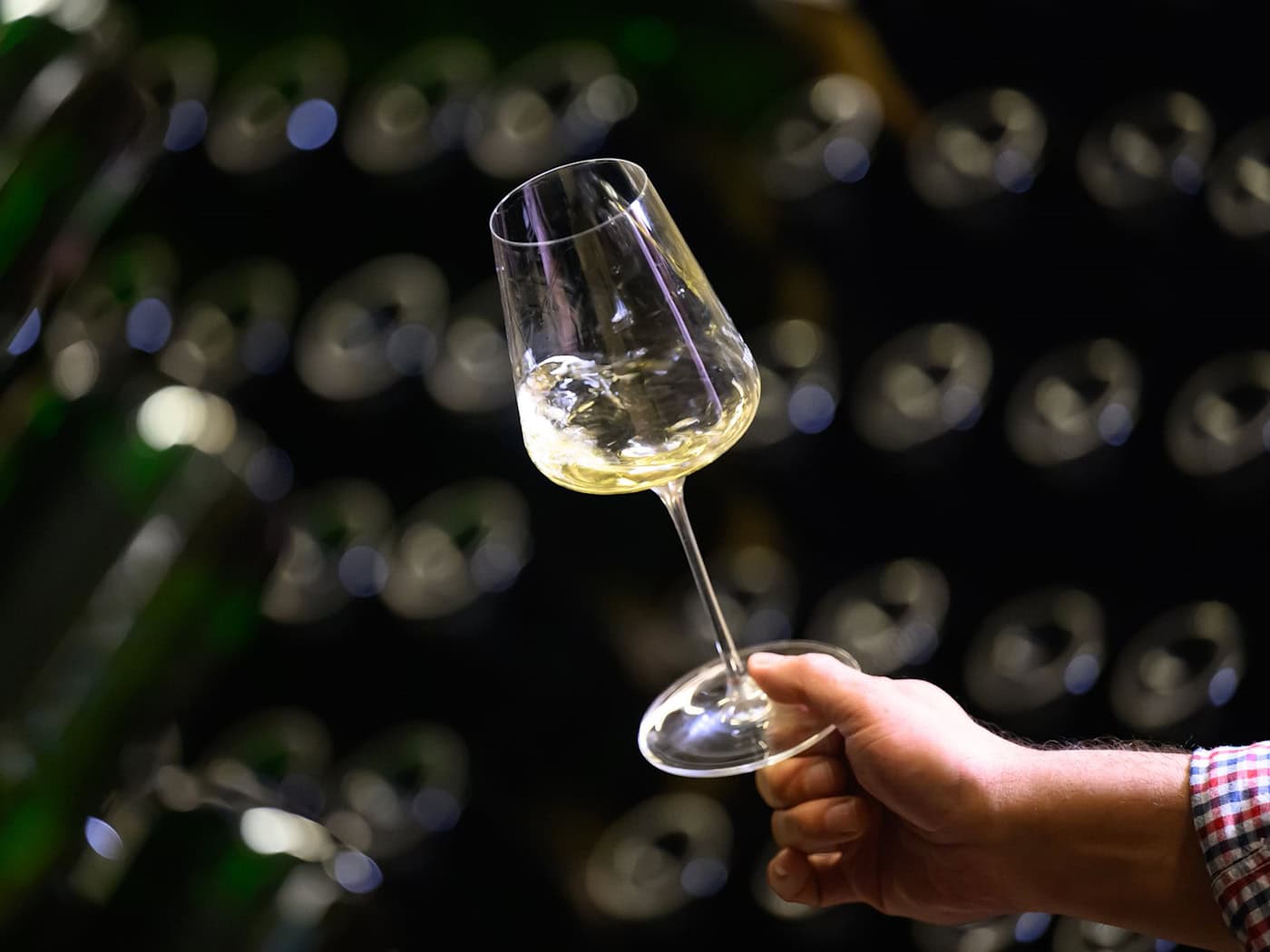
In the cellar of the Saxon state winery Schloss Wackerbarth, countless individual pieces mature that need Jürgen Aumüller's attention. One of the cellar master's tasks is to monitor sparkling wine production using the classic bottle fermentation method. The bottles, which are stored upside down, have to be "shaken" again and again, says the cellar master, in order to gently move the fermenting yeast into the head of the bottle step by step. Not only in France's Champagne region, but also in the Elbe Valley, sparkling wine has been produced according to this "méthode champenoise" for 190 years now. The fermentation process is always slightly different in nuances. "Every bottle is unique," says Aumüller. The market for sparkling wine appears to be a stable anchor in times of declining alcohol consumption: While wine consumption fell again last year, according to the German Wine Institute (DWI), sales of sparkling wine and sparkling wine remained largely stable - at 3.5 liters per capita among over-16s. "The Germans are world champions when it comes to drinking sparkling wine," says Wackerbarth spokesman Martin Junge. Every fifth bottle of sparkling wine worldwide is uncorked here. Castle Wackerbarth has increased its sparkling wine sales fivefold since 2002, according to its own figures. Since last year, the traditional manufactory has also been producing an alcohol-free variety - after a long period of tinkering. Because if the alcohol is technically removed from the wine, which forms the basis for the sparkling wine, a flavor carrier is also missing, as cellar master Aumüller explains. The ratio of sweetness and acidity must therefore be adjusted "to simply make the taste a little more full-bodied". According to the company, Rotkäppchen, probably the best-known sparkling wine brand in eastern Germany, has also been available alcohol-free since 2008. "Alcohol-free is a key lever for further growth for us," said the Managing Director of Rotkäppchen-Mumm Sektkellereien GmbH, Silvia Wiesner, to the German Press Agency. According to the company, it is now the market leader for non-alcoholic sparkling wines and believes that its strategy has been strengthened by its own market research. According to the study, one in two of the 1,500 people surveyed in a trend study would like more choice in this area. Secco, Riesling and rosé without intoxication and alcohol were also on everyone's lips this month at the industry get-together - the "ProWein" trade fair in Düsseldorf. Sales and turnover of this type of wine increased by 25 percent last year, according to the Wine Institute DWI at the start of the trade fair. The range and quality have continued to improve. Nevertheless, this type of beverage remains a niche for winegrowers: the DWI states that non-alcoholic wines only account for around two percent of total sales. The Freyburg Winegrowers' Association is correspondingly skeptical. Managing Director Hartmut Schreiter puts the brakes on expectations that alcohol-free wines could become a mass market. "We absolutely see this as a supplementary product." The two non-alcoholic varieties account for around three percent of the wine sold. The smaller the business, the more difficult it is to enter the non-alcoholic business. The complex alcohol removal process requires transportation to external service providers. Additional production steps and costs are incurred. For the approximately 360 winegrowers in the Freyburg Winegrowers' Association, this is already a high cost given the low proportion of sales. The situation is different with the growing trend of wines with a lower alcohol content. They are already working on bringing a new variety onto the market. The aim is a wine with an alcohol content of 7 to 8.5 percent instead of the usual 12 to 13, says Schreiter. Such products could be achieved using traditional methods without additional effort. The taste is also closer to classic wine. Despite a difficult market environment with declining wine consumption, the Saale and Unstrut regions remain optimistic and are focusing primarily on marketing in eastern Germany as a regional product. With success: sales at the Freyburger Winzervereinigung are stable "with a small growth trend", says Managing Director Schreiter. The Saxon state winery Schloss Wackerbarth also speaks of an overall positive development and refers to increasing visitor numbers, stable to growing sales and strong regional awareness as an "experience winery". Copyright 2026, dpa (www.dpa.de). All rights reservedThe market for non-alcoholic beverages is growing
Trend study: One in two would like to see more alcohol-free options
Freyburg winegrowers are working on reduced-alcohol wine
Winemakers in the east optimistic despite difficult market situation


