

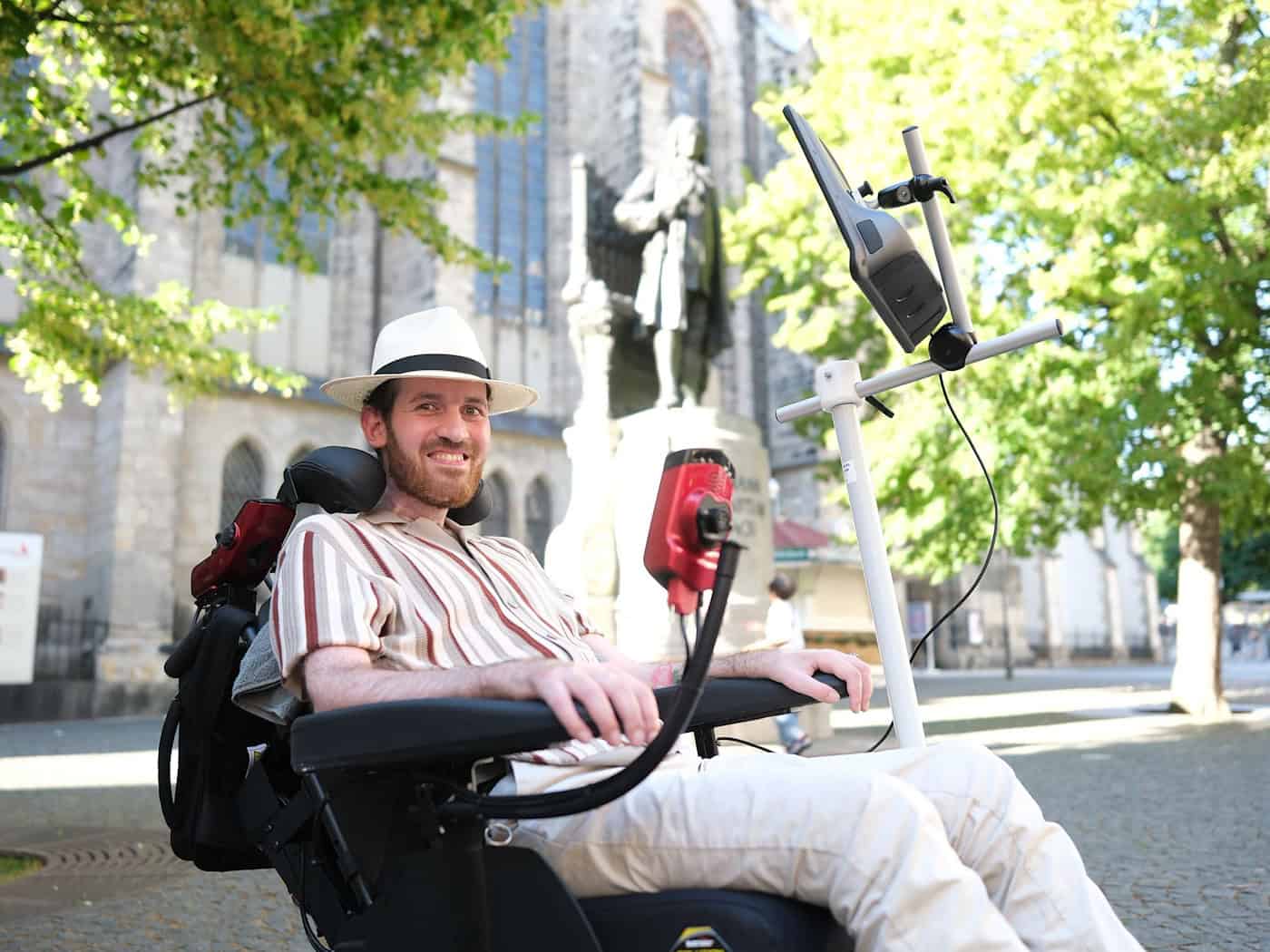
Jean Darras has lost his freedom—bit by bit. At first, one of his hands wouldn’t do what he wanted. He didn’t think much of it at first, but then it got worse and worse. Eventually, the then 27-year-old went to see a doctor. After several tests, he received his diagnosis in 2022: amyotrophic lateral sclerosis, or ALS for short. Darras’s nervous system is terminally ill. But that won’t stop him from fulfilling his wishes—such as a visit to Leipzig, the city of Bach. ALS attacks nerve cells in the brain and spinal cord that are responsible for muscle movement. Over time, patients therefore experience muscle weakness, paralysis, and problems with speaking, swallowing, and breathing. According to the German Brain Foundation, most people are diagnosed between the ages of 50 and 70. The exact cause of ALS is not yet known. Four years have now passed since Darras’s diagnosis. Today, the French native can only speak with the help of a computer that he controls with his eyes. His own voice comes from the device. This is possible because there are many recordings of his voice—after all, Darras once wanted to become an actor. Now he can barely move his body. He can still drink, but he can no longer eat. Darras is fed through a feeding tube and has moved back in with his parents in the Dordogne instead of living in Paris. Because his options are dwindling, he’s had to learn to be content with less, Darras explains. But there’s one thing he never wants to have to do without: his friends. And anyone who visits Darras quickly understands why that is. They dance with him, even though he can no longer dance. They travel with him to spend quality time with him. They laugh with him, even though Jean first has to type his playful comments into the computer, so they’re only audible after a noticeable delay. In the past, when necessary, they carried him and his wheelchair down the stairs. And while Darras’s body continues to deteriorate, to his friends he remains the same as ever: the one with the extravagant sense of style; the one who used to complain about minor aches and pains; the one who brings people together, inspires them, and connects them, as they say. Once it became clear that he was ill, Darras quickly realized he would have to give up certain things. “So one of the things I did after my diagnosis was to write down everything I wanted to experience before it’s all over,” says the Frenchman, who has lived in Germany for years. Leipzig also made it onto his list, as Bach has long fascinated him. Traveling in his condition, however, requires a tremendous amount of effort. He has to organize special equipment and ensure accessibility, figure out the costs, and arrange for his caregivers to take time off. Nevertheless, the 31-year-old was determined to visit the city of Bach. Months of planning and financial support even made it possible for him to attend two concerts during the Bach Festival at St. Thomas Church. “I felt like a privileged gentleman from the 18th century, embarking on a spiritual journey in the church,” Darras says after the first concert, laughing. Since he can no longer act, he now focuses primarily on music. He creates digital musical pieces on his computer, composed by controlling the cursor with his eyes. ALS means losing one’s physical freedom—and sometimes even one’s mental freedom, Darras explains. “When you can no longer communicate, the mental anguish is almost impossible to grasp.” He compares his illness to being imprisoned. And while thousands of patients are trapped inside their own bodies, billions of euros are spent, for example, on a World Cup and huge new stadiums, he laments. “But we don’t have the money for research into such cruel diseases,” he says. That’s another reason why he’s telling his story. And ALS isn’t all bad, Darras then emphasizes. The disease is a “school of life.” “When you have to go without so much, you learn to enjoy other things that healthy people can’t even imagine,” he says. Today, smells, sounds, or good news from his friends make him happy. “I believe humanity can learn a thing or two about respect from people who are confronted with humility every day.” Copyright 2026, dpa (www.dpa.de). All rights reservedSpeaking with the help of a computer and eye control
Dancing, laughing, traveling—despite ALS
What he can no longer do doesn’t stop him
Seeing the good in everything despite it all—and a “school of life”


