


Flocks of birds defy one of physics' fundamental laws
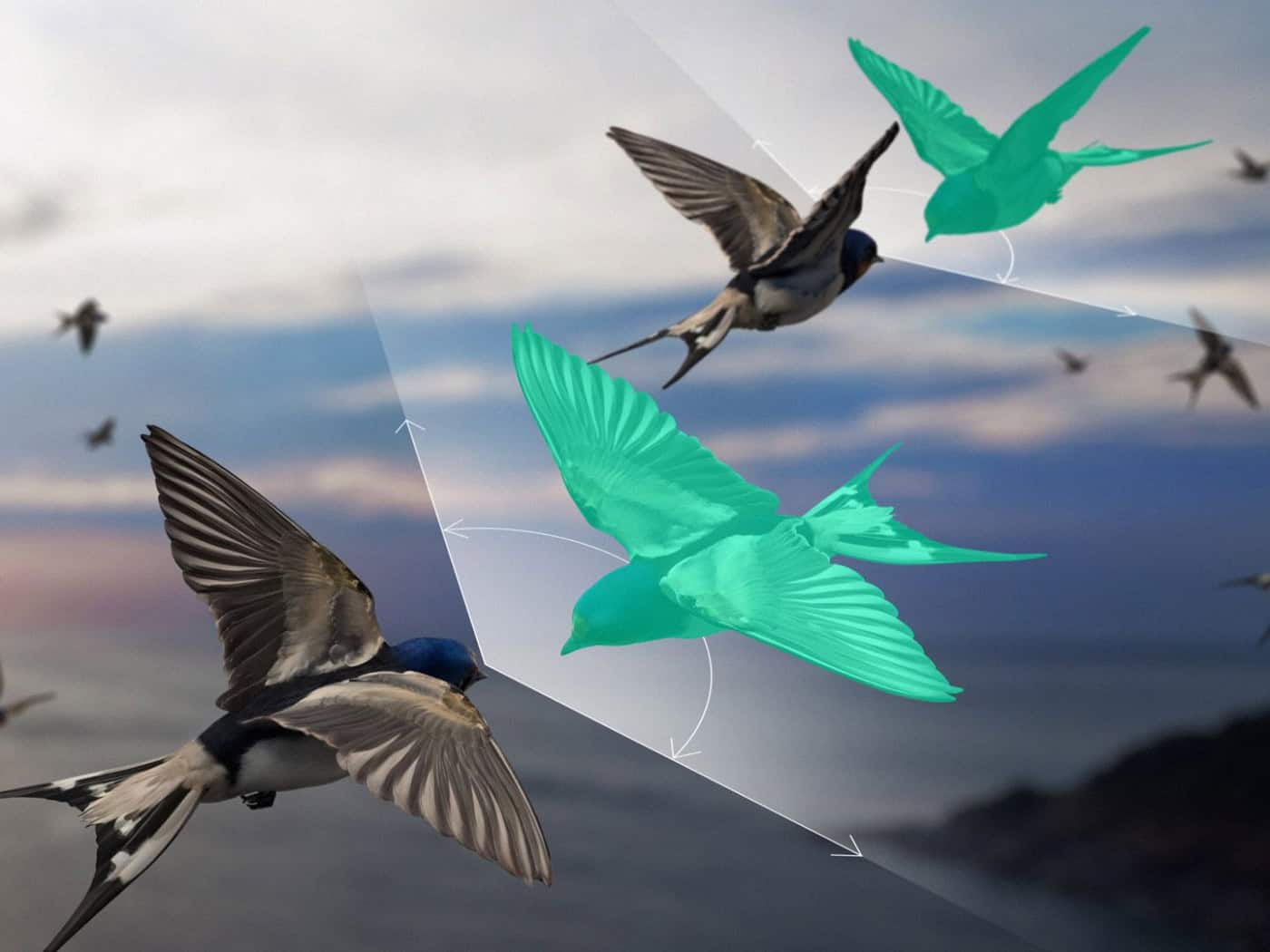
A bird in a flock looks forward and to the side. Never backward. That sounds trivial, but it is a physical problem that has puzzled scientists for decades.
The behavior flocks of birds contradicts one of the best-known laws of physics. Isaac Newton formulated it more than 300 years ago: When a force acts, there is always an equal and opposite reaction. If you push against a wall, the wall pushes back. If you step on the ground while running, the ground pushes back. This principle of interaction applies to cars, rockets, and people jumping.
"Everything we normally teach our students in theoretical mechanics is based on the actio = reactio principle," explains group leader Marín Bukov from the Max Planck Institute for the Physics of Complex Systems in Dresden.
When Nature Ignores Newton
But in nature, there are many exceptions. Birds in flocks, fish, bacteria, tissue cells, and people in crowds align themselves with only part of their environment. A bird reacts to its neighbors in front and to the sides, not to those behind it. This makes the interaction one-sided. Researchers call this “non-reciprocal interactions.” Simply put, this means: Reciprocity is missing.
Until now, these systems could not be fully described or precisely simulated on a computer. Anyone seeking to understand exactly how cells migrate in the human body or how a school of fish reacts to an attacker has thus reached a limit.
A team led by Roderich Moessner, Director at the Max Planck Institute for the Physics of Complex Systems and a founding member of the Würzburg-Dresden Cluster of Excellence ctd.qmat, has now developed a theory that allows such systems to be described and simulated much more effectively.
"The research team has developed and proven a theory that makes a large part of what we teach our students applicable to non-reciprocal systems as well," says Bukov.
The Dresden Physicists’ Clever Trick
The researchers’ trick consists of assigning each bird in the mathematical model an additional, artificial partner. This does not exist in nature. In the calculations, however, it ensures that the movements of the flock can be described using known physical methods.
Biophysicist Ricard Alert describes it this way: "To precisely simulate the birds’ movements, we describe the dynamic ‘bird swarm’ system using established methods. The elegant solution: An additional bird is artificially placed in front of each bird, oriented exactly in the opposite direction."
These additional "counter-birds" exist only in the model. However, they make it possible to calculate the movements of such systems using established methods of physics. This allows researchers to draw on many proven tools that were previously unusable for such systems.
The research opens a new door. "The exciting question now is whether Newtonian exceptions lead to entirely new forms of collective quantum behavior. We still know very little about this. That is precisely what makes the topic so exciting," says Moessner.

