


Everyone knows it: After a bad night’s sleep, it becomes harder to think, concentration drops and the body feels exhausted. Yet researchers still only partly understand why sleep has such profound effects on health, memory and metabolism. A team from Technische Universität Dresden has now identified a possible key mechanism.
The research group led by Henrik Bringmann from the Biotechnology Center (BIOTEC) at TU Dresden investigated how the hormone somatostatin works in the body. Somatostatin has been known for decades. It regulates growth and metabolism and occurs in both animals and humans. Until now, however, it remained unclear how a single molecule could influence so many different biological processes at the same time. The study was published in the journal Science Advances.
Sleep as the control center
The answer may lie in sleep. Somatostatin apparently does not directly regulate every bodily function. Instead, it acts specifically on a sleep-active nerve cell. Through sleep, the hormone then influences metabolism, memory and possibly even lifespan. “Hormones basically work according to the lock-and-key principle: they fit into certain receptors on cells and activate specific functions,” explains Byoungjun Park, who conducted the study. “We discovered that the ‘lock’ for the somatostatin-like molecule in the worm is located directly on the sleep-active nerve cell.” This single cell controls the animal’s entire sleep cycle.
To test the mechanism, the researchers genetically switched off this receptor. This allowed them to observe what happens when the hormone can no longer reach the sleep cell.
A worm as the key to humans
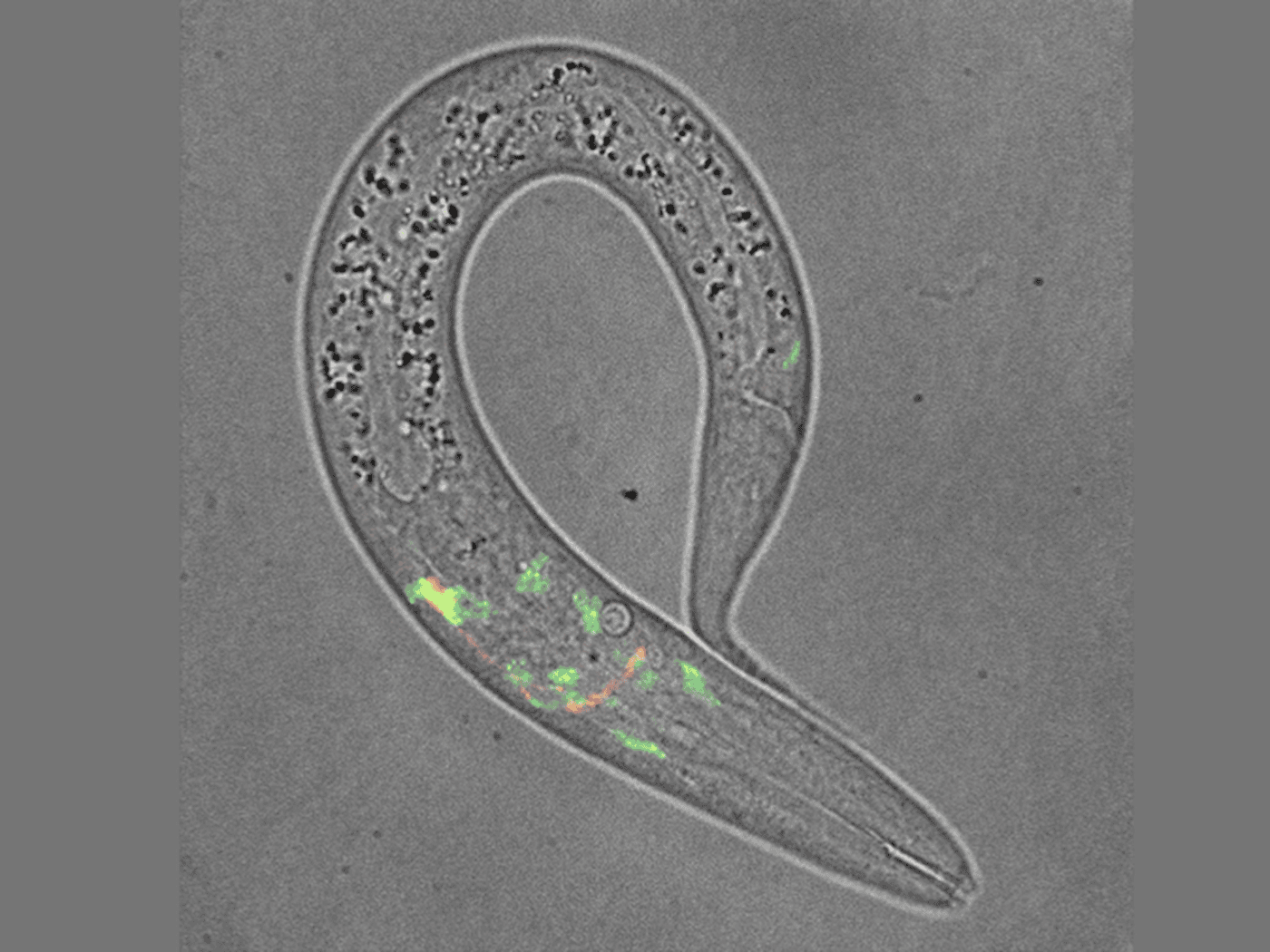
The experimental animal is called Caenorhabditis elegans, or C. elegans for short. It is a tiny nematode about one millimeter long that lives in soil and possesses exactly 302 nerve cells. Humans, by contrast, have billions. Yet many fundamental biological processes are remarkably similar. “C. elegans are small organisms that are easy to study genetically. Because they share many basic biological processes with humans, they are a valuable model for deciphering fundamental phenomena such as sleep,” says Bringmann. The worm’s simple structure makes complex interactions easier to observe. “This is precisely why basic research on nematodes is so valuable: it enables us to unravel complex interactions and understand the elementary mechanisms that determine our lives and our health,” he adds.
The findings from Dresden suggest that sleep is not simply a passive state. It could instead function as a central biological switchboard through which hormones coordinate important processes throughout the body. And a tiny worm helped researchers understand that a little better..
Original publication:
Byoungjun Park, Lama Mohsen, Inka Busack, Laura Uhlig, Lorenzo Rossi, Gill Pollmeier, Ellen Geens, Majdulin Nabil Istiban, Sajal Mandal, Reshma Dominic Savio, Isabel Beets, Attila Stetak, and Henrik Bringmann: C. elegans somatostatin/allatostatin C signaling regulates sleep, metabolism, survival, and memory via a sleep-active neuron. Science Advances (April 2026)

