


Stardust in Antarctic ice
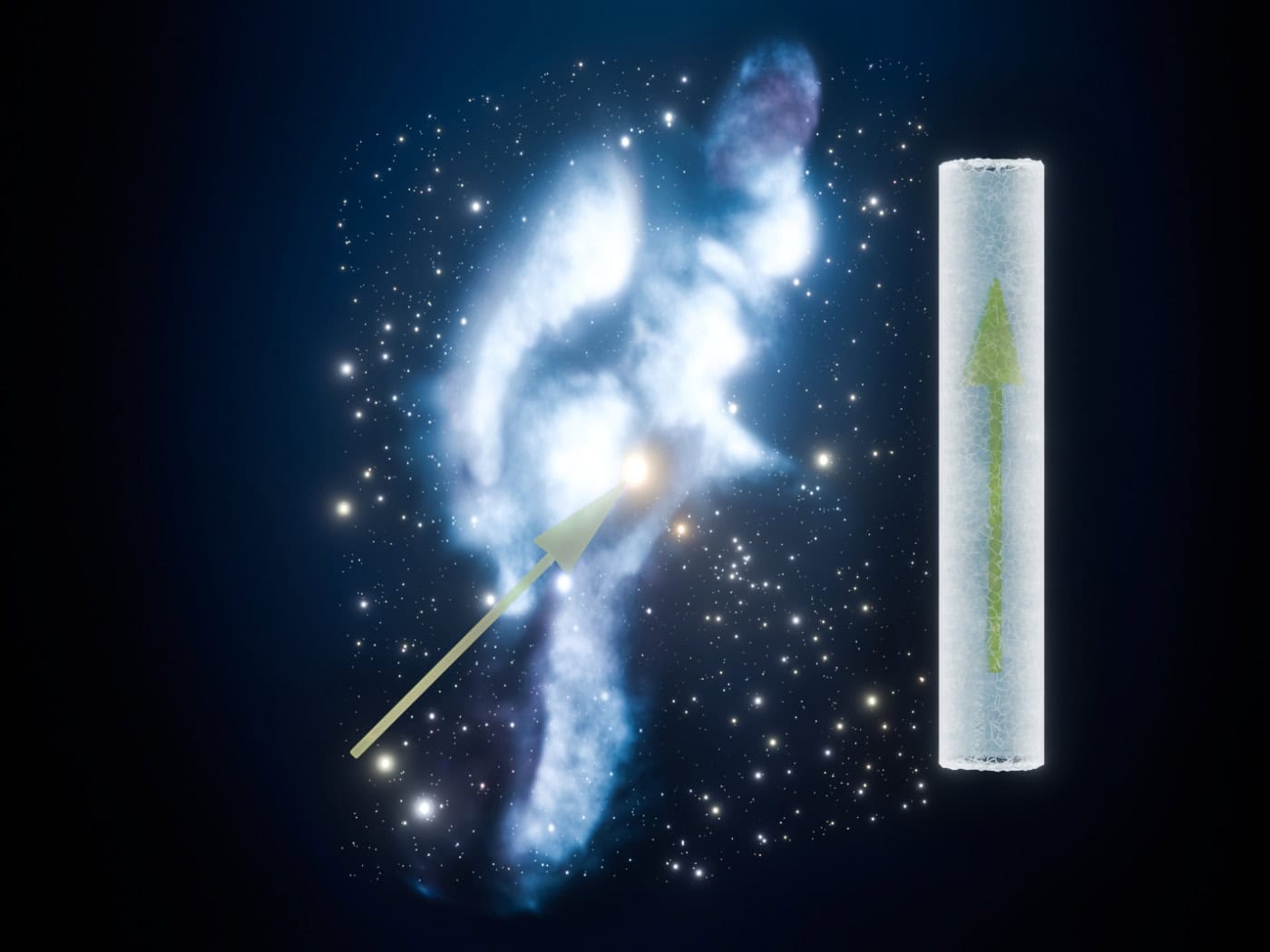
Every year, a little bit of the cosmos reaches Earth. Not as visible meteorites, but as tiny particles and individual atoms from distant stellar explosions drifting through interstellar space. An international research team led by the Helmholtz-Zentrum Dresden-Rossendorf (HZDR) has now found such material in ancient Antarctic ice and traced its origin more precisely. The results were published in the journal Physical Review Letters.
What the researchers were looking for is called iron-60, a rare radioactive form of iron that hardly occurs naturally on Earth. It forms inside massive stars and is hurled into space when these stars explode in a supernova. Iron-60 can therefore only be detected on Earth if it arrived here from space.
A cloud of gas and dust
Our solar system is currently moving through the so-called Local Interstellar Cloud – a huge region of extremely sparse gas and dust between the stars. The solar system entered this cloud several tens of thousands of years ago and will leave it again in a few thousand years. At present, we are near its edge.
The crucial question was: does this cloud contain iron-60 from an ancient stellar explosion – and is this material still reaching Earth today? “Our idea was that the Local Interstellar Cloud contains iron-60 and can store it over long periods of time until today. However, we were unable to prove this at the time,” says Dominik Koll from the HZDR Institute of Ion Beam Physics and Materials Research. The team has now been able to investigate this connection in much greater detail. The decisive clue came from the analysis of an ice core from the European Ice Coring Project EPICA, provided by the Alfred Wegener Institute (AWI). The ice, between 40,000 and 80,000 years old, contained less iron-60 than younger samples.
This suggests either that the amount of cosmic material varies within the cloud or that the solar system previously passed through a different region of interstellar space. The study therefore provides strong evidence for the first time that Earth is still continuously collecting material from its galactic environment. At the same time, it helps researchers better understand the history of the Local Interstellar Cloud and past stellar explosions in our cosmic neighborhood.
A needle in 50,000 soccer stadiums
Detecting the isotope was an extraordinary technical challenge. The team transported around 300 kilograms of ice from the AWI in Bremerhaven to Dresden, where it was chemically processed. In the end, only a few hundred milligrams of dust remained. The actual measurement was carried out at the HIAF facility at Australian National University — currently the only facility in the world capable of detecting such tiny quantities of iron-60. “It’s like looking for a needle in 50,000 soccer stadiums filled to the ceiling with hay. The machine finds the needle in an hour,” explains Annabel Rolofs from University of Bonn.
The findings suggest that the environment around our solar system still contains traces of ancient stellar explosions. “This means that the clouds around the solar system are linked to a stellar explosion. And for the first time, this gives us the opportunity to investigate the origin of these clouds,” says Koll. The researchers are already planning the next step: analyzing even older ice cores from the time before the solar system entered the Local Interstellar Cloud.
Original publication:
D. Koll, A. Rolofs, F. Adolphi, S. Fichter, M. Hoerhold, J. Lachner, S. Pavetich, G. Rugel, S. Tims, F. Wilhelms, S. Zwickel, A. Wallner: Local Interstellar Cloud Structure Imprinted in Antarctic Ice by Supernova 60Fe, Physical Review Letters, 2026.

