


A rock from the deep sea reveals secrets of the universe
At the bottom of the Pacific Ocean, beneath kilometers of water, an unassuming black rock has been growing for millions of years. It grows only a few millimeters every million years, yet in doing so, it records cosmic history. Researchers from the Helmholtz-Zentrum Dresden-Rossendorf (HZDR) have now deciphered this history.
Together with colleagues from Sydney and Canberra, they have examined a so-called ferromanganese crust from the deep sea. These mineral deposits form at depths ranging from several hundred to several thousand meters. They grow millimeter by millimeter over millions of years, absorbing and storing substances from their surroundings. This includes tiny amounts of radioactive isotopes.
Isotopes are variants of a chemical element that differ in mass. For scientists, these atoms are like a diary of cosmic events.
Plutonium from Space
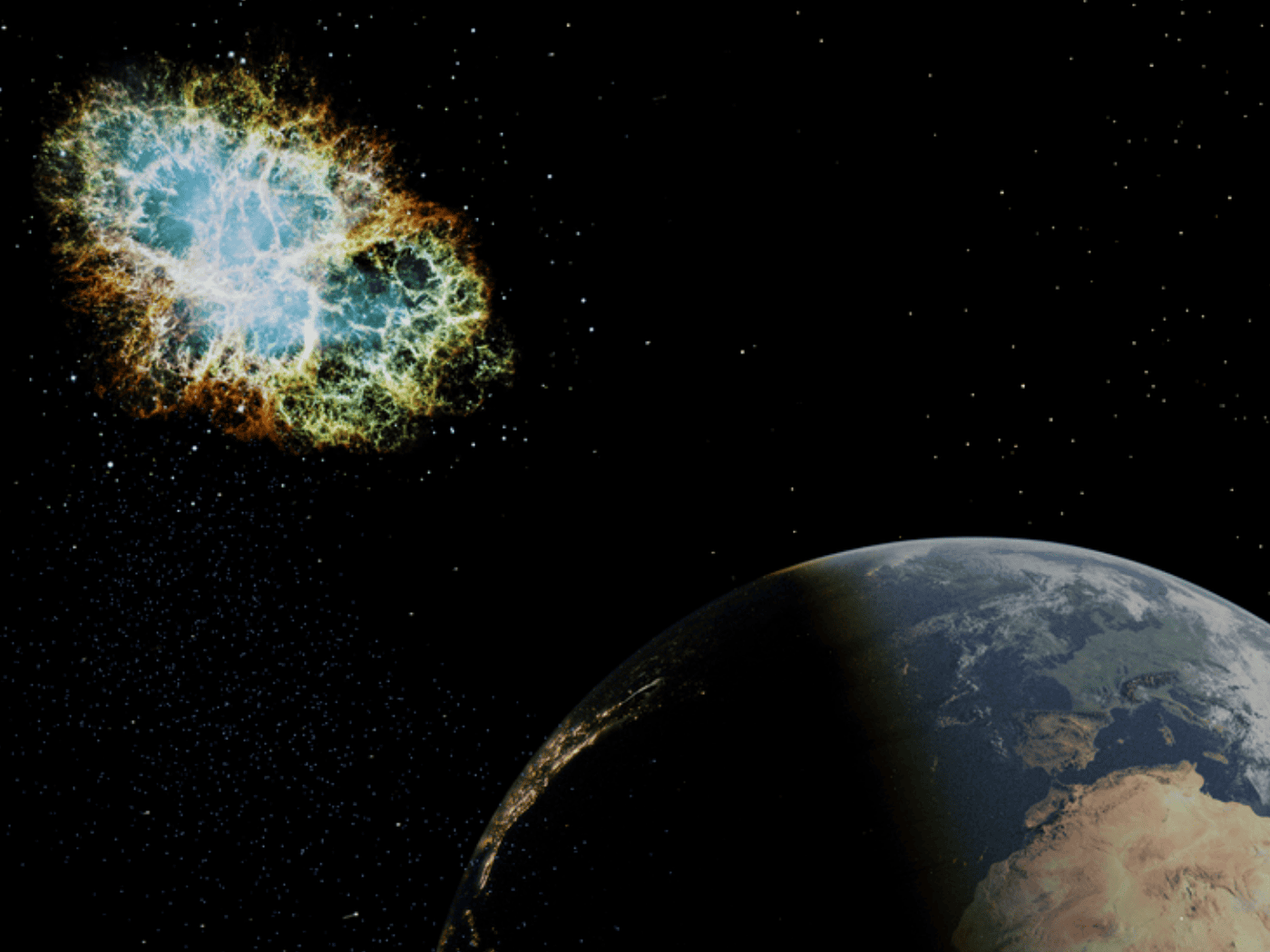
The team was particularly interested in a rare radioactive atom called plutonium-244. It is produced only during exceptionally violent events in space, such as when two neutron stars merge or particularly high-energy stars explode. Such events are a thousand to ten thousand times rarer than ordinary stellar explosions.
The researchers compared the plutonium with iron-60. This radioactive element is produced during normal supernova explosions and is therefore considered an indicator of such events. "Iron-60 is a clear fingerprint of regular supernovae. That’s why we looked for both iron-60 and plutonium-244 and compared their traces,” explains Dr. Dominik Koll from the Institute of Ion Beam Physics and Materials Research at HZDR.
Accordingly, the plutonium tells a different story than the iron. While iron-60 primarily leaves traces of individual stellar explosions, plutonium-244 has been detected in the deep-sea crust over long periods of time. This suggests that it had been traveling through space for a very long time before reaching Earth.
The source must therefore have been significantly older and much rarer than the stellar explosions of the past million years.
100 million years ago
The decisive clue was provided by a third radioactive substance: Curium-247. It is produced during the same rare cosmic events as plutonium-244, but disappears much more quickly. For researchers, this is an important dating tool.
If the event in question had occurred less than 100 million years ago, traces of curium-247 would still be detectable in the deep-sea crust today. Yet despite the highest measurement sensitivity, the researchers found not a single trace of it. From this, they draw a clear conclusion: The last such event near our solar system must have occurred more than 100 million years ago.
This discovery was made possible only by a technical feat. A single plutonium atom is hidden among roughly ten quadrillion other atoms. "We only need 100 plutonium atoms in the final sample to capture one of them in the detector. This sensitivity is unique worldwide," says Michael Hotchkis, lead scientist at the VEGA facility in Sydney—currently the only machine capable of such measurements.
In Dresden, the new HAMSTER research facility is set to enable similar measurements in the future. “Our results suggest that the plutonium originates from very rare cosmic explosions, such as those that would occur when two neutron stars merge. Since then, it has spread throughout space," says Prof. Anton Wallner, head of the Department of Accelerator Mass Spectrometry and Isotope Research at HZDR.
The researchers are already looking ahead to the next investigations. Using NASA lunar samples, they aim to reconstruct the history of these rare cosmic events even more precisely in the future. The study was published in the journal Nature Astronomy.
Original publication:
D. Koll, S. Fichter, M. A. C. Hotchkis, S. T. Battisson, S. Beutner, L. K. Fifield, M. B. Froehlich, J. Lachner, S. Pavetich, G. Rugel, Z. Slavkovska, S. G. Tims, A. Wallner: The timing of the last r-process event near Earth from interstellar 60Fe, 244Pu and 247Cm deposition on Earth, Nature Astronomy, 2026.

