


Peter Arnold: How Prince Löwenstein Preserved the Kallmuth
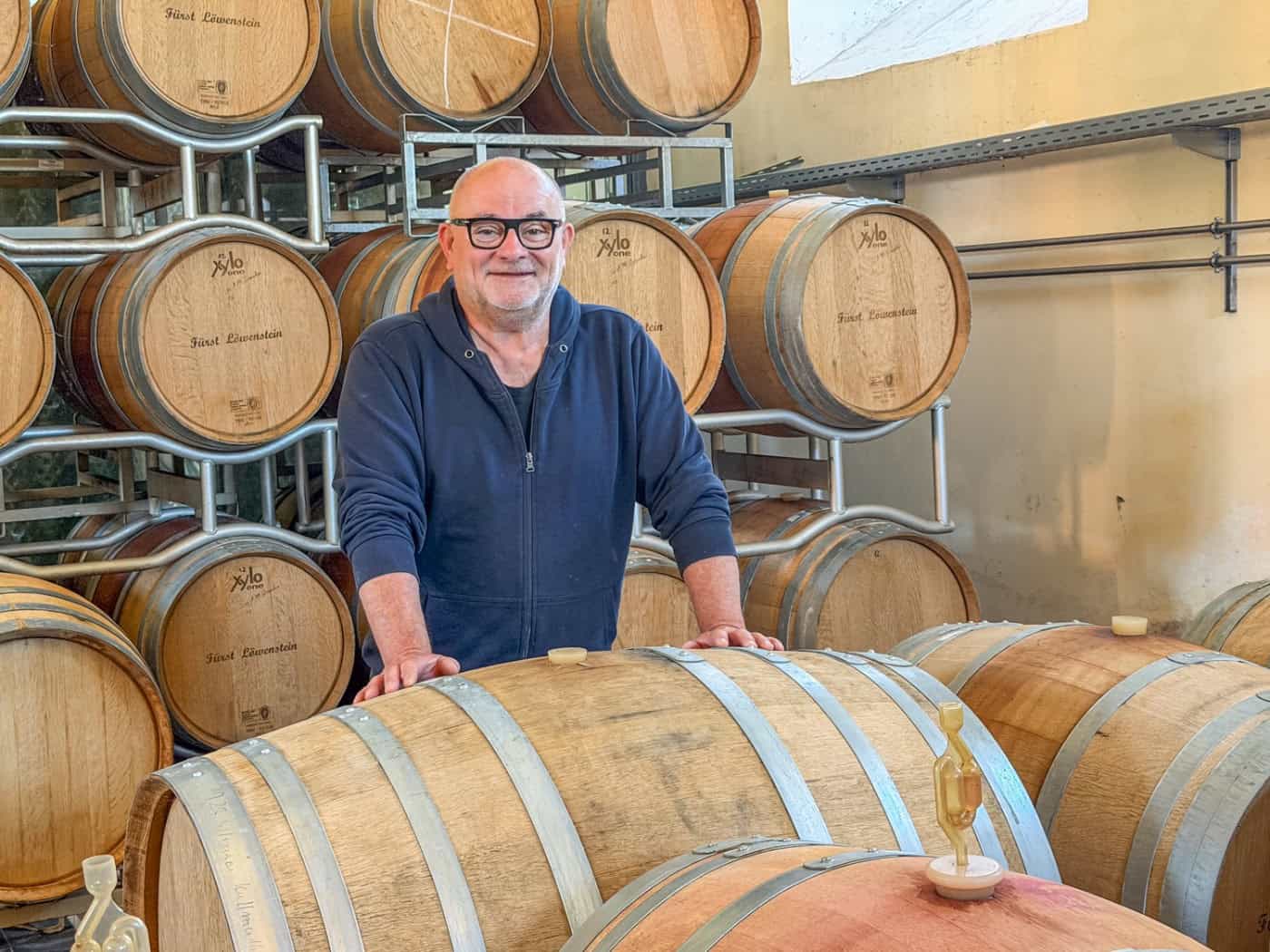
Cultivating the Homburger Kallmuth requires patience, experience, and an understanding of the unique characteristics of this special vineyard. The steep terraces near Triefenstein in the Chur-Franconian Main Valley have been owned by the House of Prince Löwenstein for more than 400 years. Their dry stone walls stretch for a total of more than twelve kilometers. Some are only about 60 centimeters high, while others exceed four meters. A significant portion of the work must be done by hand. This makes the site interesting from a viticultural perspective, but also makes its cultivation labor-intensive and expensive. Peter Arnold is responsible for the cellar and the winery’s operations. But he knows the Kallmuth vineyard not only from his current position: he began his training here and later wrote his thesis on the vineyard. After working in Germany, South Africa, and Spain, he returned to Fürst Löwenstein in 2016. For him, this brings his professional journey full circle.
The Kallmuth vineyard is located in a geological transition zone between the Upper Buntsandstein and the Lower Muschelkalk. Erosion and the displacement of rock material have caused various influences to overlap. The soils and steep terraces shape the conditions under which the vines grow. Of the approximately twelve hectares of terraced land, seven to eight hectares are currently still under cultivation, according to Arnold. Other areas lie fallow or are being redesigned. In addition to costs, labor requirements are also a factor. Maintaining the walls, tending the vines, and cultivating the steep plots can only be mechanized to a limited extent.
Silvaner is a key variety in Franconian vineyards, along with Riesling and Sauvignon Blanc. However, the winery is not limited to Franconia. The estate also includes vineyards in the Rheingau, including sites near Hallgarten. There, Riesling and Pinot Noir are the primary varieties. Although the estate owns vineyards in Tauberfranken—which is part of the Baden wine region—they are currently all leased out. As a result, Arnold must navigate the regulations of three different German wine regions in his day-to-day work. He laments that the varying forms, procedures, and administrative requirements can sometimes be difficult to understand.
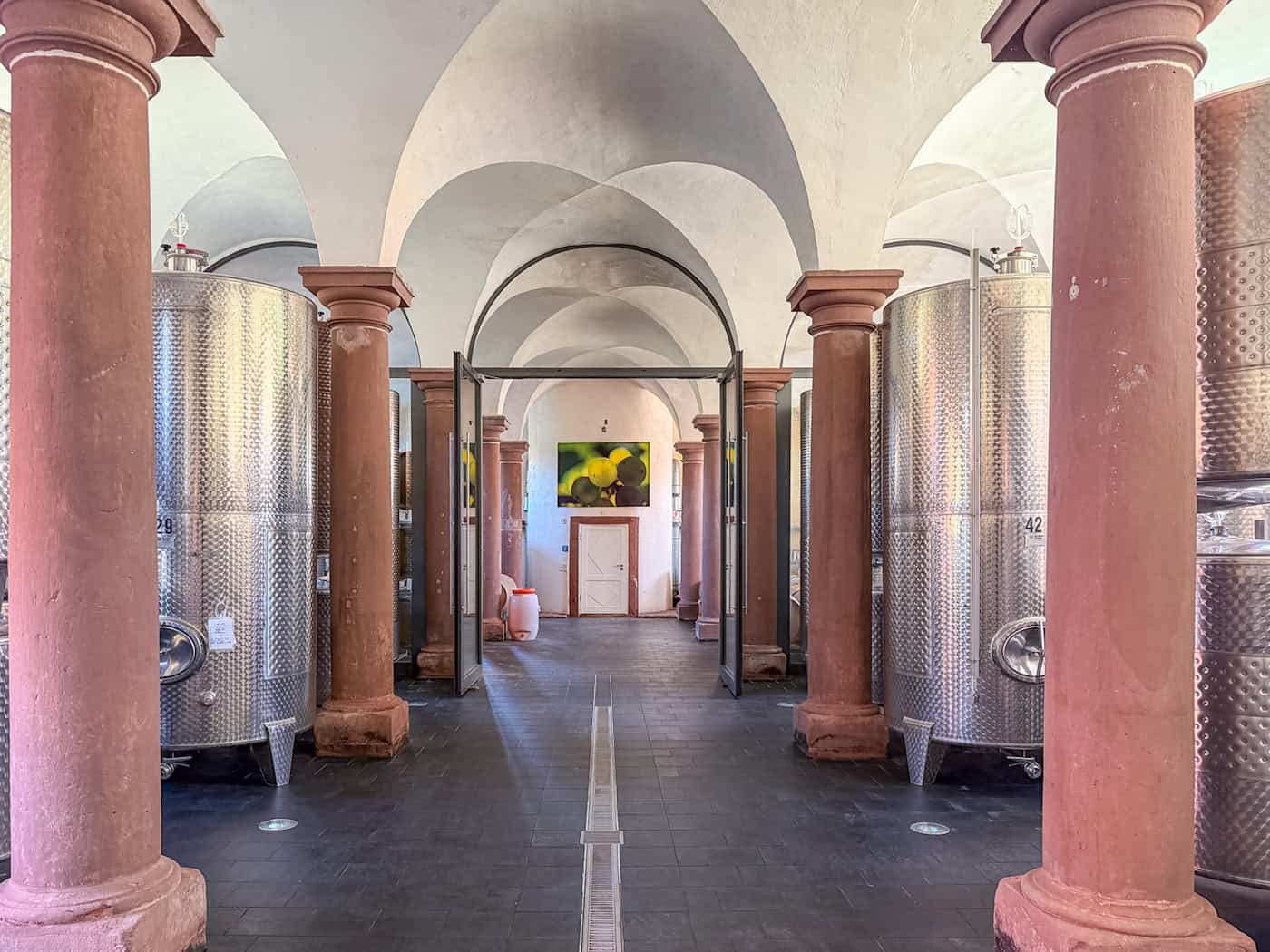
The interview took place in late September, while the harvest was still underway. Arnold expressed satisfaction with the 2026 vintage at the time of the interview: The grapes were healthy and sufficiently ripe, and the first wines had already completed fermentation. The acidity of the base wines for the sparkling wine was also just right. However, he noted that it was still too early to reliably assess how the wines would ultimately develop.
When deciding when to start the harvest, Arnold does not rely solely on measurements. While must weights are checked, the sensory evaluation of the grapes is also crucial for him. He must detect a specific flavor during tasting before he begins the harvest. In the past, the winery often began harvesting later than neighboring estates, but this time window is now getting shorter.
These changes are also evident in the calendar. At the start of his career, the harvest began in early October, Arnold explains. Today, depending on the year, it can start as early as the end of August. At the same time, the harvest must be completed in a shorter period. What used to take four to five weeks now often has to be finished within about three weeks. The climate changes therefore worry him. Although the vines in his own vineyards have recently weathered the drought relatively well, In Kallmuth, he estimates, they have benefited, among other things, from underground waterways. However, it remains to be seen how conditions will develop in the long term. Silvaner has coped well with the changing conditions so far, and Riesling is also holding its own. It is impossible to predict with certainty which varieties will grow in which regions in the future.
From Apprentice to Operations Manager
After completing his apprenticeship with Fürst Löwenstein, Arnold’s career path first took him to other German wineries and then to South Africa. What was originally intended to be a one-year stay turned into twelve years. In Franschhoek, he helped establish a winery. He then moved to Spain, where he spent about ten years working on his own winery project in the Alicante region. Further career moves took him to the Bergstraße region and to England before he returned to Franconia in 2016—as the successor to Bastian Hamdorf (Podcast Episode 181).
The experiences he gained in these diverse wine-growing regions shape Arnold’s perspective on his work today. He considers technical advancements important—not least in light of the labor shortage. But he also argues that knowledge acquired over generations must not be lost: Modern methods and traditional experience must work together. One example is the use of drones on steep slopes. Since helicopter operations have become increasingly difficult for managing these relatively small areas, drone technology offers new possibilities for plant protection. It can reduce physically demanding work and change how staff are deployed. Arnold sees this as a meaningful step forward, but he also criticizes the fact that the introduction of such methods is being slowed down by cumbersome approval processes.
Arnold also takes a nuanced approach in the cellar. The winery produces the base wine for the Silvaner sparkling wine itself; the sparkling wine production is handled by an external company in Würzburg. Aging typically takes about nine months, though occasionally longer. For him, the Silvaner sparkling wine (tasted here for the first time!) is a distinct alternative to the widely available sparkling wines made from Chardonnay and Pinot Noir. When it comes to still wines, Arnold places particular importance on the aging period. Estate wines and rosés are intended for immediate enjoyment. More complex wines, especially those from the Kallmuth vineyard, on the other hand, often need two years or more to fully reveal their aromas. For this reason, the winery sets aside individual batches and also offers older vintages.
Between High Standards and Economic Viability
Like many wineries, Fürst Löwenstein faces the challenge of balancing rising demands with limited human and financial resources. Arnold describes a market in which price is becoming an increasingly prominent factor. At the same time, it is becoming more difficult to find sufficiently qualified workers for the physically demanding work in the vineyard.
The transition to organic viticulture is also an open question for him. Especially on steep slopes, the additional workload can be considerable. Under the current conditions, he does not believe it is readily possible to completely forego the use of pesticides. The winery strives to intervene as little as possible and as much as necessary. Whether and when certification is realistic remains to be seen. Furthermore, a pensive Peter Arnold sees a contradiction between high expectations for regionally and naturally produced products on the one hand, and the simultaneous demand for wines that are as inexpensive as possible from distant countries of origin on the other. For him, ecological considerations, working conditions, and economic viability go hand in hand. A vineyard must not only be managed well from a technical standpoint but also enable a business that is sustainable in the long term.
Listen to the podcast
Fürst Löwenstein Winery
Schlosspark 3
63924 Kleinheubach
Tel. +49 9371 9486600
loewenstein-wein.de
[Recorded on September 23, 2026]

