


The "Host" Gene in Fürstenlager on the Hessian Bergstraße

Katja Simon is the 77th German Wine Princess—one of two who share the title “77” (the other is Emma Meinhardt from the Saale-Unstrut wine region; the 77th German Wine Queen Anna Zenz from the Mosel region, whom we’ve already featured here in the podcast “Auf ein Glas”). She is—as the candid snapshot above perhaps shows—a princess of the cheerful and upbeat variety, but she also has a lot to say. She knows a lot, she explains things well—and she does it all with wonderful naturalness, which (like her colleagues in office) sets her fabulously apart from outdated notions about wine royalty.
Katja Simon hails from the Hessian Bergstraße, a region that’s usually a blank spot on the map even for well-informed wine connoisseurs. Is it because, at 440 hectares (as of 2025, source: DWI), it’s currently the second-smallest wine-growing region? Incidentally, the “smallest of the small” is the Middle Rhine—with just one hectare less… Or is it because the Hessian Bergstraße has only existed as an independent wine-growing region since 1971 (before that, it was part of the Bergstraße along with the Baden Bergstraße—now one of the nine regions in Baden)? Regardless, it’s certainly not because there’s nothing worth tasting between the Stachelberg in the north and the Eckweg in the south.
Katja works at the Simon-Bürkle Winery—a two-family winery founded a generation before her by the two winemakers Kurt Simon (a native of Zwingenberg) and Wilfried Bürkle (a native of Baden). The two had met while studying and went on to found the winery. Their daughter, Katja Simon, studied in Geisenheim and Vienna, and after viticulture internships in Mallorca, South Tyrol, the Palatinate, and the Rheingau, she is now back home on the Hessian Bergstraße. So it was a homecourse for her when she led journalists to the Fürstenlager.
Fürsten-what? Do you have to know about it? Let’s put it this way: Anyone who lives in Bensheim or Zwingenbach and doesn’t know about it either didn’t pay attention in local history class and/or has only themselves to blame. For the rest of the world: it’s okay if you don’t know it, but a visit might be worth it… That goes for the 46-hectare estate, which (yes, where else would you find such a thing?) can be visited for free. Only guided tours cost money—but if you just want to experience the beauty of the English landscape garden with its numerous viewpoints and several natural landmarks (including one of Germany’s oldest sequoias), you can save your money for a visit to the restaurant. Of course, since it’s well over 30 degrees in the shade outside (or, on other days, because it’s pouring rain), you can head straight to the restaurant—though you’ll have to walk there, since the park is car-free. But that actually helps with digestion (on the way back)!
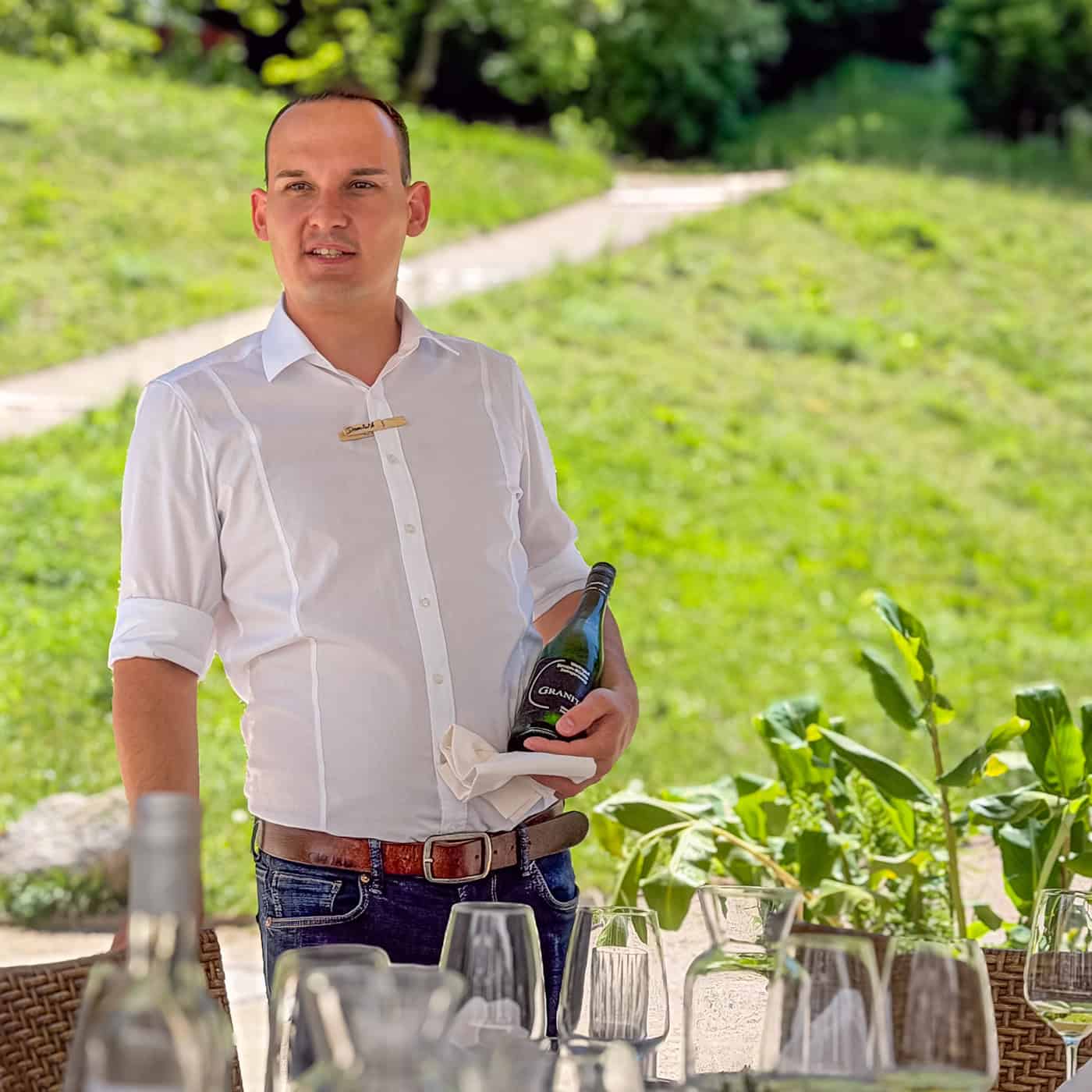
Dominik Stenger welcomes the group of journalists on the restaurant’s terrace. He has been the leaseholder of the restaurant in the manor house at Fürstenlager State Park in Bensheim-Auerbach since 2024. Together with his wife, he runs the restaurant and also manages the kiosk in the park. His concept didn’t just win over the landlord: Six months after the reopening, Stenger received the Start-up Award from the Bergstraße Economic Development Agency. When he explains his concept in person at the table, the first thought that comes to mind is: this works. Stenger embodies the unfortunately all-too-rare combination of a solid education (training as a hotel specialist at the Schlosshotel Bühlerhöhe and earning a state-certified degree in hotel management from the Heidelberg Hotel Management School) and practical experience in a leadership role in chain restaurants at Block House, L’Osteria, and Gastro & Soul (Vapiano and others). But there’s something else—something that can be honed but must be innate: the host’s gene.
Uncomplicated and good
Being uncomplicated and open is, after all, far more difficult than simply writing terms like “regional” and “sustainable” on the menu. That said, this approach is, of course, put into practice at the restaurant: the wines on the open wine list all come from the Hessian Bergstraße, and among the bottled wines, there are not only regional options but also a wider range of flavors from farther afield. The website promises authentic German cuisine, but what does that even mean? For example, we had a salad with an incredibly flavorful dressing and gambas on top. Not Hessian, but a good fit. But when steak is served as the main course, that’s already closer to the mark, and you can order the tarte flambée with Handkäs for a distinctly Hessian touch. But regardless: it has to taste good (and the first two dishes we tried certainly did!).
As wine journalists on tour, there was of course more than one wine to sample, ranging from the house cuvée “Fürstenglück” to the Syrah. Incidentally, the cuvée was blended by eight members of the restaurant team at Hanno Rothweiler’s winery, Dominik Stenger explains. This isn’t just good for team building, but also boosts sales—after all, who doesn’t like to sell their own wine? Among other vineyards, Rothweiler cultivates the Auerbacher Fürstenlager site, the restaurant’s local hill. Theoretically, the restaurant could use a high-quality wine from there as its house wine—but the team found the cuvée more exciting (and Hanno Rothweiler loves and masters the art of blending different varieties)..
From the Simon-Bürkle Winery—yes, the one owned by the “Wine Princess”—we tasted a 2023 Riesling Granit, and from the Bergsträßer Winzergenossenschaft, a 2024 Roter Riesling. After the refreshing whites, two red wine samples—both from the 2023 vintage—paired quite well with the steak: Hanno Rothweiler’s Syrah was grown in the aforementioned Auerbacher Fürstenlager vineyard and was then allowed to age in barrique before demonstrating at the Fürstenlager Restaurant just how much such a wine can enhance a meal with its additional complexity (and, of course, the drinker as well—w/w/d). Another excellent pairing: the Spätburgunder Bernsheimer Kirchberg from the City of Bensheim’s winery.
Fürstenlager Restaurant
Fürstenlager 1
64625 Bensheim-Auerbach
Tel. +49 6251 8605572
fuerstenlager-restaurant.info
[Visited on June 18, 2026]

