

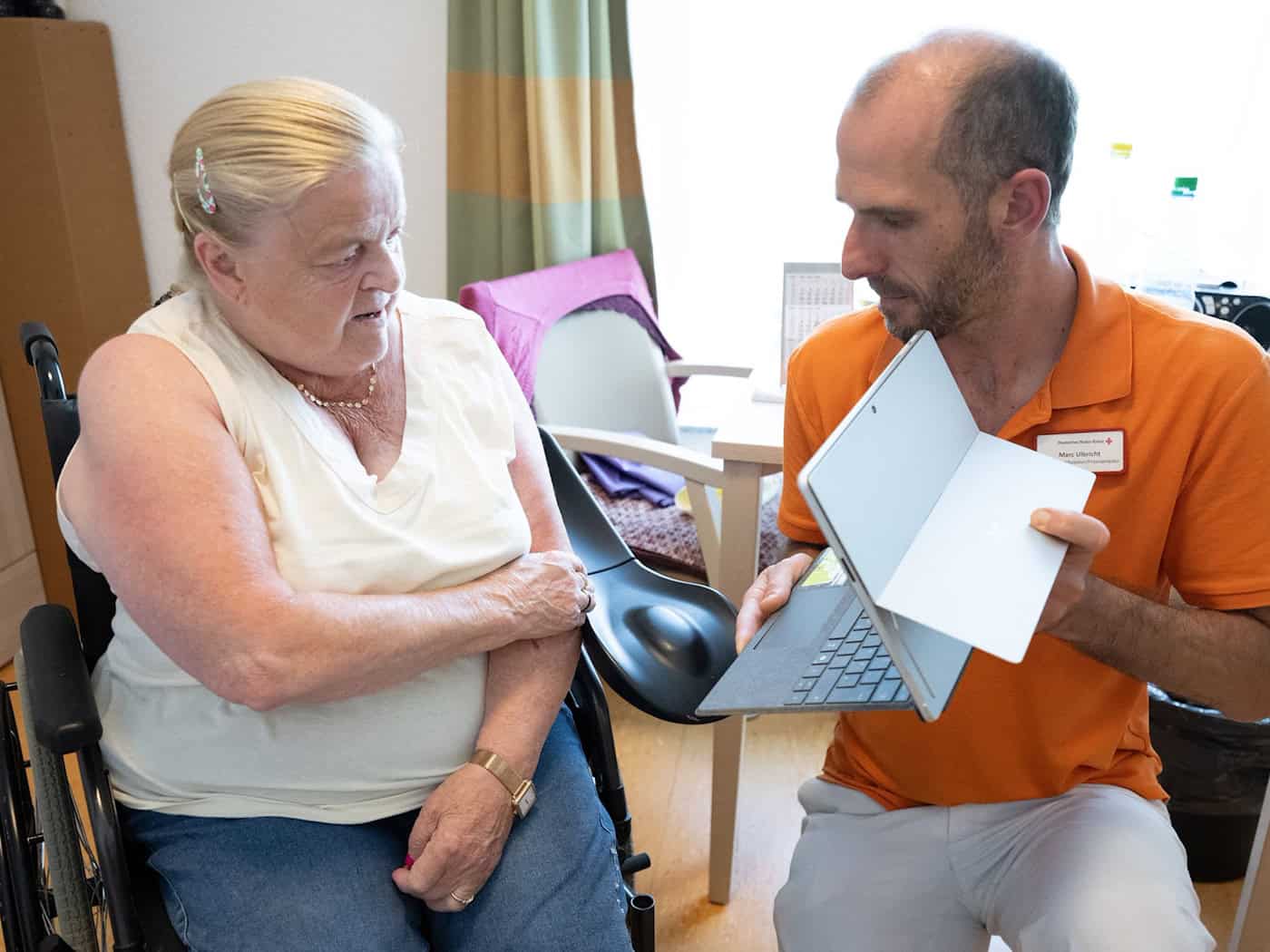
Wednesday morning at the “Herbstsonne” senior center in Dresden. Resident care manager Marc Ulbricht is on his way with family physician Antonio Kantchew-Haustein. The Dresden-based general practitioner is scheduled to check on Irene Weise. The 80-year-old is waiting for the doctor in her wheelchair. Since suffering a stroke, the left side of her body has been paralyzed—a bruise has formed on her arm because the backrest of her wheelchair often gets in the way, she explains. “Show me that little sore spot,” says the 49-year-old doctor. He prescribes an ointment for the woman. So far, it seems like a perfectly normal house call—but Kantchew-Haustein isn’t actually in the room. To his patient, he appears only as a face on a tablet that Ulbricht has placed in front of her. Irene Weise finds it rather unusual not to be sitting face-to-face with her doctor. “But this works just fine, too.” Next visit: Lutz Kiesewalter, 64, had to have his big toe amputated. Ulbricht uses the tablet as a camera. The doctor, joining the call remotely, examines the wound and decides how many stitches should be removed for now. This has become routine for the nursing home. While Kantchew-Haustein conducts home visits from his office, Ulbricht performs many of the tasks on site that are otherwise reserved for the doctor: drawing blood or inserting catheters. He is a qualified nursing professional and one of about ten staff members at the facility to whom the doctor has delegated certain tasks. This model, in which non-medical staff work on-site under medical supervision, is seen as a potential solution to the looming shortage of care in the Free State of Saxony. In fact, qualified non-medical staff are now frequently employed in Saxony. According to the Saxon Association of Family Physicians, there are currently 551 so-called care assistants (VERAH) working in family practice offices throughout Saxony. The Saxony Association of Panel Physicians reports that 486 practices have been authorized to employ non-physician practice assistants (NäPa). These figures represent a “significant number,” estimates Torben Ostendorf, chairman of the Association of General Practitioners. However, these additionally qualified staff are primarily deployed in day-to-day practice, where they help relieve the workload on physicians. Telemedical home visits with an assistant on site are “conceptually appealing,” but have not been established on a widespread basis beyond pilot projects. The Saxony Association of Statutory Health Insurance Physicians (KV Sachsen) reports a single case last year in which the collaboration between a telemedicine assistant and a doctor was billed. Thus, while assistants play the greatest role in regions considered underserved—“that is, in rural areas, such as parts of the Ore Mountains, Lusatia, or Northern Saxony”— Practices operating there under considerable pressure to provide care rely on qualified delegation, simply because medical capacity is not infinitely scalable,” reports Ostendorf. Telemedicine does not appear to be in widespread use. However, there are still some examples, according to a spokesperson for the Saxony Association of Statutory Health Insurance Physicians (KV Sachsen): video consultations in psychotherapy, electronic rounds in long-term care facilities, and “dermatological teleconsultations.” The pilot project is intended to help address the shortage of specialists in underserved regions. Using a special camera, primary care physicians take photos of their patients’ skin areas and thus seek advice from dermatologists. However, whenever telemedicine is used, new equipment—and sometimes expensive software—is required, and certifications and qualifications must be verified. In practice, all of this means that the barriers to entry are sometimes high, believes Dresden-based general practitioner Antonio Kantchew-Haustein. After an initial “COVID boom,” telemedicine has since become significantly less relevant and is “not a major factor” in normal daily practice. At “Herbstsonne,” the model works well as a supplement to in-person visits by the family doctor. Facility director Katrin Mittag reports that the video consultation around noon is firmly integrated into the daily routine and is a great help to the senior center: “Something can always come up—the doctor was here in the morning, but something might still happen in the evening,” she says. In such cases, it’s helpful when staff can quickly contact the doctor via tablet and the doctor can help decide whether immediate action is needed or if they can wait until the next visit. For the residents, what matters most in the end is that someone is checking on them—whether at their bedside or on the screen. Copyright 2026, dpa (www.dpa.de). All rights reservedAssociation of General Practitioners: Telemedicine Attractive, but Not Yet Established
General Practitioner: Expensive Equipment, Expensive Software, High Barriers


