

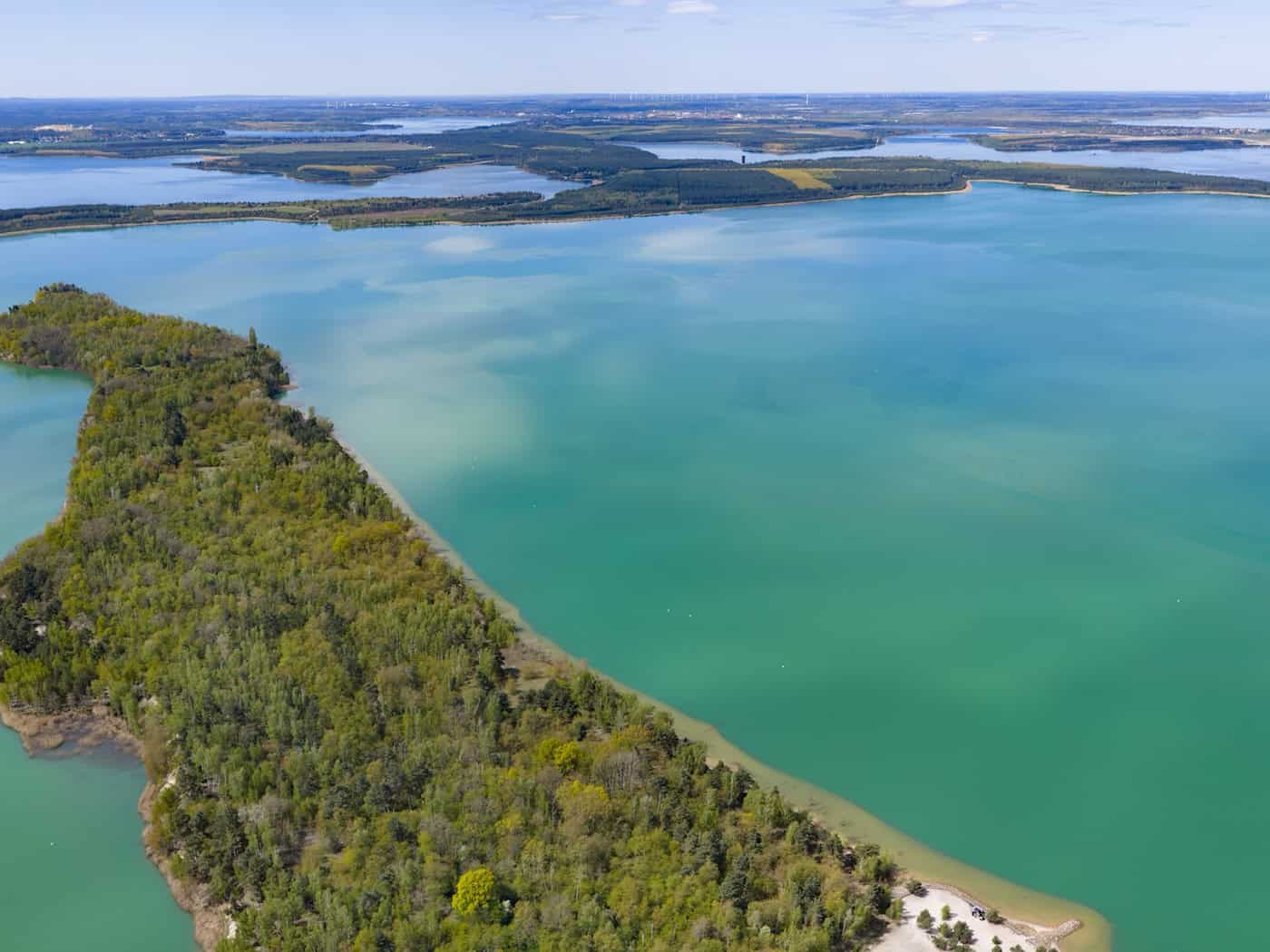
With the opening of the Lusatian Lake Network next Monday, a massive mining reclamation project will come to a close. For the first time, the five lakes along the state border between Brandenburg and Saxony will form a navigable network. The tourism association hopes this will become a paradise for swimming and water sports for vacationers and day-trippers from Dresden, Berlin, and far beyond. Around 150 guests from the worlds of politics, business, tourism, local government, and public agencies—including Brandenburg’s Minister President Dietmar Woidke (SPD) and Saxony’s Minister President Michael Kretschmer (CDU)—plan to celebrate the opening. The five large lakes—Senftenberg, Geierswalde, Partwitz, Sedlitz, and Großräschen—will all be connected for the first time and navigable by boat, according to the Lusatian Lake District Tourism Association. This will create a 50-kilometer route navigable by ship and boat across a water area of 5,300 hectares. The plan is to connect even more lakes via canals. Until now, the Koschen Canal between Senftenberg Lake and Geierswalde Lake, as well as the Barbara Canal between Geierswalde Lake and Partwitz Lake, were the only navigable waterways in the region. All five lakes are navigable by motorized vessels, said Kathrin Winkler, managing director of the tourism association. A trip across the lakes takes up to 2.5 hours—not including waiting times. Currently, a passenger boat operates on Lake Großräschen. The “Wilde Ilse,” a restored historic passenger boat from 1938, has 55 seats, according to the tourism association’s website. After Lake Sedlitz was also opened for swimming and water sports in May of this year, guests can now fully enjoy all five lakes. “All of the participating bodies of water now have a stable, pH-neutral environment and offer excellent conditions for swimmers and water sports enthusiasts,” reports the Lausitzer und Mitteldeutsche Bergbau-Verwaltungsgesellschaft mbH (LMBV). In addition, there are paved trails around the lakes for cyclists and hikers, among others. With this opening, “the largest man-made water landscape in Europe” has been created, according to tourism director Winkler. At the same time, the LMBV notes, this marks a major step toward structural change in Lusatia. It has been exactly 100 years since the first excavators broke ground for the “Ilse-Ost” open-pit mine, on the site of which Sedlitzer Lake now lies. Generations of miners have worked on the reclamation of the former open-pit mines. In the 1980s, nearly 190 million metric tons of lignite were mined annually in Lusatia, according to the Lusatian and Central German Mining Administration Company (LMBV). According to the LMBV, a lake district comprising 23 post-mining lakes with a total water area of 14,000 hectares is being created in the Lusatian mining region. By comparison: Lake Müritz—Germany’s largest inland lake—covers an area of approximately 11,300 hectares, according to the Water and Shipping Authority. The last active open-pit mine in the area of the five lakes was the “Meuro” open-pit mine. Coal was mined until 1999 in the area where Großräschener Lake is located today. The remaining open-pit mines were shut down during the GDR era. Lake Senftenberg, for example—the tourist heart of the lake system—was flooded as early as 1967 and opened in the 1970s. The scale of the project becomes clear when expressed in numbers: In the area of the four “youngest” lakes in the network—for which the LMBV is responsible for rehabilitation and flooding—approximately 925 million metric tons of coal were mined. Just under 3.8 billion cubic meters of earth were moved to access the lignite, explains LMBV spokesperson Uwe Steinhuber. Today, all five lakes together hold a theoretical water volume of 640 million cubic meters. According to LMBV data, approximately 61 million cubic meters of water flowed into all the lakes in the Lusatian mining region last year alone—15 million cubic meters of that into the “Restlochkette” alone—that is, the network of the five large lakes. According to the data, most of the water came from the Spree River. Conversely, the lakes are also used as water reservoirs to replenish the rivers, for example, when water levels are low. Since the early 1990s, the LMBV has, according to its own figures, spent 941 million euros on the restoration of the four lakes in the system for which it is responsible. Tourism Association Director Winkler hopes for an “attractive vacation region with international appeal.” Last year, according to the association, the region already welcomed 269,000 guests and recorded 800,000 overnight stays. The most important foreign market for the region is the Czech Republic. Guests from Saxony’s neighboring country accounted for around 23,000 overnight stays. Polish guests accounted for 4,399 overnight stays in the region. According to the association, there are already over 300 boat moorings on the Saxon side and over 700 on the Brandenburg side. In the future, this number is expected to exceed 1,400. Copyright 2026, dpa (www.dpa.de). All rights reservedWhat visitors can experience in the Lusatian Lake District
The significance of the five lakes
How much earth was moved and what the flooding cost
What the lakes bring to tourism


