

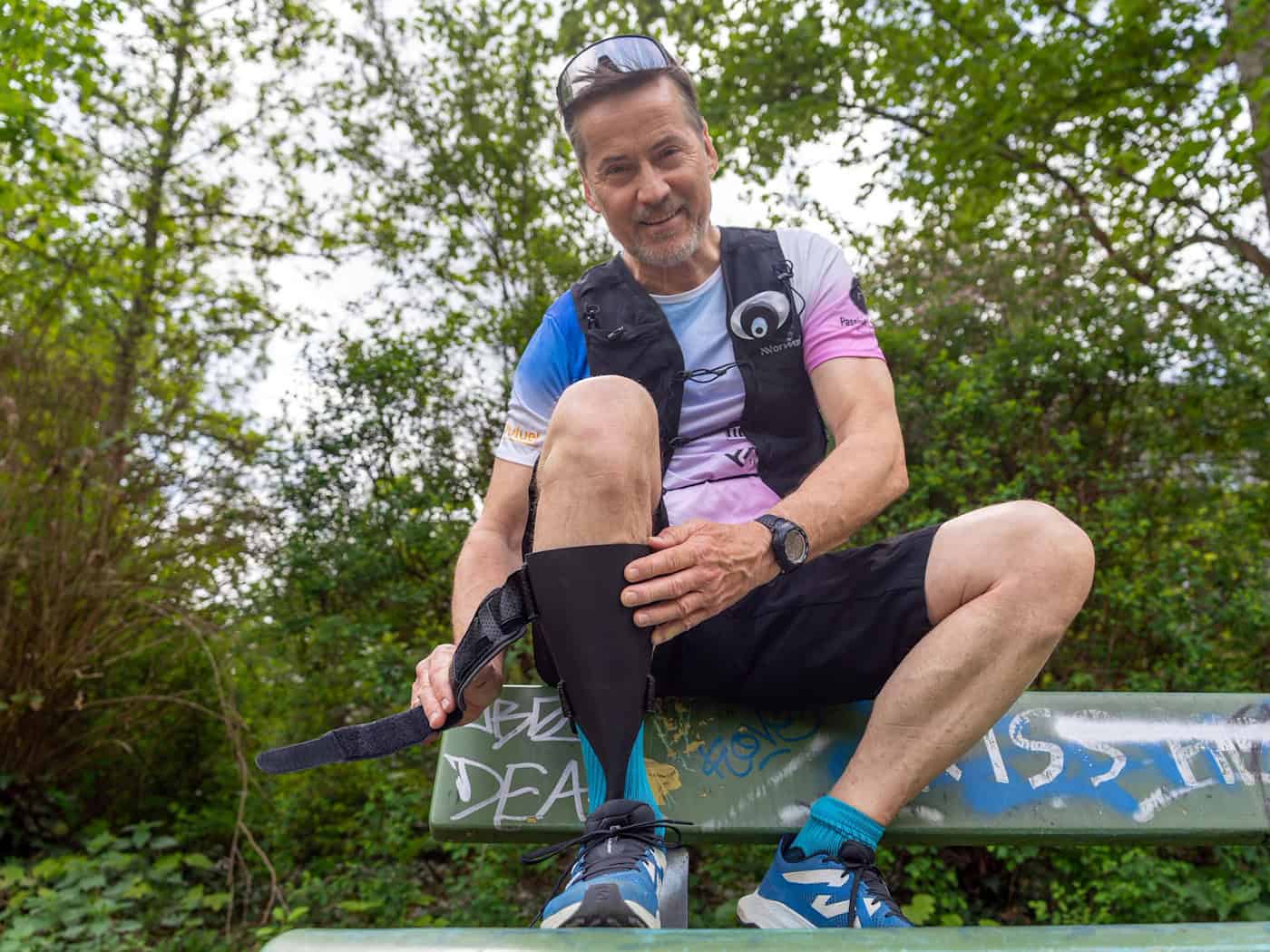
Stephan Scherzer is a fighter through and through. Himalayas, Alps or in the water in the bay off San Francisco: the Berliner would probably only have known all this from documentaries if his doctors had been right at the time. Due to an illness, he has difficulty lifting his foot. But at 61, he still laces up his running or hiking shoes. This is not a matter of course. Scherzer suffers from a condition known as weak foot dorsiflexion. To put it simply, people with this condition find it difficult to lift their feet. "When you're 12 or 13 years old and you're constantly bumping into things, getting stuck, stumbling, falling down - it's demoralizing," he recalls. Scherzer has been able to compensate for the limitations for decades through sport and training his muscles and, by his own account, has managed to get rid of the so-called Heidelberg angle - a brace that keeps the foot straight. "I was told that you have to wear a splint like this so that you can maybe walk normally. But you can't do any more sport." The Berliner was able to live without any major problems for decades - until he was in his mid-50s. Between Zugspitze and Alpspitze near Garmisch-Partenkirchen, his hip gave out, he explains. "As it turned out, I had fourth-degree osteoarthritis." The question then arose: What next?" In contrast to 48 years ago, when Scherzer's doctors prescribed a splint, today there are significantly more options to help people get back into everyday life after accidents or in the event of restrictions due to illness, for example. An overview of such options will be provided at the orthopaedics and rehabilitation industry trade fair in Leipzig over the next few days. OTWorld (May 19 to 22) is the world's largest event in the industry, according to its own information. It is all about exchanging ideas on how specialists can help those affected. All over the world, people are dependent on aids such as prostheses, orthoses, bandages, compression stockings, insoles and wheelchairs. According to statistics from the German Association of Orthopaedic Technology (Bundesinnungsverband für Orthopädie-Technik), a quarter of people with statutory health insurance in Germany require such aids every year. In 2024, the statutory health insurance companies would have spent almost ten billion euros on this. According to the figures, half of these aids would be for the 65 and older age group. The Federal Association of Orthopaedic Technology Guilds speaks of an overall increase in demand. "This is due to an ageing society, chronic illnesses, the desire for mobility and participation into old age, but also the consequences of accidents from everyday life, work and leisure," says Kirsten Abel, spokesperson for the association's executive committee. The First Vice President of the German Society for Orthopaedics and Trauma Surgery believes that Germany is well positioned: There is a long tradition and a lot of research is being carried out, says Christoph Lohmann, Director of the Orthopaedic University Hospital Magdeburg. "Germany has world-leading companies that provide injured and operated patients with technically sophisticated exoprostheses, for example computer-controlled knee prostheses," he says. "The field of sport, especially at the Paralympics, is also highly developed with state-of-the-art prosthetics that enable top performance." The supply of foot orthoses for children, adolescents and adults is also being developed further and further, "to relieve foot pain or to be able to continue doing sports without pain". The fact that Scherzer can continue doing sports and climbing mountains after his osteoarthritis diagnosis is also thanks to the patience of Petra Menkel. She is the co-managing partner of an orthopaedic company in Berlin. For more than a year, she worked with another company from Bavaria on a custom-made orthosis from the 3D printer. "Plastics have been processed for a long time, but the possibility of printing orthoses is relatively new," says Menkel. Scherzer's orthosis was the first to be printed in her company. They tried, adapted and tested again and again until Scherzer was able to walk without any problems. An experiment that companies cannot always afford. "We are now under so much cost pressure that we can no longer afford this development work economically, much to the detriment of all people with disabilities," regrets the entrepreneur. Scherzer believes that good aids could save costs in the healthcare system - in his case probably a hip operation, as he says. "And who knows if I could have done everything afterwards." Copyright 2026, dpa (www.dpa.de). All rights reservedWhen his hip failed while hiking
How many people are dependent on aids such as prostheses
How experts assess the supply situation
An orthosis from the printer


