


Inside plasma: how atoms lose their electrons
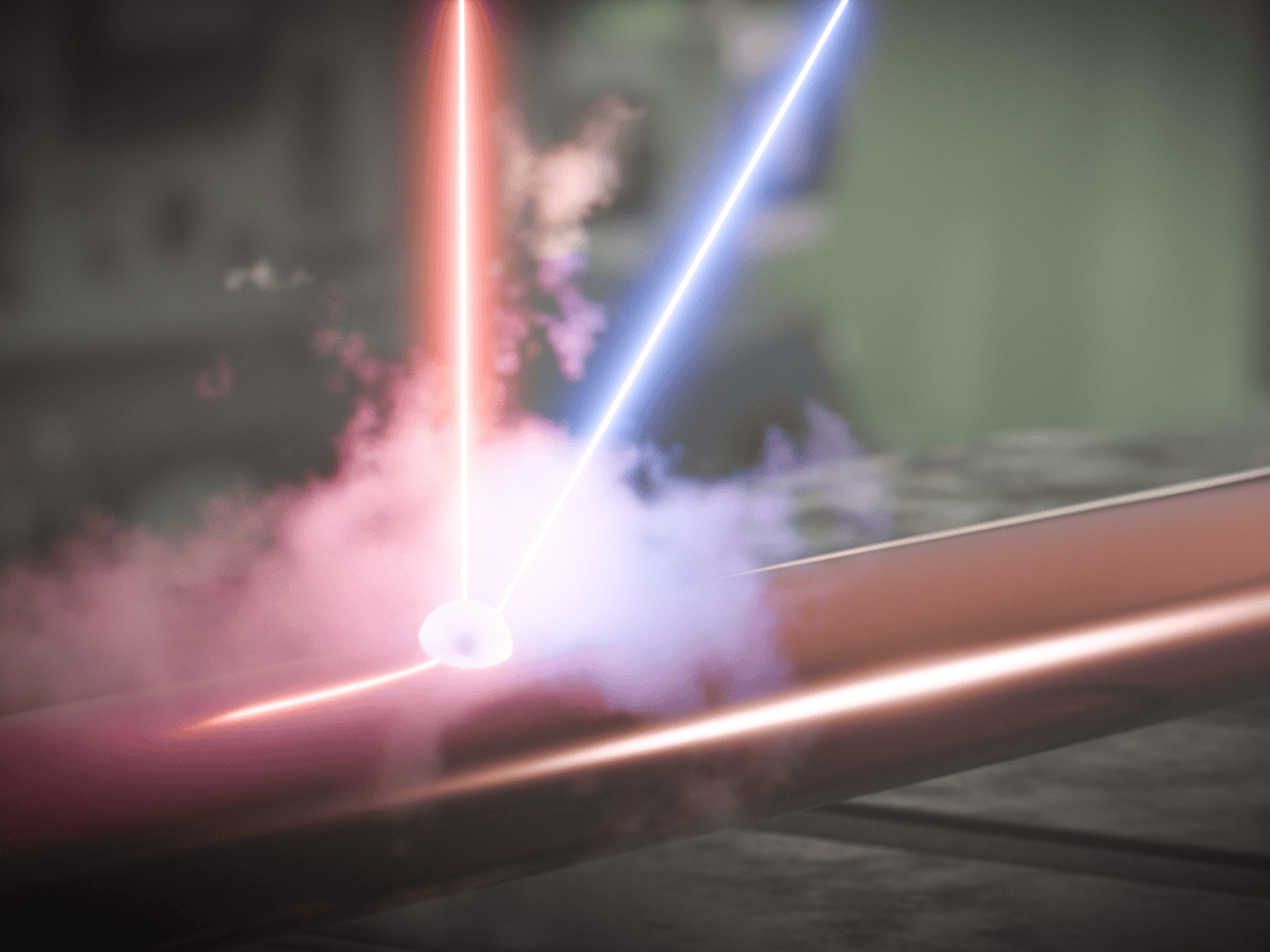
Light can destroy matter. Anyone who doubts this only needs to imagine what happens when a laser hits a copper wire seven times thinner than a human hair. The wire vaporizes instantly, creating a plasma several million degrees Celsius hot. Researchers at the Helmholtz-Zentrum Dresden-Rossendorf (HZDR) have now observed this very moment more precisely than ever before. Their results have been published in the journal Nature Communications.
Two lasers, one tiny wire
The scientists used two state-of-the-art lasers for their experiment. The first, a high-intensity optical laser called ReLaX, fires a pulse of light at the copper wire. This pulse lasts just 25 femtoseconds – or 25 quadrillionths of a second. In other words, one femtosecond is to one second as one second is to 32 million years. The pulse is so intense that it creates conditions otherwise found only near neutron stars. The wire vaporizes, and the copper atoms lose many of their electrons – they become ionized. This creates a hot plasma of charged particles.
A second laser, the X-ray free-electron laser at the European XFEL in Schenefeld near Hamburg, then captures snapshots of this plasma. It works like an extremely fast camera. "In our pump-probe experiment, we precisely measure the temporal evolution of this stimulated X-ray emission," says Dr. Lingen Huang, who led the experiments in HZDR’s High Energy Density department. "This allows us to determine how many Cu²²⁺ ions are present in the plasma at any given time." Cu²²⁺ refers to copper atoms that have lost exactly 22 electrons.
Electrons on the run - and their return
What the researchers observed could be tracked with unprecedented precision. Immediately after the laser pulse, the first highly ionized copper ions form. After about two and a half picoseconds – that is, two and a half trillionths of a second – their number reaches its peak. The electrons are then recaptured, and after around ten picoseconds, these ions can no longer be detected.
"No one has ever observed this type of ionization in such detail before," says Prof. Tom Cowan, former director of the Institute of Radiation Physics at HZDR. Using computer simulations, the physicists were also able to explain why this happens. The first laser pulse removes only a few electrons from the copper atoms. "These electrons are so energetic that they spread like a wave, knocking more and more electrons out of neighboring atoms," he explains. Over time, however, they lose energy and are recaptured. In the end, neutral copper atoms remain.
These findings go beyond basic research. They help scientists understand how matter behaves under extreme conditions. Such conditions are also central to nuclear fusion, where atomic nuclei fuse and release large amounts of energy – a process considered a potential source of clean energy in the future. To make such reactors work, researchers need to understand exactly how electrons and ions behave in these plasmas. The new measurements provide crucial data for this and help significantly improve existing computer models.
Original publication:
L. Huang et al.: Probing ultrafast heating and ionization dynamics in solid density plasmas with time-resolved resonant X-ray absorption and emission, Nature Communications, 2026.

