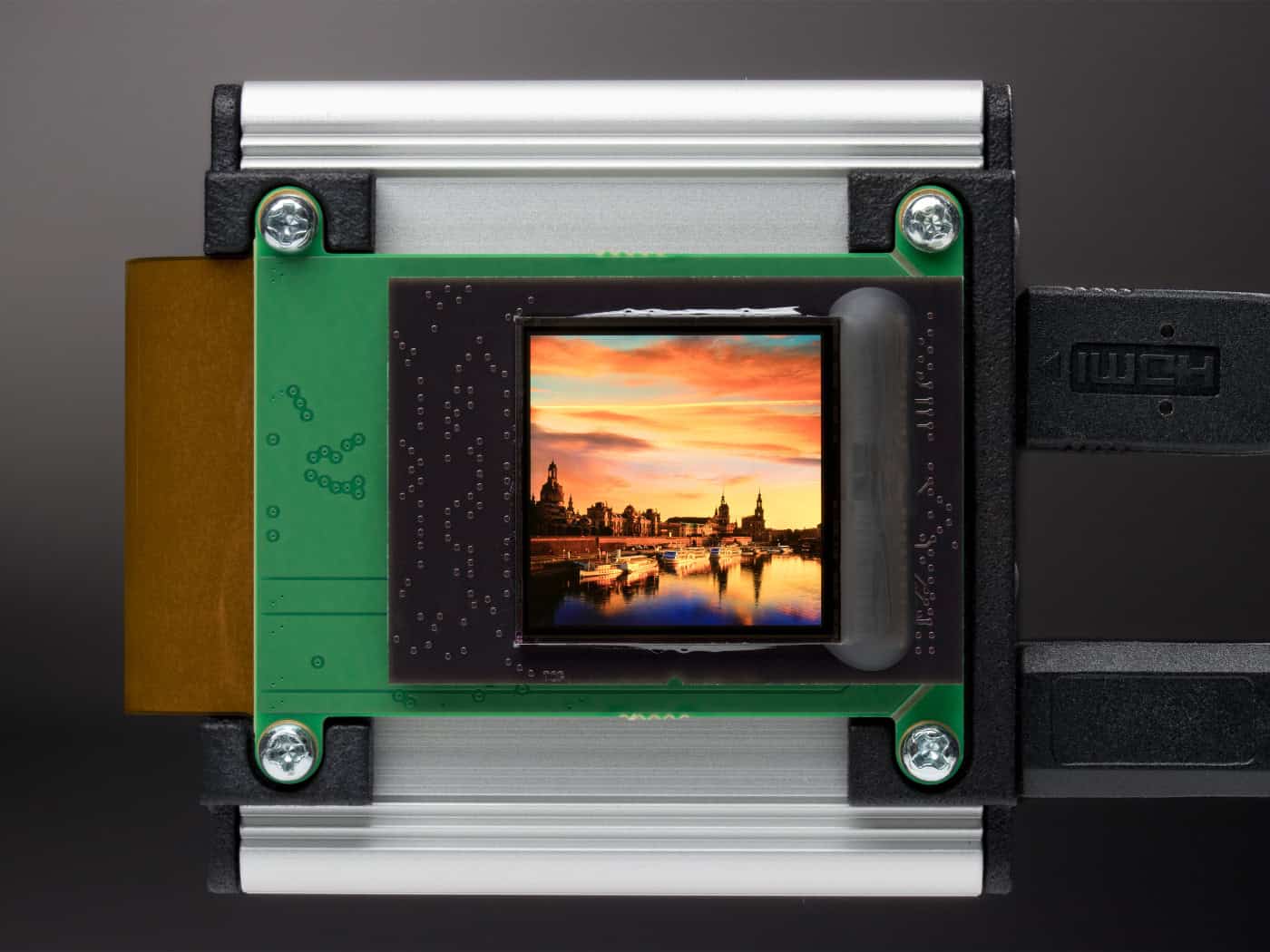
Data glasses and augmented reality are on the rise. Researchers in Dresden are working to make these technologies suitable for everyday use. Their latest component is a screen just a few centimetres in size.
Scientists at the Fraunhofer Institute for Photonic Microsystems have developed a so-called 2K OLED microdisplay. OLED is a technology also used in modern televisions and smartphones: organic materials emit light when electricity is applied, so each pixel lights up on its own without the need for backlighting. This results in particularly sharp, high-contrast, and bright images. A “microdisplay” simply means the screen is very small – measuring just 2.7 centimetres diagonally – yet it still displays around four million pixels..






Part of a global trend
The work in Dresden reflects a broader international development. Companies and research institutions worldwide are working to make displays smaller, brighter, and more energy-efficient for applications such as augmented reality, medical devices, and industrial systems. Microdisplays are gaining importance because they enable high resolutions in very small spaces.
At the same time, alternative technologies such as micro-LED displays are being explored, promising even higher brightness. The goal is to create displays that remain clearly visible even in bright sunlight while consuming as little energy as possible. Fraunhofer IPMS is contributing to this effort with a focus on compact, high-brightness OLED microdisplays for specialized applications.