


AI Giants Gather in Dresden: Anthropic and OpenAI to Deliver Keynotes at Brains on Silicon
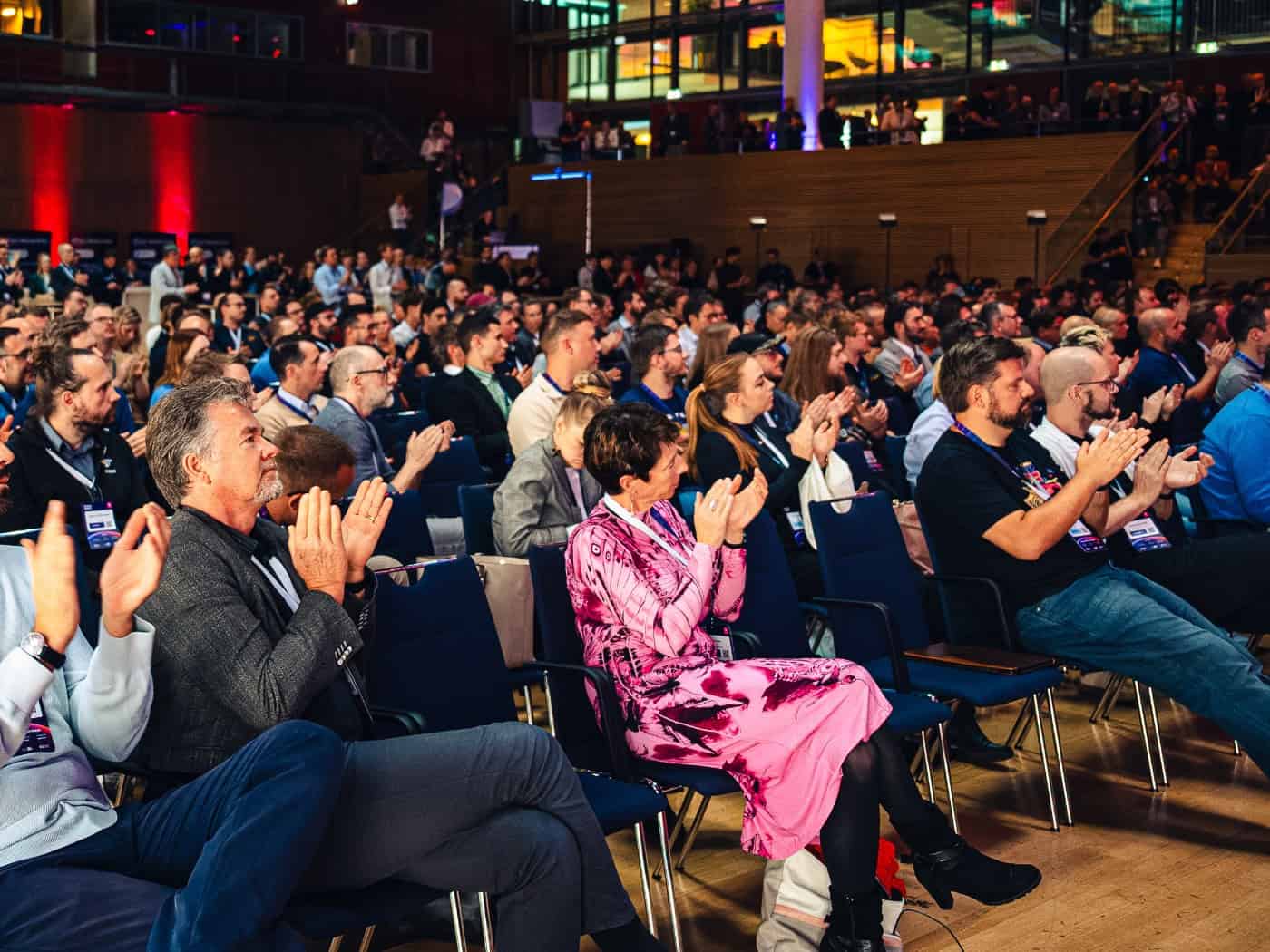
On September 14 and 15, 2026, the Dresden International Congress Center will serve as a gathering place for the international AI industry for two days. More than 100 speakers are now on the program for the second Brains on Silicon, spread across four stages and 94 program items. The organizers expect more than 1,500 participants.
Two names stand out in particular: Anthropic, developer of the AI model Claude, and OpenAI, the company behind ChatGPT. Both are currently competing for companies, developers, talent, and technological leadership in high-performance AI models. In Dresden, they will take the stage on two consecutive days.
Anthropic kicks things off on Monday, with OpenAI taking the stage on day two
The first day of the conference begins on Monday, September 14, at 9:30 a.m. Following the opening, a brief welcome address by Saxony’s Minister of Economic Affairs Dirk Panter, and a presentation by Thuy-Ngan Trinh of A11, Roman Howe will take the main stage at 9:55 a.m. Howe leads Anthropic’s business in Germany, Austria, and Switzerland, as well as Central and Eastern Europe. The title of his presentation is still listed as “Roman’s Session” in the current program. This means Anthropic is part of the conference’s opening segment.
On Tuesday, the lineup is even clearer. Sarah Kemether from OpenAI’s Go-to-Market team will open the program on the main stage at 9:30 a.m. Her presentation is titled “AI Adoption Instead of AI Discussion: How Companies Successfully Use AI.” Kemether works with companies in the DACH region on the implementation of generative AI. Before joining OpenAI, she worked at Google and Microsoft.
For Brains-on-Silicon organizer Stefan Queißer, bringing both companies to Dresden is, in his own words, something special. These names lend international prestige to the still-young conference. Queißer describes the event’s mission as follows: “Top-level applied AI doesn’t just happen in Berlin, Munich, or Silicon Valley—it also happens here in Dresden. That’s the message we want to send.”
DIE SACHSEN NEWS had already reported in June on the second edition of Brains on Silicon and the growing international lineup . At that time, OpenAI and Anthropic weren’t yet the two names that now particularly define the program.
OpenAI vs. Anthropic: The AI Competition Comes to Dresden
The fact that OpenAI and Anthropic, of all companies, are appearing on two consecutive days is more than just high-profile name recognition for the program. One of the fiercest rivalries in the tech industry is playing out between the two U.S. companies. It’s all about more powerful models, AI agents, programming, corporate clients, and enormous sums spent on computing power.
In June, Reuters described the competition as an “all-out war,” citing an industry expert. New models from one provider regularly ramp up the pressure on the other. The conflict has now extended to the presentation of their respective financial results. OpenAI has internally criticized Anthropic’s revenue reporting, while Anthropic defends its accounting practices.
Anthropic has made significant ground, particularly in the enterprise business. In April, Reuters reported that Anthropic’s reported annualized revenue was, mathematically speaking, even higher than OpenAI’s. The figures are only comparable to a limited extent due to differing accounting methods. One key driver is Claude Code, which has fueled Anthropic’s strong growth among developers and enterprises. OpenAI, on the other hand, is focusing a larger portion of its product strategy on enterprise customers and coding applications.
This gives visitors to Brains on Silicon two perspectives on the same market. Roman Howe represents Anthropic, and Sarah Kemether represents OpenAI. Both come from the commercial side of their companies and will therefore address precisely the question that many German firms are currently grappling with: How can a powerful AI model be turned into a tool that is actually used within a company?
This aligns with the conference’s theme, “Closing the implementation gap.” In 2026, Brains on Silicon aims to focus less on theoretical possibilities and more on demonstrating how AI is integrated into business processes, software, and industrial applications.
Google, GitHub, Infineon, and Richard Socher are also on the program
OpenAI and Anthropic are the names drawing the most attention, but the program extends far beyond them. Google is also sending a representative to Dresden. Livia von Mitschke-Collande, Industry Leader for Retail Ads at Google, will speak on Monday at 3:30 p.m. on the main stage about how data and retail are changing as machines play a greater role in purchasing decisions and product searches.
Joining them will be executives and experts from companies such as SAP, Deutsche Telekom, Microsoft, GitHub, Flix, Fielmann, and Infineon. Pierre Tempel, Director of Product Management at GitHub, will discuss software development with agent-based teams. Flix CTO Hanna Huber will be there on the first day. On Tuesday, Uwe Gäbler from Infineon will present a talk titled “From Fab to Future,” exploring how artificial intelligence is transforming the semiconductor industry.
Gäbler’s presentation, in particular, ties the topic of AI to Dresden’s industrial base. On a separate stage on the second day, the focus will be on “AI on Silicon” and “Physical AI.” The spotlight there will be on new computer architectures, neuromorphic computing, photonics, and robotics. René Jäkel from ScaDS.AI Dresden/Leipzig will speak about scalable AI and efficient computing. Markus Höfling from the Dresden-based robotics company Wandelbots will demonstrate Physical AI in practical applications.
An internationally renowned figure with roots in Dresden will also be in attendance. Richard Socher, founder of You.com and former Chief Scientist at Salesforce, will join via remote interview on Monday starting at 5 p.m. Tech analyst and investor Philipp Klöckner will close out the main stage on Tuesday with a 45-minute session.
The program is thus broader than a traditional conference on chatbots and language models. AI agents intersect with semiconductors, robotics, enterprise software, retail, media, public administration, and research.
Dresden Is Gaining Visibility Among International Tech Companies
The fact that OpenAI, Anthropic, and Google are appearing at a conference in Dresden aligns with an economic shift that has been evident for years. Dresden is now Europe’s largest microelectronics hub. According to the state capital, one in three microchips manufactured in Europe is produced in Dresden.
In 2026, additional investments in the billions were made. Infineon opened its new Smart Power Fab on July 2. The company invested around five billion euros and is creating about 1,000 additional jobs. The new factory doubles Infineon’s production capacity at its Dresden site. Some of the power semiconductors manufactured there will be used to power AI data centers.
At the same time, the ESMC factory is under construction in northern Dresden. The project is backed by the Taiwanese chipmaker TSMC, as well as Bosch, Infineon, and NXP. Production is scheduled to begin in 2027. DIE SACHSEN NEWS has already provided a detailed description of the current expansion of Dresden’s chip hub and the new jobs it will create.
The employment figures also illustrate the scale of the project. Saxony’s microelectronics and ICT sectors most recently employed around 82,500 people. About 1,500 jobs were added within a year. Silicon Saxony now has more than 700 members and describes the region as Europe’s largest high-tech cluster. International suppliers from Japan, Taiwan, and the U.S. have recently expanded their operations in Saxony or announced new locations.
Brains on Silicon expands this industrial profile with a prominent AI focus. Dresden produces chips, conducts cutting-edge research, and is simultaneously building a community for the applications that run on this hardware. For companies in Saxony, the conference thus offers an unusually direct path to some of the firms currently shaping the global AI market.
The history of the event itself is still brief. The first Brains on Silicon took place in 2025 with around 1,000 industry professionals in attendance. It grew out of the Dresden AI community and smaller networking events. DIE SACHSEN NEWS traced this development in 2025, from the first community meetings to the conference. A year later, OpenAI, Anthropic, and Google are on the program.

