


The Sunday Poll for Wine Drinkers
Last weekend, the “Sunday poll” results in the Elbland region differed from those in neighboring Saxony-Anhalt. While over there you read a lot about the AfD and figures around 40%, here among winemakers like Aust, Fourré, and Drei Herren, although the AfD did gain ground from west to east, the percentages here remained at a very encouragingly moderate 11 to 13 percent—depending on the source. Our leisurely, pleasure-filled stroll—once linked to political associations—yielded further surprising insights.
The idea, after all, was to drink our way through the political spectrum. That would have been easiest with the “reds”; after all, you can pair the SPD nicely with Spätburgunder, Portugieser, and Dornfelder. A cuvée made from all three grape varieties, however, wouldn’t stand up to a reality check: after all, a cuvée is a successful blend with great harmony, and as we all know, that’s not necessarily synonymous with the Social Democrats. So I stuck with a Spätburgunder from the Aust winery. Harvested in 2024 at the “Goldener Wagen,” Saxony’s premier vineyard. Karl Friedrich Aust’s winery is practically right in the middle of this vineyard, and during events like the Open Winery Days, you sit on the edge of it, where magnificent sunflowers and fragrant roses really spruce up the scenery.
Finding wines for the CDU is difficult in Germany—especially since the Christian Democrats, deep down in their black souls, aren’t exactly fond of the Reds. So maybe look for—and find—something summery and white? There aren’t many white grape varieties starting with a D or a U in Saxony anyway (and certainly not among the three “Sunday Question” winemakers I visited). That leaves something with a “C,” which is fine anyway in the spirit of equal treatment (after all, the Social Democrats had only provided the first letter for the wine). Take Chardonnay, for example (it’s available in Saxony, but not from the winemakers I selected)—but then there’s our clever man from Paris: Frédéric Fourré. He once blended Pinot Gris and Pinot Noir into a cuvée, which isn’t really intended for quality wine—but hey: even German wine made with grapes from Saxony can taste good! Besides, it’s naturally quite fitting, since the “C” parties also come in pairs—with one major partner and another who considers itself immensely important. Wine can really be so true to life!
Frédéric Fourré has been celebrating the open-winery days for years now at Bennostraße 9¾—an address that would do Harry Potter proud. But with Matthias Gräfe and his team from Graefes Wein & fein as the culinary partner, there’s also someone there who likes to go against the grain: at the entrance to the garden property, you’ll find Frédéric Fourré’s wines, and at the opposite end, a Bøbbel Bar. “Bøbbel” is a made-up German word reminiscent of the English “bubbles”—so it’s all about sparkling wine; at the Bøbbel Bar, of course, that means Frédéric Fourré’s, but also some truly excellent (and quite pricey) champagnes. And since it’s a wine festival: of course, it’s also served by the glass. Naturally, that didn’t leave me cold, because opportunity makes the connoisseur, but on the way to the Bøbbels, there was a little political homage. For the Greens, I picked out something that seemed like a pretty good fit—at least for Saxony—since the wine of choice was an unfiltered 2023 Grüner Veltliner. Grüner Veltliner is virtually never grown in Saxony (my latest figure is from 1922, when it covered 0.4921 ha)—so it’s certainly a rare find. In terms of diversity, it’s also fitting, of course, for a winemaker from Paris to serve this flagship Austrian wine at the Goldener Wagen in Hoflößnitz. What’s more: at least when it comes to the wines from winemakers Stefan Bönsch and Frédéric Fourré, not even Pinot Noir or Chardonnay enthusiasts will have anything to complain about—quality is guaranteed.
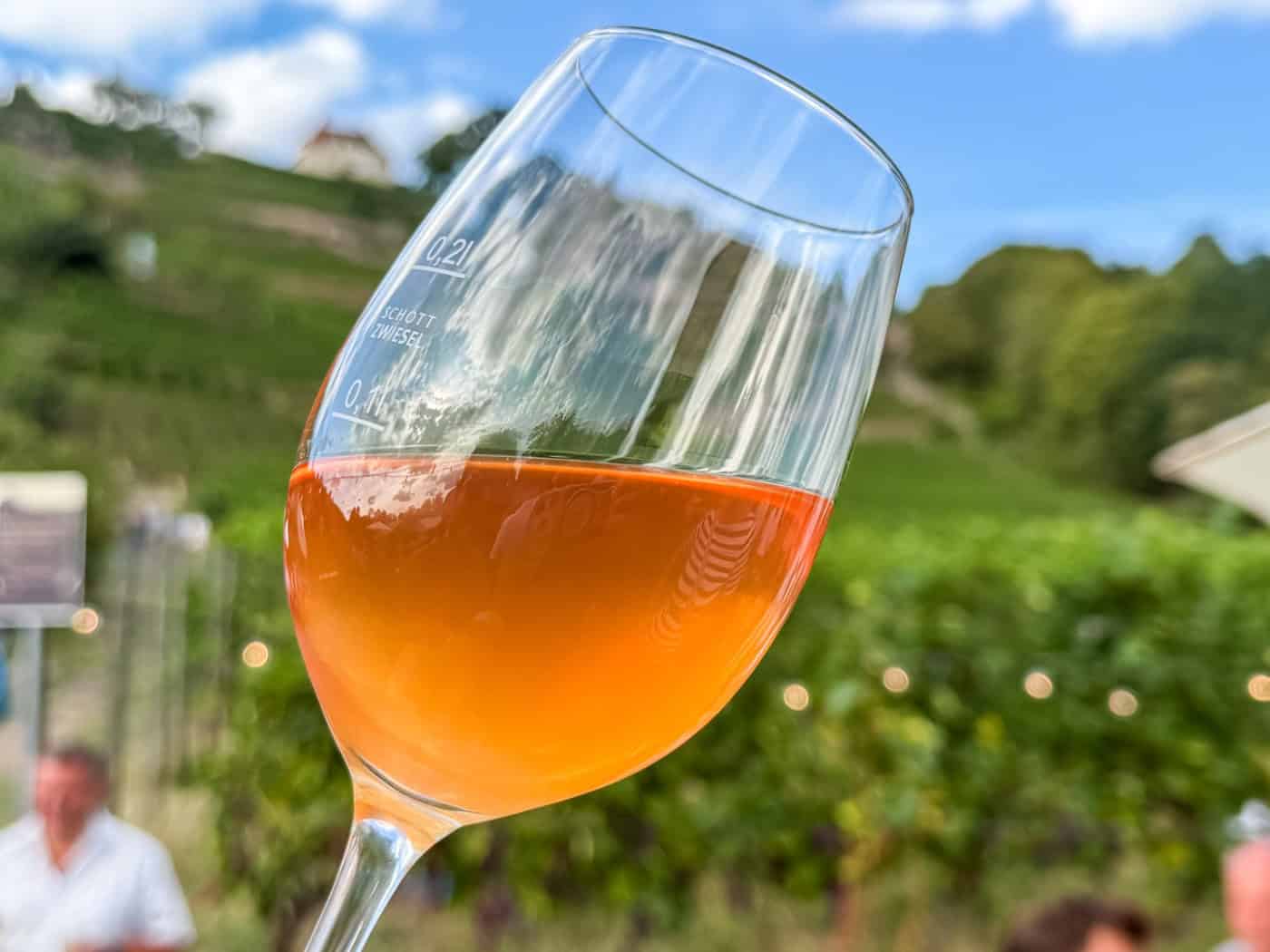
The Drei Herren Winery also benefits from its location right at the foot of the Hermannsberg. You sit (or stand) practically in the vineyards and, with a skillful selection, drink what was grown just a few meters away and—if you happen to be standing in the right spot—pressed right beneath your feet in the modern cellar. For me, however, that wasn’t a deciding factor, because in my political wine-tasting tour, I was still missing a wine for the left. A simple red wouldn’t have been appropriate here; it had to be a bit more complex. So it worked out quite well that the Drei Herren also offer an orange wine. The interesting color comes from the production process: just as the red in red wines comes from the grape skins, color also comes into play when white wine grapes are crushed—depending on the variety, even a very sparkling orange. That said, the fresh fruitiness one expects from clear white wines isn’t part of the flavor profile of orange wines, and when they’re bottled unfiltered, the wine in the glass can sometimes look quite naturally cloudy. But: the world needs new ideas! And in that case, a well-made orange wine is definitely welcome…

