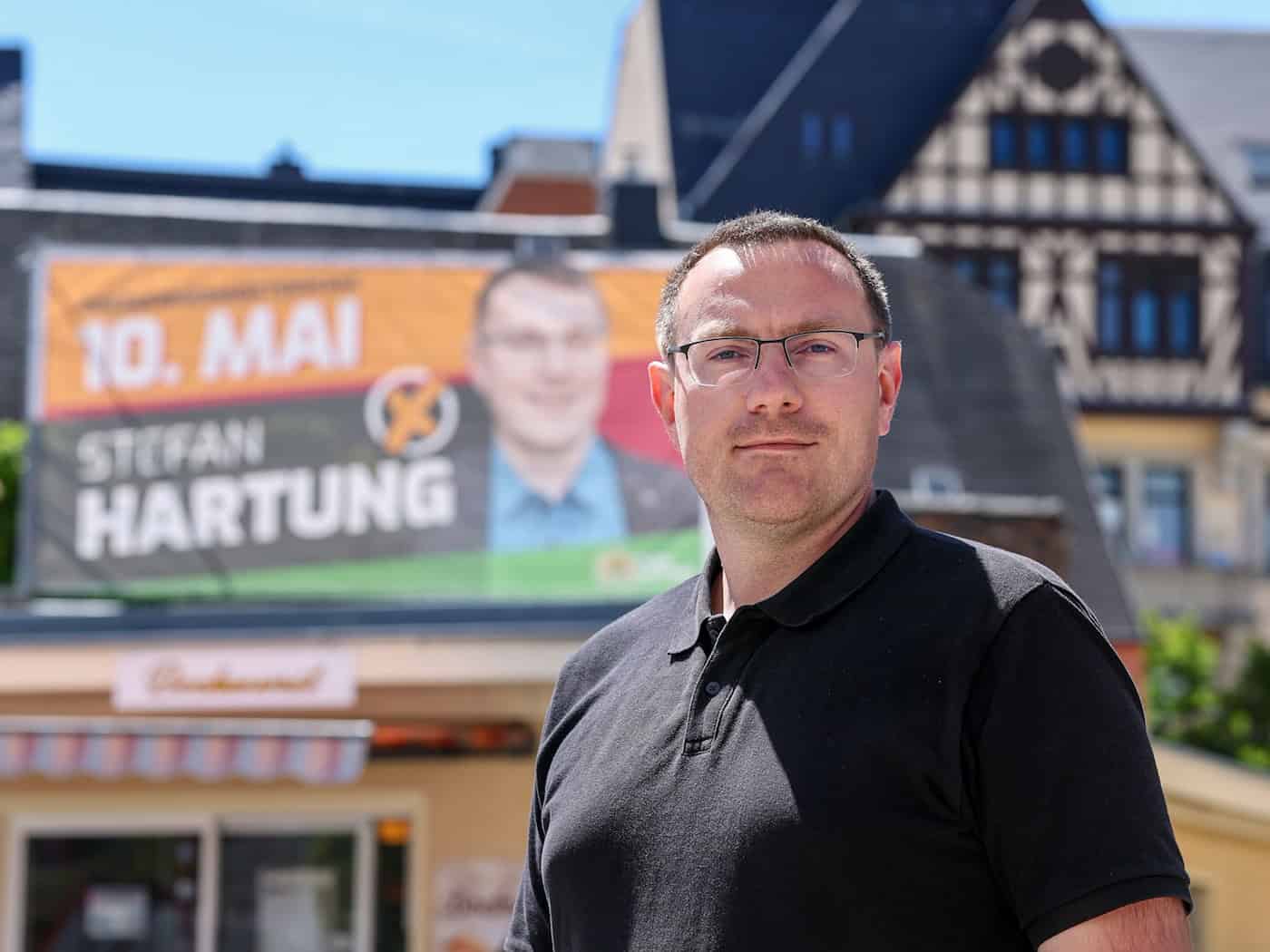
Whoever comes to Aue-Bad Schlema these days will come across a flood of posters from the far-right "Free Saxons". Their state deputy, Stefan Hartung, is hoping to soon sit in the executive chair of the town hall there - and is omnipresent with his advertising. The 37-year-old not only outperformed the AfD candidate in the first round of the mayoral election, but also received the most votes overall. Now it's time for a duel with CDU candidate Marcus Hoffmann this Sunday. Can he stop Hartung or will a right-wing extremist soon be in charge of the town hall? "The danger is there," says political scientist Benjamin Höhne from Chemnitz University of Technology. He is certain: "There is now maximum mobilization in the far-right spectrum and adjacent milieus." In the first round, 29.0 percent voted for Hartung and 18.5 percent for the AfD candidate. Together, this brings the 50 percent mark within reach. The outcome will probably also depend on the voter turnout. The fact that candidates from the Saxon AfD, which has been classified by the Office for the Protection of the Constitution as definitely right-wing extremist, achieve remarkable results in elections is nothing new. Höhne sees the fact that the AfD candidate in Aue-Bad Schlema was overtaken even further to the far right as a warning signal. "This clearly shows the direction in which the political situation in eastern Germany could develop," says the expert. "The voting behavior of many people is no longer evidence of protest, but of entrenched far-right attitudes and convictions." Hartung is an IT entrepreneur and was an official of the NPD - now known as "Die Heimat" - for many years. He is not only active in the city council and district council, but also repeatedly organizes public protests - such as torchlight marches against a shelter for asylum seekers in Schneeberg. In 2021, he co-founded "Free Saxony", of which he is deputy leader. According to the Office for the Protection of the Constitution, this is a "group organized as a party of neo-national socialists, Die Heimat functionaries and other scene members or sympathizers". Although the "Free Saxons" do not have a large organization, according to the most recently published report for 2024, they are largely responsible for the fact that "most right-wing extremist events took place in Saxony in Germany in the reporting year". This is because they are able to mobilize many supporters via platforms such as Telegram. This was particularly evident during protests against coronavirus protection measures. Politically, the party is calling for more autonomy for Saxony, including a "Säxit" if necessary - in reference to the UK's exit from the EU, known as Brexit. Saxony is understood not only in its current borders, but also in those of the former kingdom. As a city councillor, he has only been able to exert limited influence so far, says Hartung. For the interview, he suggested a snack bar in the city center with his likeness emblazoned on it. "I want to finally take the reins of action myself." There is a high density of asylum seekers in Aue, he complains. This has caused problems in the city center in the past. When asked, he cannot say how high the proportion of foreigners is. "Everyone who comes here to work is welcome," says Hartung. In his opinion, however, immigrants who do not work should not receive social benefits. "I don't want Aue-Bad Schlema to become a multicultural melting pot." He refers to the controversial cityscape statement by Federal Chancellor Friedrich Merz (CDU). "That is very true in Aue." In his election manifesto, Hartung also promises low parental contributions for kindergartens, the relocation of doctors and a reduction in administrative staff. He wants to cut out "old habits" in the town hall. The city with a population of 19,000 was previously in CDU hands. Mayor Heinrich Kohl, born in 1956, has been the mayor of Aue since 1999; in 2019, he also won the election following the merger with the neighboring spa town of Bad Schlema. He is now retiring due to his age. The Christian Democrats have put Marcus Hoffmann in the running. The 41-year-old works in the town's building department. Just under one in four voters (23.6 percent) voted for him in the first round of voting. What can he do to counter Hartung and the "Free Saxons"? "My main concern is that people see the potential in the city that I see," he says. He has just dismantled his campaign stand in Bad Schlema's spa gardens. The park is currently being spruced up and is expected to attract up to 400,000 visitors to the State Garden Show in 2027. The focus is often on problems and the positive aspects and achievements are overlooked, Hoffmann regrets. "We need to create a positive dynamic again." He fears that companies that want to be cosmopolitan will avoid the city and the region in future if a right-wing extremist is in charge of the town hall. This also applies to tourists in the Ore Mountains, which are a UNESCO World Heritage Site as a mining region. "Not everyone who votes for Stefan Hartung is right-wing extremist," says the 41-year-old. But there was a lot of disinformation during the election campaign. He also wants to modernize the city administration. "We can speed up processes and digitalize more." However, there still needs to be a point of contact for citizens. The CDU man predicts that the election result on Sunday will be close. For political scientist Höhne, the situation in Aue-Bad Schlema is the rule rather than the exception. "Right-wing extremism and right-wing populism are a challenge for Germany as a whole," he clarifies. It's just that they are already more apparent in eastern German regions. "The developments we are seeing in the East will probably also occur in the West with a delay." This can already be seen in the growing voter support for the AfD in elections in the old federal states as well. Copyright 2026, dpa (www.dpa.de). All rights reservedWho are the "Free Saxons"?
This is what Hartung himself says - and refers to the "cityscape" debate
CDU candidate focuses on positive aspects - is that enough?
Expert: shift to the right also delayed in the west