Logo Die Sachsen News
News / Culture

Marble for the people: Palace of the Republic opened 50 years ago

Marble for the people: Palace of the Republic opened 50 years ago
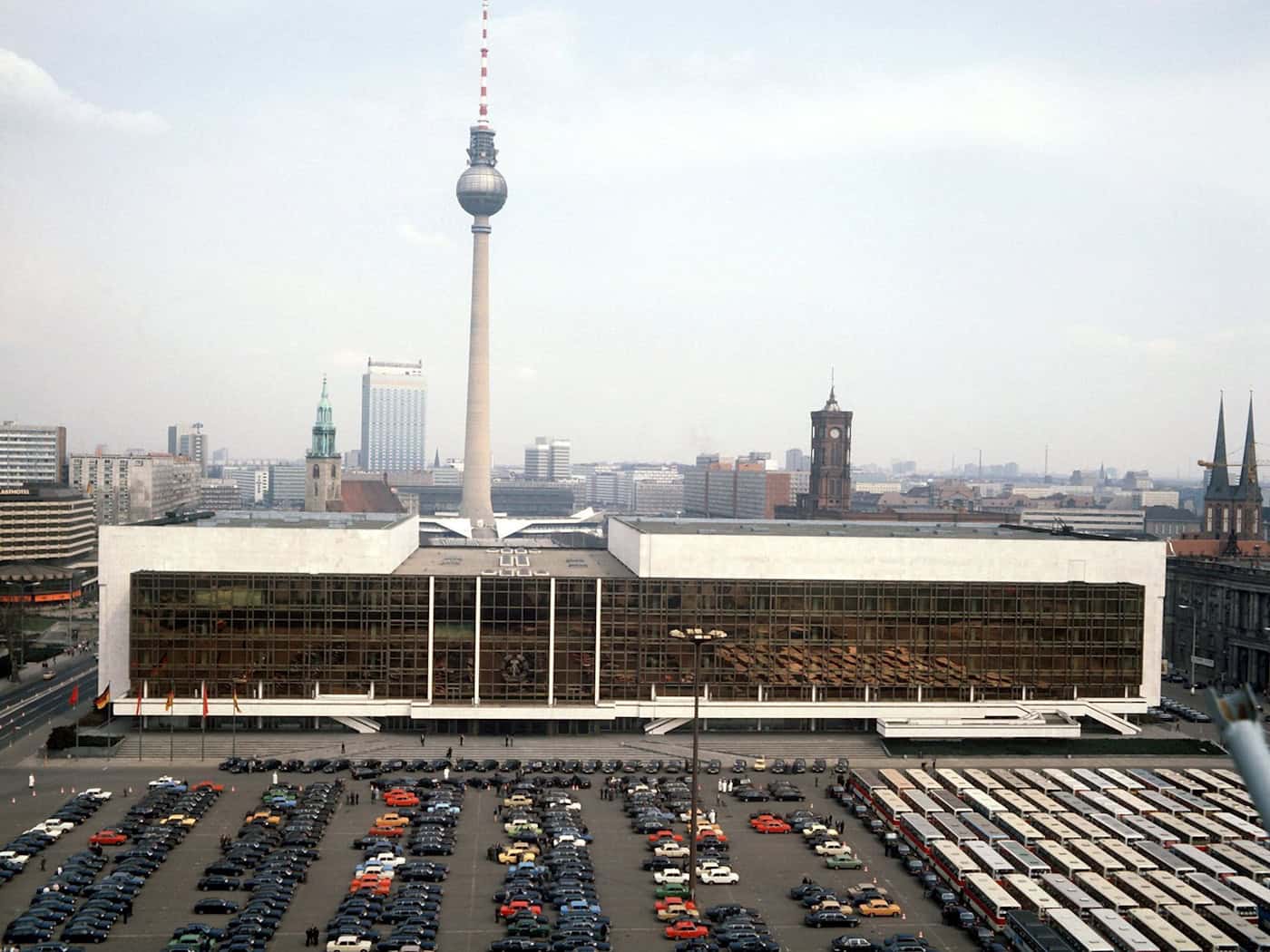
The Palace of the Republic in East Berlin was open from 1976 to 1989. (Archive photo) / Photo: dpa/dpa
From: DieSachsen News
From prestige to demolition project: how the Palace of the Republic, which opened 50 years ago in Berlin, shaped the attitude to life of many GDR citizens. And why it is still remembered today.

Many GDR citizens can no longer cease to be amazed. Marble floors, comfortable seating areas, plant arrangements, large paintings on the walls and a five-metre-high glass flower in the middle - they wandered through the brand new Palace of the Republic in East Berlin in April 1976 with curiosity, almost disbelief. Their gaze is also directed upwards, where a sea of almost 10,000 spherical lamps is illuminating the huge foyer - the inspiration for the name "Erich's Lamp Shop", which soon became popular.

The palace, whose striking, copper-brown reflective façade made of Belgian thermal glass quickly dominated the cityscape, was a prestige project of SED and State Council Chairman Erich Honecker. The remains of the Hohenzollern City Palace had already been blown up in 1950. In its place, thousands of workers built the palace in just 32 months - a kind of people's house for meetings, culture, entertainment, food and drink.

The costs were immense, but unlike other GDR construction sites, there was no shortage of materials. "There's no doubt that the workers and engineers put a lot of effort into this building. The workmanship is neat and decent," enthused a West German television correspondent at the time.

More from this category

"Manhattan" for 3.55 marks

And the people gratefully accepted the palace. After the opening on April 23, 1976, which was reserved for political celebrities and the builders, visitors flocked in. There is a bowling alley and theater, as well as a large concert and event hall and a disco with a rotating dance floor. There is also space for art and 13 catering establishments. These include restaurants and the well-stocked foyer bar, where a "Manhattan" costs 3.55 marks. Ice cream sundaes are flambéed in the chic milk bar with a view of the Spree.

Whoever lives in the former capital of the GDR or comes to visit - the palace is a fixed destination. Concerts with the crème de la crème of GDR music and performances by Western stars such as Tangerine Dream and Carlos Santana are popular. Panic musician Udo Lindenberg ("Sonderzug nach Pankow") was allowed to perform at a concert for peace in 1983 - in front of a select audience. The GDR People's Chamber and the SED jubilee party conferences also met in the palace.

"The palace was used to stage a kind of socialist affluent society; people could leave their everyday problems behind," says historian and GDR researcher Stefan Wolle. Even the telephone booths always worked - not a matter of course in the GDR. "The SED's goal of demonstrating the unity of the people and the party was achieved back then."

Dying in installments

In 1989/90, the Palast der Republik became a place of history before its death in installments was heralded. On the 40th anniversary of the GDR on October 7, 1989, Honecker and his guests toasted with champagne at a ceremony inside, while demonstrators outside demanded freedom and reforms in the face of the People's Police and Stasi.

At the first and last free election in the GDR on 18 March 1990, the palace became a media center, with TV stations from all over the world reporting. The new People's Chamber was tasked with abolishing itself and paving the way for reunification. On August 23, 1990, it decides in the palace that the GDR will join the Federal Republic with effect from October 3. The GDR coat of arms on the façade and in the plenary chamber had long since been dismantled.

Asbestos in the Marble Palace

The People's Chamber meeting planned for September 19, 1990 no longer took place in the Palace: The GDR Council of Ministers ordered the entire building to be closed due to asbestos contamination. More than 700 tons had been used to encase the steel beams during construction for fire safety reasons. "When the palace was closed, it was clear to me that it would be demolished," recalls waiter Roland Pröh in the RBB documentary "Palast der Republik - Honeckers Traum aus Marmor und Asbest", which Das Erste is broadcasting on Monday (April 20) at 11.50 pm.

This is exactly what happens: After a long back and forth, after asbestos removal, as a result of which only a kind of shell remains, after art projects, protests and discussions about alternatives, the Bundestag decides in 2002 to demolish the palace and reconstruct the City Palace.

Although the palace was only open for 14 years, 4 months and 27 days, many people still associate it with personal memories - perhaps mixed with a dash of nostalgia for the East. "The palace is a symbol of GDR memory, precisely because it has disappeared," says historian Wolle.

Should GDR testimony be removed?

To this day, the theory persists that asbestos was not the real reason for the demolition, but rather that the intention was to erase a piece of GDR history. "That's nonsense," says Berlin's former governing mayor Eberhard Diepgen (CDU). The decisive factor was the high level of asbestos contamination. Keeping the Palast would have been more expensive than building a new one in its place.

"The fact that the Palast der Republik was heavily contaminated with asbestos is undisputed and was the reason for its closure before reunification," says Hartmut Dorgerloh, General Director of the Humboldt Forum. However, after reunification, the architectural heritage of the GDR did not receive greater public appreciation. The fact that many people identified strongly with the Palace of the Republic was also not recognized and acknowledged.

Dorgerloh's museum, which opened in 2020/2021, brings world history to life in the shell of the palace. Originals from the Palace of the Republic are also on display in various places. These include design objects such as the wayfinding system, a Stasi monitor, a wall relief and other works of art.

Copyright 2026, dpa (www.dpa.de). All rights reserved

The translations are automated with the help of AI. We look forward to your feedback and your help in improving our multilingual service. Write to us at: language@diesachsen.com.
Sachsen News
Article from

Sachsen News

Sachsen News is responsible for the content itself. The platform's code of conduct applies. The platform checks and treats content in accordance with the legal requirements, in particular the NetzDG.

Social Media