

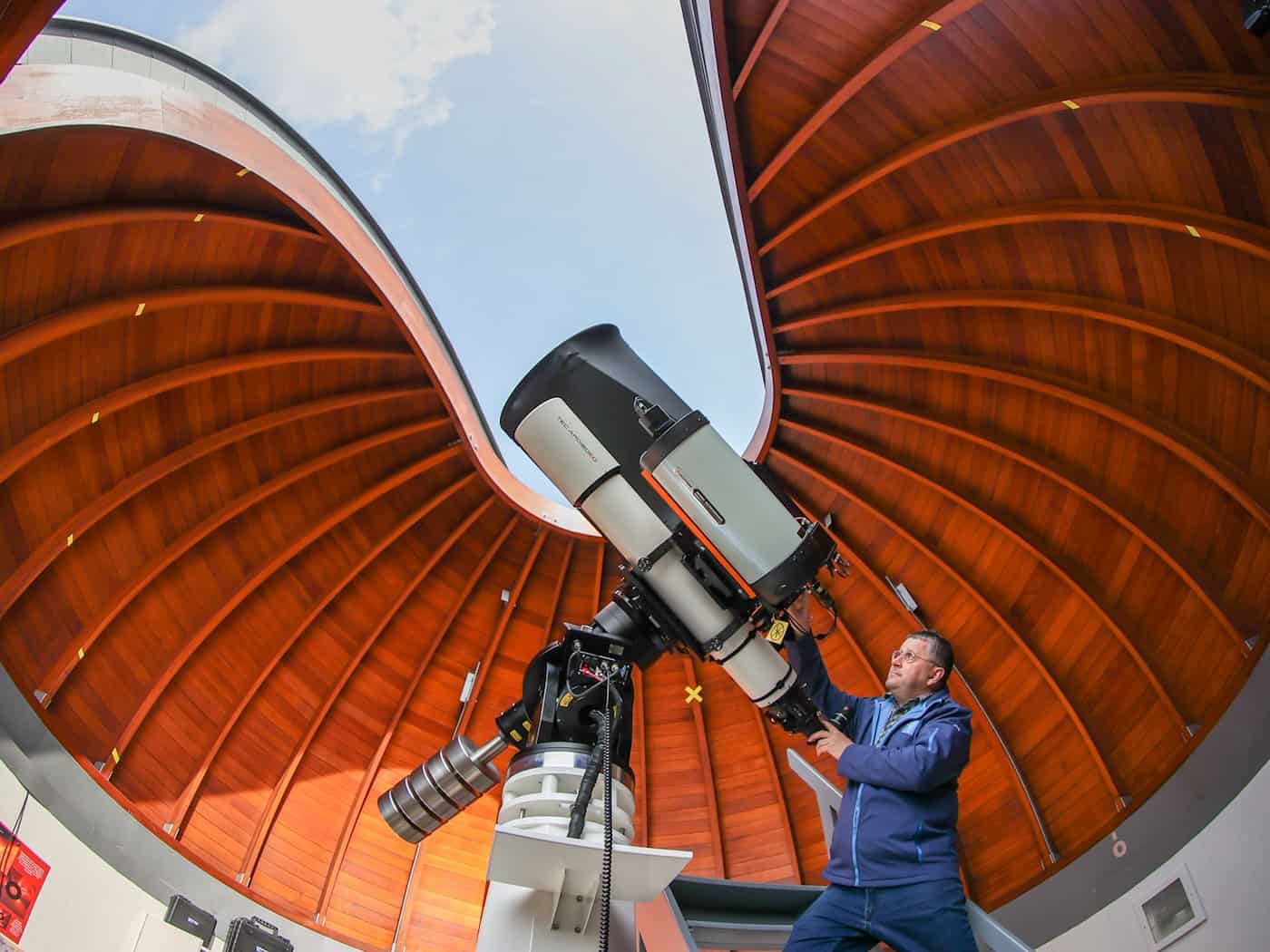
Saxony wants to score more points in space research. The German Center for Astrophysics is being built in Lusatia - and the region is being discussed as a location for the new Einstein telescope. A Saxon satellite called Saxon-1 is also being considered. But what about astronomy in schools? After all, knowledge about the world of stars and planets has not been taught as a separate subject for years. How far is it to the horizon? Very few people know the answer to this question, explains Thomas Weisbach. For the long-time director of the Chemnitz school planetarium, the answer is simple: "We can only see about five kilometers." The math and physics teacher has recently been able to pass on his astronomical knowledge again after the planetarium was closed for almost a year due to a lack of teachers. Knowledge about galaxies, seasons and celestial bodies is spread across different class levels and subjects in Saxony's schools, as Weisbach explains. The subject of astronomy itself has no longer existed since 2007. Astronomy is an integral part of the subjects of physics, geography and profile lessons, emphasizes the Ministry of Education. Places of learning outside of schools, such as observatories, museums or research institutions, make a major contribution to supplementing lessons, according to the ministry. However, the teaching staff situation in the natural sciences remains tight. This also affects the subject of physics, which includes a large proportion of astronomical content. Olaf Graf, for example, is the head of the "Sigmund Jähn" school observatory and planetarium in Rodewisch in the Vogtland region and provides basic astronomical education. Last year, around 12,000 pupils attended 270 events at the municipal facility, with a total of 20,000 visitors. "We are trying to make education about the universe accessible to everyone," says Graf. However, it should not be forgotten that this is a knowledge offering that the municipalities also provide. Employees are municipal employees, including in similar facilities in the region such as Drehbach or Schneeberg. The school classes themselves make a small financial contribution. Despite good capacity utilization, observatories and planetariums often come up against staffing limits, according to Graf. For example, larger school visits require supervision by him and two freelancers. And younger teachers are taught little astronomical knowledge during their training - in physics, for example. This is why they are often grateful for a collaboration with an observatory. "It works quite well in Saxony. We were able to save some of them after the fall of the Berlin Wall and they are in good condition." What is a star or a planet? In which direction does the sun rise? According to Graf, basic astronomical knowledge stands and falls with the parents and the respective school lessons. "Some come to us and know a lot. Others don't." Carsten Drebenstedt from the TU Bergakademie Freiberg is generally positive about basic astronomical education in Saxony. The professor is responsible for the "Space Technologies" course. In Saxony, the natural science STEM subjects are well positioned and many girls also show an interest in them. "The young people who come to us to study have a good basic knowledge of our solar system and already know a lot about how we can obtain information in space." One reason for this could be that there are many places to go in the Free State to learn about the subject, which teachers also like to use. In addition to the observatories, this also includes the German Space Exhibition in Vogtland. Drebenstedt nevertheless assumes that our knowledge of the universe and distant galaxies is still in its infancy. "What we measure today is only a fraction of what is really there." This opens up enormous career prospects for young people and the opportunity to research cutting-edge technologies. In Freiberg, the scientist is hoping for a research center that will focus on the life of humans on alien celestial bodies - including the use of raw materials, energy, electricity and water storage for self-sufficient life support under extreme environmental conditions. The scientist is certain that the findings from this research could also benefit life on Earth. Copyright 2026, dpa (www.dpa.de). All rights reservedObservatories impart astronomical knowledge
Staff shortages at observatories and planetariums too
Astronomy as a career prospect


