

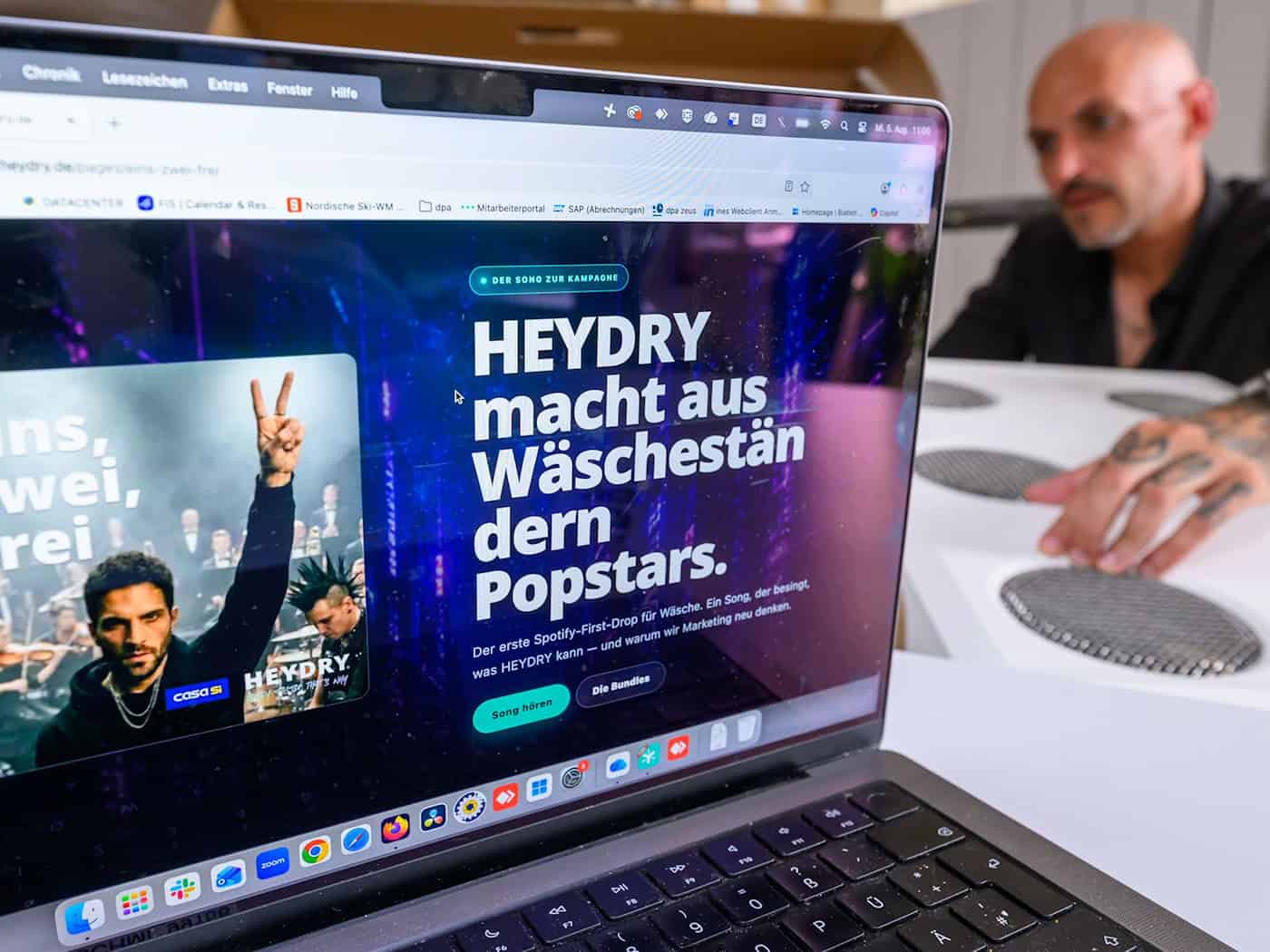
From hip-hop artist to entrepreneur: Marcel Nagler spent a lot of time on tour—not only performing his own music, but also as a manager. That’s when he ran into a common problem. “When we were on the road, my artists’ laundry often didn’t dry fast enough,” he explains. When the concert industry ground to a halt due to the COVID-19 pandemic, he began working with a partner on a solution and founded a company in Mittweida. Their product: an electronic dryer that fits under a standard clothes drying rack. Like a hair dryer, it uses air circulation to dry shirts, pants, and other items faster. But how do you launch an advertising campaign when, as a founder, your budget is tight? Nagler’s answer: artificial intelligence (AI). From planning to implementation—including the music—everything is completely AI-based, he explains. The goal is to market his device as part of a bundle with a clothes drying rack from an Austrian manufacturer. In doing so, Nagler draws on his experience in the music business. Similar to the lead-up to an album release, he has posted several songs along with videos—all AI-generated—on platforms like Spotify. He estimates that the campaign would have cost tens of thousands of euros. “We would never have had that kind of budget.” Experts agree that AI is profoundly transforming work in advertising and communications. Artificial intelligence will also fundamentally change marketing, according to a study published by the consulting firm Boston Consulting Group in late 2025. “However, most companies are currently far from realizing the full potential in this field.” At the same time, it is predicted that the share of marketing work handled by agencies will decline significantly in the coming years—in favor of technologies and AI-powered systems. The German Advertising Industry Association (ZAW) compares AI in a paper compares AI to the development of the steam engine. It fundamentally changes the way “we think about and design communication, as well as the meaning of communication,” the report states. “From the first creative impulse to the final execution of campaigns and how they’re received by consumers—AI permeates and transforms every aspect of our work and reality.” For the communications industry, this essentially means reinventing its operating system. With AI, the number of tools available to the advertising industry has increased significantly, explains Joerg Fieback, one of the managing directors of the Zebra agency in Chemnitz. With 120 employees, it is one of the largest owner-managed advertising and communications agencies in eastern Germany. Clients include the health insurance provider AOK, the energy company EnviaM, and the food company Kathi. Zebra also relies on AI—for example, in the Christmas film “The Stollen Fantasy—The Magic of a Saxon Christmas” for the “So geht sächsisch” campaign. Traditional figures from the Erzgebirge region’s arts and crafts were photographed in real life and then brought to life using AI. Without AI, this would have required a complex studio production, explains Fieback. He speaks of a democratization of creative tools through AI. However, the expert does not believe that AI will completely replace people in advertising campaigns. “We will always need people to provide the special idea, the spark of inspiration.” He is convinced that anyone who relies entirely on AI in marketing will always achieve only mediocrity and the ordinary. “And it’s also about authenticity.” Studies have shown that many people do not consider images generated purely by AI to be authentic. This also affects the credibility of advertising messages. “In a world where deepfakes, avatars, and chatbots are becoming increasingly common, more people are longing for real people.” Against this backdrop, some large companies are evidently making a conscious effort to take a more artisanal approach to advertising their products. Fieback points, for example, to Apple’s 2025 Christmas ad. Instead of AI, the U.S. company uses handcrafted animal puppets to showcase the capabilities of its smartphone camera. And in the clips for the Chinese car model Omoda 7, the vehicle’s features are showcased and staged in a visually striking way—without animated effects—using real elements such as thousands of flowers, countless cats, or large amounts of water. Marcel Nagler has tailored his AI-generated ads to different target audiences—each with its own cast of characters. He used various AI programs—even pitting them against one another. The 42-year-old says they don’t even try to hide the fact that artificial intelligence—not humans—is behind it all. “You can tell it’s AI, and that’s exactly how we want it to sound.” He estimates that it will take the next few months to see how well the commercials catch on. That’s because sales of clothes dryers typically slow down in the summer. In 2024, the company TOSA Home Appliances launched the “Heydry” on the market. According to the company, more than 1,500 units have been sold so far—not only in Germany but also in other European countries. Copyright 2026, dpa (www.dpa.de). All rights reservedAdvertising on a Tight Budget
AI Is Fundamentally Changing the Advertising Industry
Is the credibility of advertising messages suffering?
“You can tell it’s AI”


