

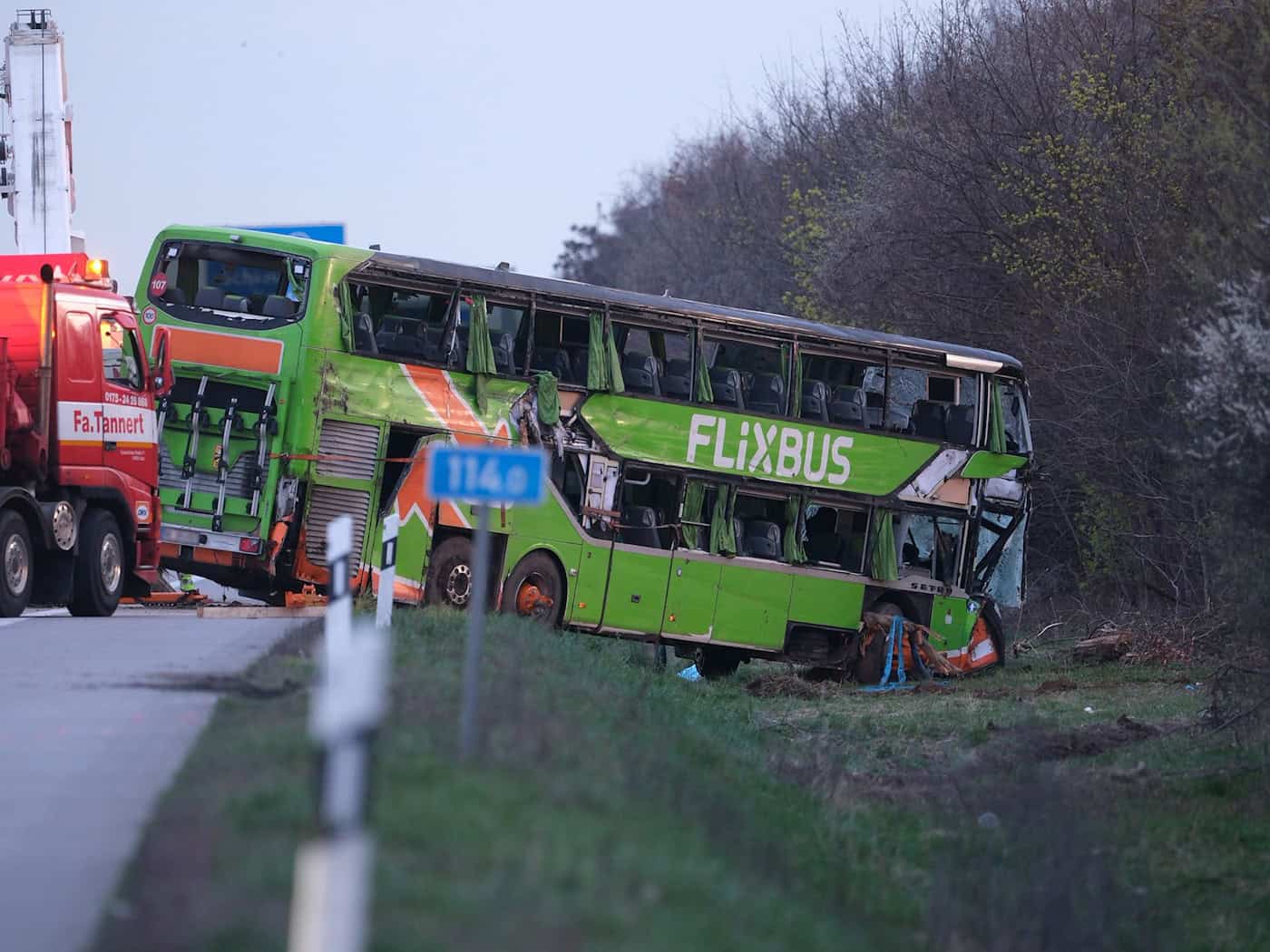
It was one of the worst bus accidents in recent years: four women died in an accident involving a Flixbus on the Autobahn 9 near Leipzig, 46 other passengers were injured, some of them seriously. The criminal trial against the bus driver is now pending in Leipzig. At around 08:00 on March 27, 2024, a double-decker bus sets off from Berlin to Zurich. There are 54 people on board, including two bus drivers. The driver loses control of the Flixbus on the A9 near Leipzig. The vehicle plows about 100 meters over the grass verge, rolls down bushes and small trees and finally crashes onto its side. Several helicopters landed on the highway and ambulances raced to the scene of the accident between the Wiedemar junction and the Schkeuditzer Kreuz junction. It took three hours before the crashed vehicle could be righted with the help of belts and the dead and injured could be removed from the interior. Mobile screens shielded the operation. Hospitals in the area had prepared for a large-scale operation to admit patients. A good two years later, the criminal trial against one of the two bus drivers begins this Friday (March 13). He has been charged with four counts of involuntary manslaughter and 46 counts of involuntary bodily harm at the Eilenburg district court. The public prosecutor's office stated that the then 62-year-old driver lost control of the bus at almost 100 km/h. It assumes that the man failed to exercise the "care required in traffic" and thus caused the accident. The driver was not under the influence of alcohol, drugs or medication. According to the expert opinion, the bus also had no technical defects. According to the bus company, the driver had been at the wheel since leaving Berlin at 8 a.m. and had complied with all driving and rest times. The trial will not take place in the small town of Eilenburg in northern Saxony, but at Leipzig District Court due to the larger venue. Only one trial day has been scheduled, so a verdict is expected on Friday. The court has summoned two witnesses and an expert witness. The defendant's lawyer did not wish to comment on the allegations before the hearing. The serious accident has also reignited the discussion about the seatbelt requirement in coaches. In Germany, seat belts have been compulsory in coaches since October 1, 1999. Within the EU, it has been in force since May 2006. Coaches that were registered before this date and do not have seat belts do not have to be retrofitted. This means that anyone who cannot find a seatbelt on a coach does not have to wear one. However, if they do exist, they must be used. It is permitted to take off the seat belts for a short time. You can go to the bus toilet, get a drink or get some new reading material from the luggage compartment. Scheduled buses and school buses are exempt from the seatbelt requirement. Bus drivers are obliged to inform passengers of the seatbelt requirement at the start of the journey. However, according to the Association of Central German Bus Companies, this is difficult to enforce. Drivers do point this out at the start of the journey and after breaks, and there are signs at the seats, said association head Mario König. However, it is simply not feasible for bus drivers to carry out checks. A spokesperson for the Dresden police also emphasized that it is more difficult to catch those who refuse to wear a seatbelt on the bus. Checks are usually carried out on sight as the bus passes by. Technical possibilities are also limited. A sensor for unbuckled seat belts, as is often installed in modern cars, would theoretically be possible, but would raise the alarm every time a passenger went to the toilet. Therefore, this technology, as in airplanes, is not practical. Copyright 2026, dpa (www.dpa.de). All rights reservedWhat happened
What is the driver accused of?
How is the seatbelt requirement in coaches regulated?
How is the seatbelt requirement checked on coaches?


