

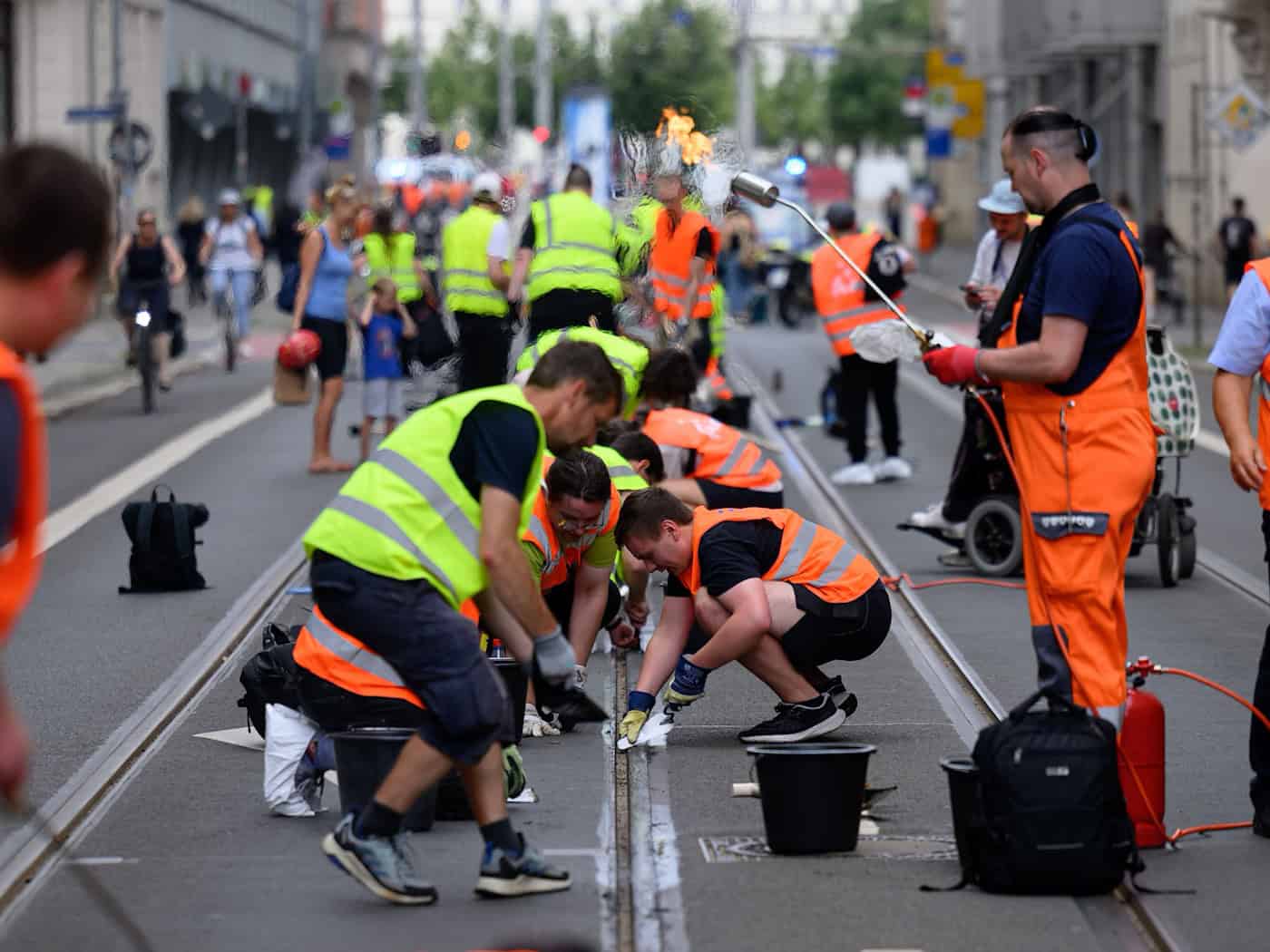
Armed with shovels, painters' putty knives, and knee pads: Several dozen Leipzig residents have helped repair the heat damage to the city’s many tram tracks. Tram service in the city has been virtually paralyzed for days. The public transit authority (LVB) had asked the public for help. “Leipzig sticks together. Now we need you,” the LVB had written on its Facebook page. Well over 50 men and women showed up to scrape the melted material that had oozed out of the joints off the tracks. “I don’t have a car, I rely on public transit, and I want Line 15 to be running again soon,” says Stefan from Leipzig-Grünau. He’s been standing by the tracks for half an hour before the agreed-upon time, scraping the rails clean with a standard painter’s putty knife. He quickly realizes it’s a Sisyphean task: despite his best efforts, he’s barely managing to push the tough, black mass off the rails. According to the LVB, the extreme heat—with temperatures around 40 degrees—had caused the joint compound used in asphalt and concrete to soften in many places throughout the tram network. “The trams then pushed the material out and spread it across the tracks with their wheels, forcing it into the switches,” explains Stefan Röll, head of infrastructure at LVB. For safety reasons, tram service was initially suspended entirely. The bitumen layer on the tracks is up to five millimeters thick. Röll estimates that about ten percent of the roughly 304-kilometer-long track network is affected. In addition, around 60 railcars that became stuck together will need to be cleaned. According to LVB, around 50 employees have been working around the clock since the weekend. Employees from other departments—such as the municipal utilities and waterworks—are also helping with the physically demanding work. But the damage is immense and unprecedented, so there is still no proven method for removing the debris from the tracks. It’s like a testing ground, explains Peter Albiez of the Leipzig-based company Top Car. Normally, he’s called in when an oil spill needs to be cleaned up after a traffic accident. “Here, we now have to experiment to see what works best.” They’re using sandblasting and freezing air, as well as industrial high-pressure washers that are 20 times more powerful than conventional garden tools. However, they must be careful not to damage the tracks or the sensitive switches. “We also sought advice from experts who clean runway surfaces at airports to remove abrasion from aircraft,” says Albiez. The volunteers receive scrapers, safety vests, and knee pads from the LVB, grab a shovel, and—after a brief briefing—head to a specific section of the road. The police cordon off the area. The scraping tools are heated with blowtorches. The volunteers then scrape the material off the tracks. In particularly stubborn spots, they get down on their knees, scrape the bitumen out of the cracks, and toss it into buckets. This is extremely hard and tedious work—and after a few minutes, they’ve only made a few centimeters of progress. “We’ve seen how much damage has been done and want the trams to be running again soon,” say the two students, Vinzenta and Anna. “Doing things together is what a society should be about: Yesterday we watched soccer together, and today we’re just helping out here together,” the volunteers emphasize. “The investigation into the cause is ongoing, and we’ve commissioned an external expert report,” says LVB spokesperson Marc Backhaus. However, it will still take some time before the first results are available. It is undisputed that the unusual heat melted the bitumen. Most cities with streetcars in Germany did not experience this problem last weekend. But in Nuremberg, streetcars are currently not running for the same reason as in Leipzig. But what was different in the two cities? “Based on an initial analysis, we found that temperatures just above the tracks in Leipzig and Nuremberg were about five degrees higher than in other cities,” explains Röll. However, a final assessment is still pending. Patience is required. On Monday, the first line resumed service, followed by another on Tuesday. However, both are operating on shortened routes and are bypassing the particularly badly damaged section of the inner-city ring. It may still take a few days before the regular schedule can resume. Copyright 2026, dpa (www.dpa.de). All rights reservedWhat happened?
How are the transit authorities proceeding now?
What do the volunteers do?
What is the cause, and why were other cities spared?
When will trams start running again in Leipzig?


