

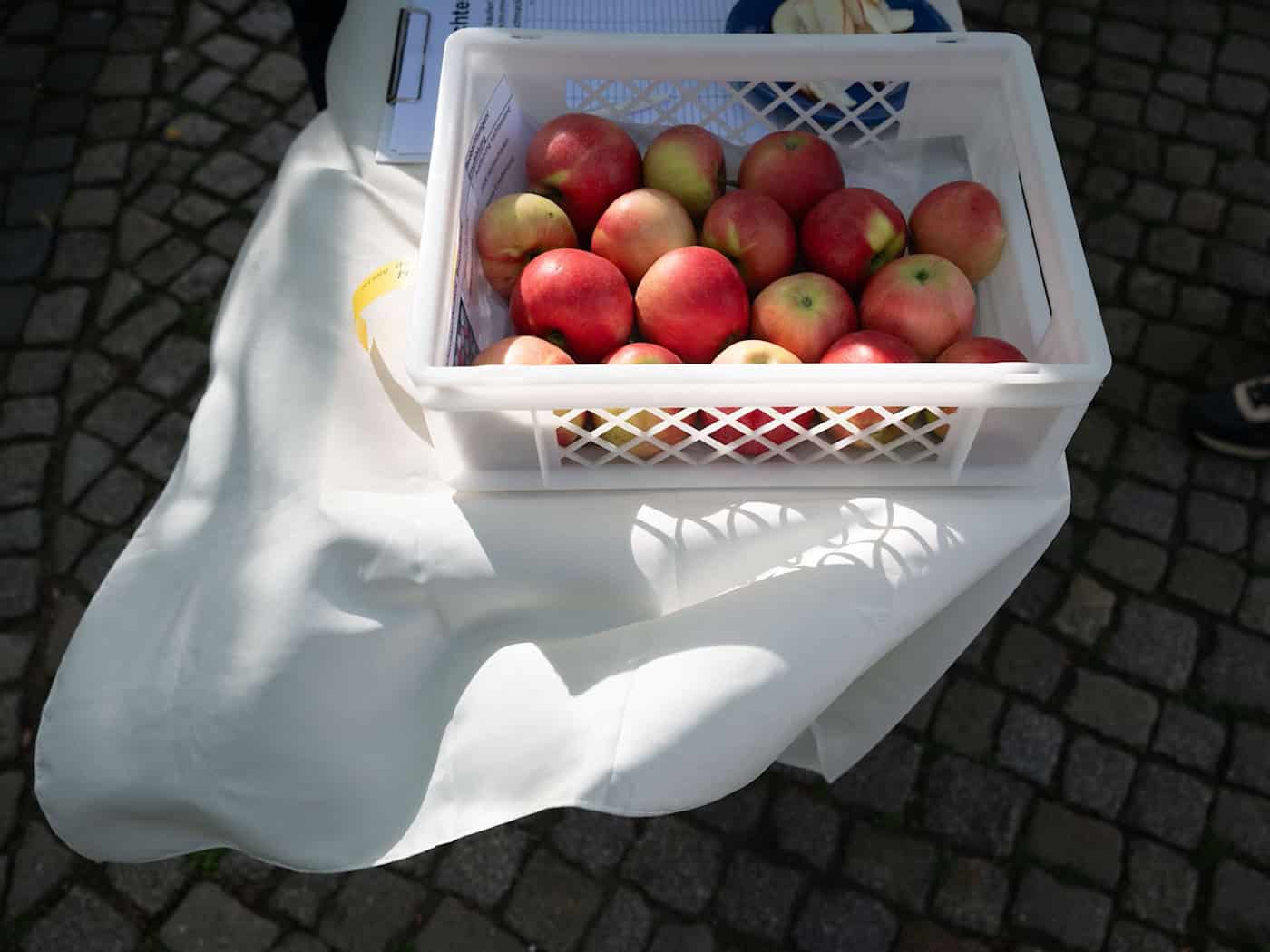
Fruit growers in Saxony expect a smaller apple harvest, though the quality of the produce is expected to be good. According to preliminary estimates, the harvest volume will be around 44,300 metric tons, said Jörg Geithel, head of the Saxony & Saxony-Anhalt. This puts the Saxony harvest 14.7 percent below last year’s yield (51,960 metric tons). He cited a smaller cultivation area, frost and hail, as well as heat and drought as reasons. Added to this is alternate bearing. In fruit growing, this refers to fluctuating fruit yields that occur in a two-year cycle. 2025 was considered a strong year for apples. On Tuesday, Saxony’s Blossom Queen Alida cut into an apple cake at the Golden Rider monument in Dresden, thereby officially opening the apple season. Despite lower yield forecasts, the Fruit Growers’ Association gave the all-clear. There is no cause for concern regarding the availability of apples. There are plenty of delicious, fresh, and high-quality apples. Prices are expected to remain at last year’s level. Saxony is not alone in this trend, officials said. The decline is part of a Europe-wide trend. According to estimates, apple production in the major EU countries is projected to total about 9.5 million metric tons this year—about 16 percent less than last year and thus the smallest EU apple harvest since 2017. Eastern European growing regions have been particularly affected by frosts, droughts, hail, and heat—especially Poland, Europe’s largest apple producer. In Germany, a harvest of about one million metric tons is expected, roughly 11 percent less than in 2025. Geithel also struck a few notes in a minor key—as he put it himself—at the season’s opening. “In the future, we’ll have to live with climate change and extreme weather, and we’ll have to adapt to it.” Domestic production is currently on the decline. Unfortunately, the self-sufficiency rate has fallen in recent years and now stands at only 20 percent for fruit in Germany, though it is still 48.7 percent for apples. It used to be 60 percent. This raises the question of whether German consumers even want domestic fruit anymore. Fruit growers in Germany produce in accordance with the highest quality, environmental, and social standards and have been investing for many years “in biodiversity, in pollinator strips, nesting boxes, flowering landscapes, and modern climate protection measures,” Geithel said. They are part of the food security system, but the operating conditions are becoming more difficult. The association head pointed, among other things, to rising production costs. This creates a competitive disadvantage. “We talk about regionality, sustainability, and security of supply, but we’re increasingly accepting that domestic fruit is being replaced by imported goods.” The Saxony & Saxony-Anhalt Fruit Growers’ Association currently has 65 member farms—four fewer than last year. According to Geithel, this was not due to the economic situation. The owners had closed their businesses due to retirement and were unable to find successors. Fruit is grown on 3,200 hectares across both states, 2,800 of which are in Saxony. Apple cultivation accounts for 1,600 hectares in the Free State of Saxony. Pears are grown on just under 100 hectares. The harvest forecast here is 2,600 metric tons. Copyright 2026, dpa (www.dpa.de). All rights reservedHarvest season officially opened with the cutting of an apple cake
Decline in Production Across Europe
Fruit growers must adapt to climate change
Conditions for fruit production are becoming more difficult


