

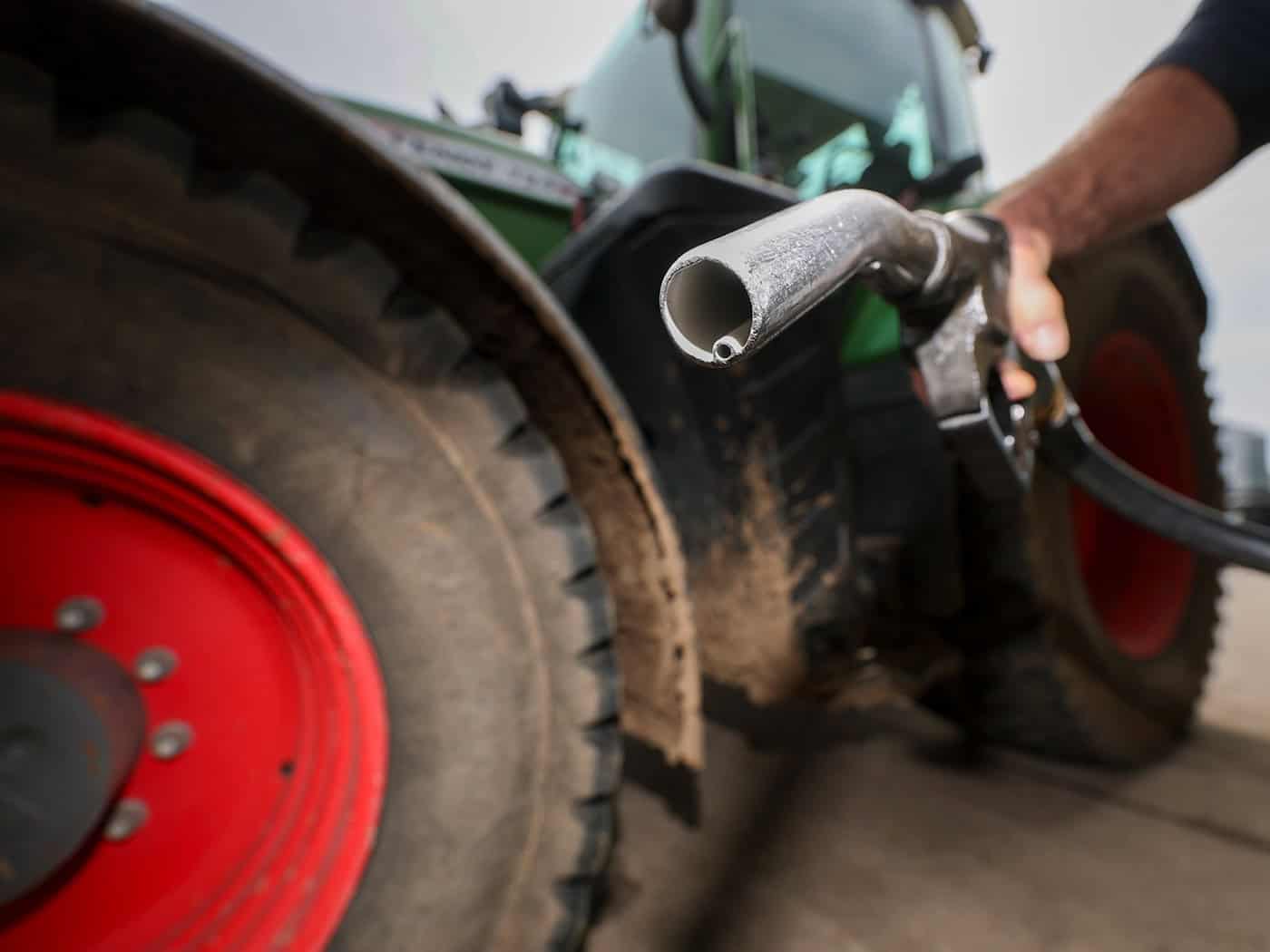
In January 2024, farmer protests escalated across the country. There were not only demonstrations, but also highway blockades and protest bonfires. One trigger was the federal government’s planned cut to the agricultural diesel tax at the time. Current figures from Customs now show that the number of applications was declining significantly at that time. But for farmers, this is not a sign that the tax breaks are not needed. The number of applications for agricultural diesel tax relief has been declining for years. According to current figures from customs, 165,975 applications were filed in the 2021 fiscal year. In the last full marketing year, 2024, there were 136,628 applications. This represents a decline of 18 percent. The figures cannot be broken down by individual federal states. Customs records the applications according to the responsible main customs offices. Each of these covers several federal states. Figures for the 2025 fiscal year are not yet available. No. Farmers’ associations argue that the number of applications alone says little about how important the relief is for farms. The German Farmers’ Association says that the agricultural diesel tax relief remains “a key instrument for ensuring the competitiveness of German agriculture.” Farmers actually see the figures as confirmation of their position: The decline in agricultural diesel rebates is directly attributable to the political decision to phase them out starting in March 2024, said a spokesperson for the Federal Association. As a result, farms will be deprived of approximately 160 million euros in relief in 2024 alone. Farmers’ associations emphasize that this support is particularly important in Germany. “Agriculture relies on mobile machinery,” says Katja Förster, spokesperson for the Thuringia Farmers’ Association. Farms primarily produce at prices determined by international markets. Rising energy prices cannot simply be passed on to customers. The agricultural diesel tax relief thus offsets part of this cost burden and helps limit competitive disadvantages compared to other EU member states. This is because diesel is very expensive in Germany compared to the rest of the EU, according to reports from Saxony-Anhalt. Agricultural diesel is standard commercial diesel fuel used for agricultural and forestry machinery and vehicles. Farms can have part of the energy tax on it reimbursed by the main customs office—the reimbursement amounts to 21.48 cents per liter. This tax break has been in place for more than 70 years. In the wake of the budget crisis and necessary cost-cutting measures, the “traffic light” coalition—comprising the SPD, the Greens, and the FDP—decided to phase out the subsidy: In 2024, the tax relief of 21.48 cents per liter was initially reduced to 12.88 cents, and in 2025 it was further reduced to 6.44 cents. There were to be no more refunds for quantities consumed in 2026. This triggered fierce nationwide protests by farmers starting in December 2023. The new federal government, consisting of the CDU/CSU and the SPD, reversed the abolition: In November 2025, the Bundestag voted to reinstate the full tax break. Since early 2026, the agricultural diesel rebate of 21.48 cents per liter has thus been fully reinstated. Critics argue that making fossil fuels cheaper weakens the incentive to switch to alternative propulsion systems. Environmental protection plays an important role here. Furthermore, the program costs the federal government approximately 430 million euros per year. Large farms, in particular, are affected by high energy prices. Farmers’ Association President Joachim Rukwied explained some time ago: “A large combine harvester needs about 1,000 liters of diesel per day. If a liter now costs 50 cents more than a year ago, that’s an additional 500 euros in costs per day. That’s a huge amount.” There are various reasons for this. It stands to reason that the reduced financial relief in 2024 and 2025 will also affect the number of applications, says Erik Heckt of the Saxony-Anhalt Farmers’ Association. The effort involved in applying has remained the same. The main effort lies less in filling out the application than in keeping invoices and proof of delivery for the diesel and, if necessary, maintaining records of diesel consumption and the machinery used. Furthermore, if information is incorrect or documentation is incomplete, there is a risk that the reimbursement will have to be repaid or that the farm will face further legal action. The financial relief may be minimal, especially for smaller farms. According to the Farmers’ Association, approximately 44 percent of the roughly 3,590 farms in Thuringia operate on a part-time basis. These farms, in particular, have only a small fleet of machinery—or in some cases, none at all. Copyright 2026, dpa (www.dpa.de). All rights reservedHow many farms are applying for the agricultural diesel tax relief?
Does this mean that farmers don’t need the agricultural diesel tax relief at all?
What are diesel reimbursements all about?
Why is the agricultural diesel rebate controversial?
Do the refunds really make that much of a difference for the farms?
So why are fewer and fewer farmers applying for the reimbursement?


