

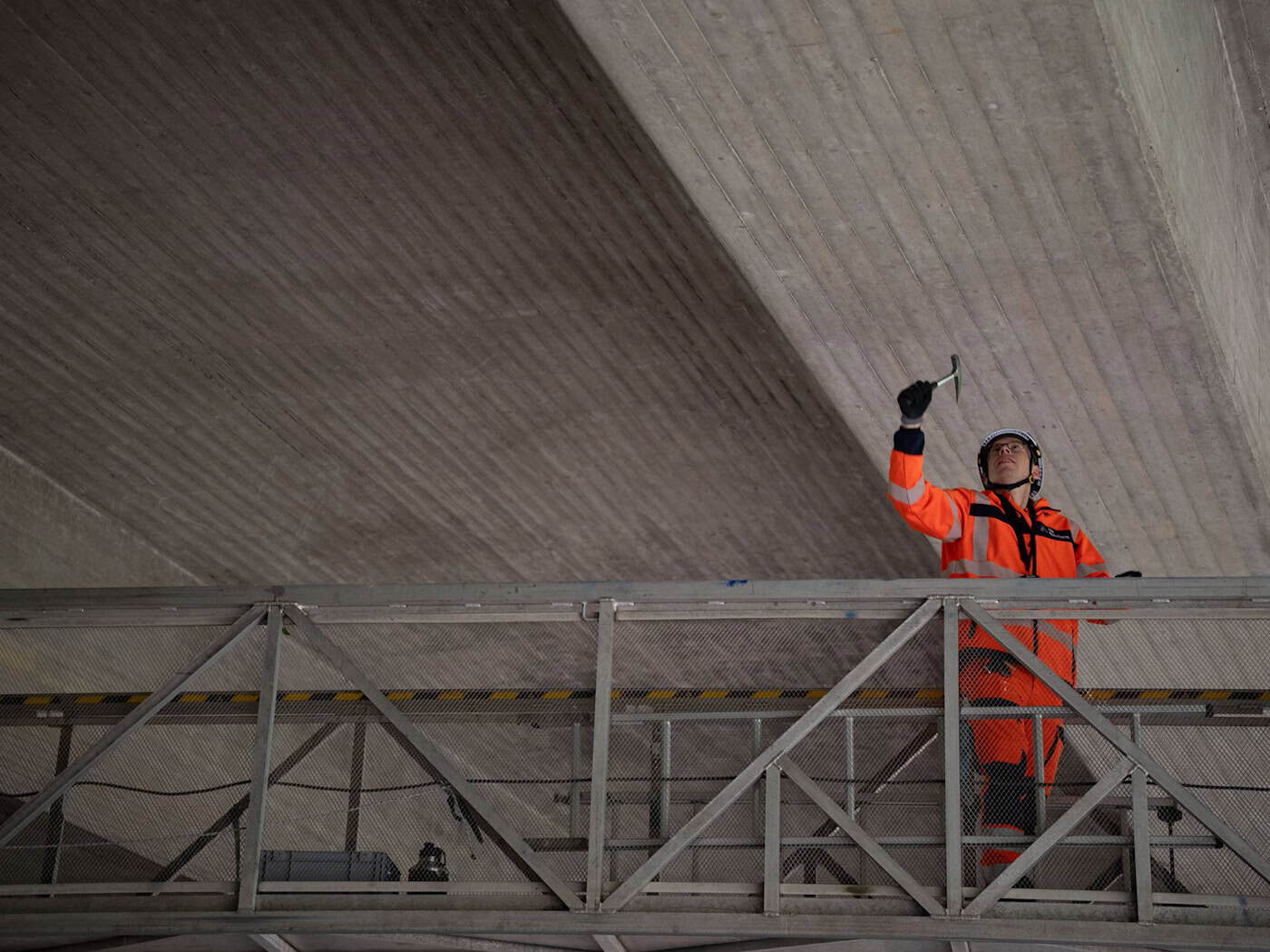
The nearly 3,000 highway bridges in Saxony, Saxony-Anhalt, and Thuringia have to withstand a lot: Between 10,000 and 60,000 vehicles cross these structures every day. To ensure their safety, the Eastern Branch of Autobahn GmbH conducts about 1,000 inspections annually. Because they are relatively new, the bridges in the three states are in good condition, explains Thomas Wirth, head of the Structural Management Department. In the east, most bridges were built in the 1990s and 2000s; there are few older structures. The bridges are inspected every three years, alternating between more detailed major inspections and simpler inspections. This is also the case for the bridge on the A4 near Siebenlehn, which the inspectors are examining on Tuesday. It’s purely a routine inspection, as spokesperson Julia Grotjahn says. “The structure is in good condition.” The prestressed concrete bridge, approximately 30 meters long and 6 meters high, was built in 1996. “It has lasted about a third of its planned lifespan,” adds Wirth. During a major inspection, all components must be “within reach,” explains Wirth. “I have to be able to reach it with my arm and take a look at it.” The cost of a major inspection ranges from about 6,000 to 8,000 euros. It all starts from above. The team inspects the road surface, joints, transition structures, the sidewalks, railings, and safety barriers. They also measure the coating depth. Then it’s on to the substructure. Using a so-called bridge inspection device, the inspectors are lowered from above on a kind of platform to inspect the bridge from below. A hammer, a flashlight, good hearing, and good eyesight—that’s all they need for their work. Using a hammer, the team taps the concrete piece by piece to detect hollow spots. The workers rely on their hearing to do this. “You can tell—if it sounds really solid, then everything’s fine. As soon as there’s a hollow spot, it sounds really dull,” says bridge inspection technician Dirk Bernhauser. “Otherwise, the inspectors examine every square meter closely, looking for cracks, moisture penetration, and spalling,” adds Wirth. “This method has proven itself over the years.” The manual method has proven to be the most reliable. Attempts were made to take images with drones, but those would only provide pictures. “You simply don’t get that auditory feedback,” says the expert. The team needs about two hours to inspect the substructure of the roughly 30-meter-long bridge near Siebenlehn. Overall, the structural inspection is completed within a day. Disruptions for drivers remain minimal. The right lane is closed for the bridge inspection equipment—in one direction in the morning and the other in the afternoon. “We actually want to be gone by the time the evening rush hour starts,” says Wirth. Any damage found is initially monitored. During the inspections, the teams compare the condition to the most recent status report. Intervention is possible if cracks measure about 0.3 millimeters. They are then sealed with resin. “Otherwise, air and moisture can penetrate, and the steel will eventually start to rust,” explains Wirth. As part of the repairs, the rubber layers at the transition to the solid subgrade can also be replaced. In addition, moisture barriers or the roadway surface can be renewed. Since the collapse of the Carolabrücke in Dresden, special attention has been paid to bridges from the GDR era that use Hennigsdorf prestressing steel. This steel is prone to stress corrosion cracking, which was identified as the cause of the collapse in Dresden. There are also about ten such bridges along the highways; for example, several such structures span the A14 near Nossen. Since the collapse in Dresden two years ago, they have been inspected particularly thoroughly. “Instead of every three years as before, we now check annually to see if anything has changed,” says Wirth. “But these bridges aren’t as critical because they have a different design,” the expert emphasizes. Unlike the collapsed Carola Bridge, the tendons were cast directly into the precast concrete sections at the factory. This prevents pre-existing damage caused by moisture in the air during on-site installation. In addition, plates have been installed to distribute the load. “If a precast element were to fail, the load would be distributed to the right and left,” explains Wirth. Nevertheless, two weeks ago, inspectors had to pull the emergency stop on an overpass spanning the A14 near Grimma. “It was in a critical condition,” says the expert. Longitudinal cracks had already been identified previously; during the inspection, these had increased significantly, and the inspectors also found the first transverse cracks. “Within a year, the cracks had widened from 0.5 to 1.5 millimeters—that was already a clear sign that something was happening inside the structure,” reports Bernhauser. It was already clear during the inspection that no traffic could pass over the bridge, which until then had connected the Grimma districts of Grottewitz and Würschwitz. Things moved quickly after that: The bridge was closed immediately. It took only one weekend to demolish the superstructure; the piers will remain standing for the time being. Copyright 2026, dpa (www.dpa.de). All rights reservedComponents must be accessible by hand
A flashlight and keen eyes are essential
Inspection takes one day
Annual Inspections of Bridges from the GDR Era
Bridge Demolition on the A14 Due to Increasing Damage


