


Lusatia and Sardinia are jointly bid for the Einstein Telescope
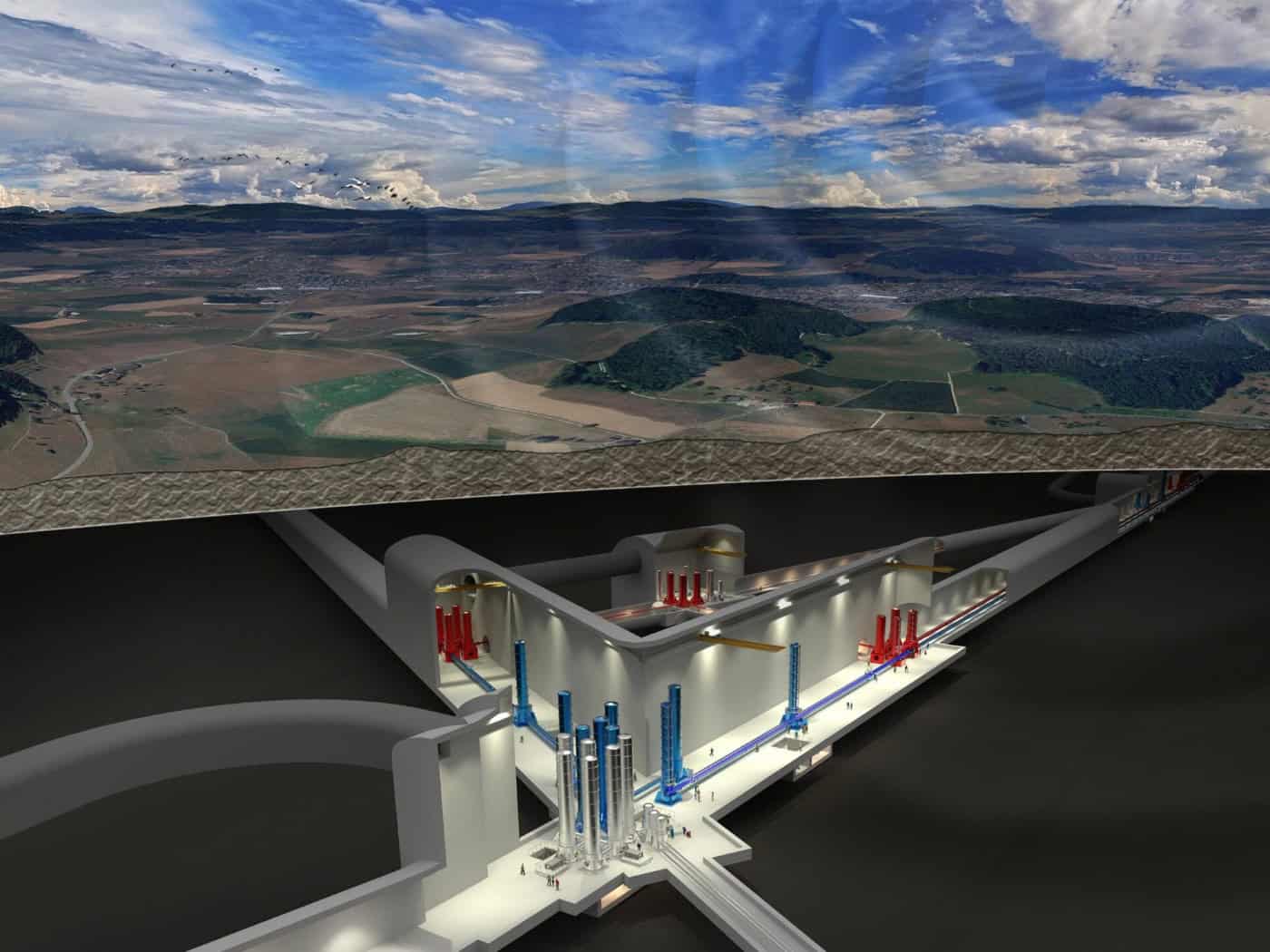
When two black holes collide, they send tiny ripples through the universe. The planned Einstein Telescope could measure such gravitational waves deep underground in the future. Saxony and Sardinia plan to build the research facility together.
German and Italian research institutions have now signed a cooperation agreement in Nuoro, Sardinia. With this agreement, the two candidate regions are reaffirming their joint bid for the Einstein Telescope. Instead of competing separately, they intend to jointly realize this European research infrastructure at two locations.
On the German side, the Technical University of Dresden and the Karlsruhe Institute of Technology (KIT) are leading the collaboration. From Italy, the Istituto Nazionale di Fisica Nucleare (INFN), the Istituto Nazionale di Astrofisica (INAF), and the Istituto Nazionale di Geofisica e Vulcanologia (INGV) are participating.
Two sites, one detector
The Einstein Telescope is to consist of two L-shaped detector arrays, known as the “double-L” configuration. One is to be built in the Lusatia region, the other in Sardinia. Together, they will be able to detect gravitational waves with significantly greater sensitivity than today’s detectors. This will also allow for more precise determination of their origin.
“This is another step forward in our partnership as a site candidate for the realization of the major European project, the Einstein Telescope,” says Saxony’s Minister of Science, Sebastian Gemkow. “The cooperation agreement is an important milestone on Lausitz’s path to becoming a site for the Einstein Telescope,” adds TUD Rector Ursula M. Staudinger.
Joint bid for Europe
Christian Stegmann, scientific co-director of the feasibility study for the Einstein Telescope in Lusatia, emphasizes the even closer cooperation among European partners in the future. “We are convinced that implementing the Einstein Telescope in the form of two L-shaped interferometer detectors creates the best conditions for the project’s success,” says INFN President Antonio Zoccoli.
Local municipalities are also supporting the project. The mayors of Ralbitz-Rosenthal, Nuoro, and Lula were present at the signing ceremony.
The Einstein Telescope is one of Europe’s most important research projects. It is expected to provide new insights into the formation of black holes and neutron stars, as well as into the evolution of the universe. In addition to Lusatia and Sardinia, the Euregio Meuse-Rhine is also bidding to host the project. Europe is expected to decide on the location in the second half of 2027.

