Logo Die Sachsen News
News / Food & Wine

Kretschko's Cosmos Instead of Crisis Mode

Wine Bottles
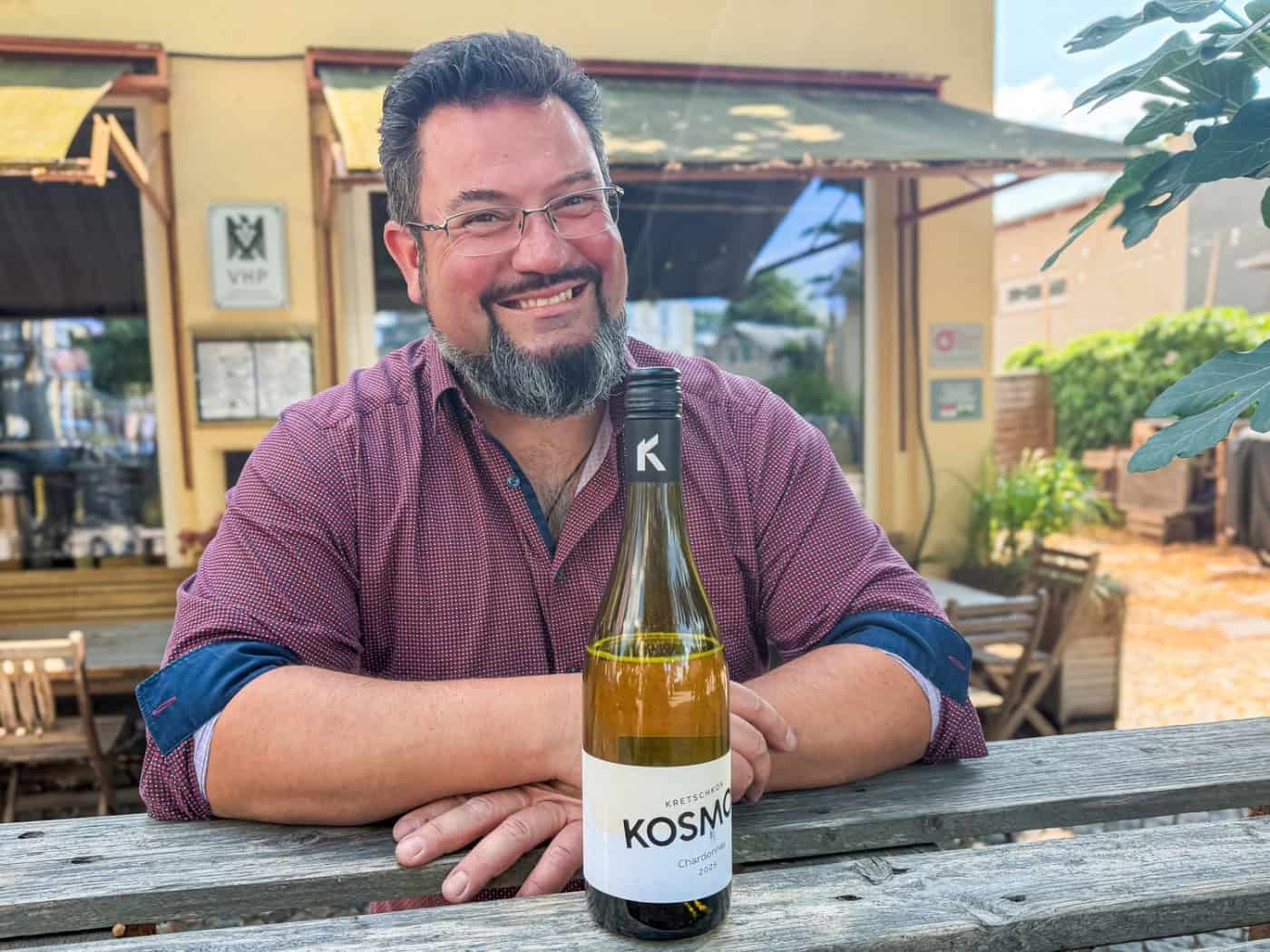
Andreas Kretschko and his Chardonnay from the Kosmos series (Photo: Ulrich van Stipriaan)
From: Ulrich van Stipriaan
Andreas Kretschko is launching “Kretschkos Kosmos,” a new line of wines sourced from external suppliers: to serve the retail market, diversify risk, and provide greater flexibility at the family-owned winery in Saxony.

Saxon winemaker Andreas Kretschko is breaking new ground (once again!)… With “Kretschkos Kosmos,” he has launched a new line of seccos and wines—wines for the food retail sector, wines sourced from other producers. There’s a lot of commotion among some local winemakers, but in times of cheerfully carefree double standards, the “St. Florian principle”—a term familiar from the firefighting world—often applies to winemakers (m/f/d) as well. In the 179th episode of our podcast “Auf ein Glas,” Andreas Kretschkos explains that the decision made in 2024 following the devastating late frosts ultimately means two things to him: risk diversification and thus business security on the one hand—but on the other hand, also more freedom at his own winery, as well as—as a side effect—the opportunity once again to experiment with grape varieties that do not grow in his Saxon vineyards.

The frost-stricken year of 2024 was catastrophic for many Saxon winemakers. In Andreas Kretschko’s vineyards, the result was a harvest loss of around 90 percent. At the same time, Kretschko observed that two of his former classmates—who had since become winemaker friends—in Rheinhessen and the Rheingau were dealing with full cellars and sales problems, even though in normal years Kretschko’s wines were often already sold out by summer. This led to the development of a concept for an independent wine line featuring purchased wines, which is deliberately distinct from the family winery and is intended to cushion economic risks.

More from this category

Some have too little, but most winemakers have too much wine after the harvest. Andreas Kretschko expects a significant decline in vineyard acreage in the coming years and describes the challenges posed by climate change, structural shifts in viticulture, and the difficult situation in Saxony’s steep slopes. A lack of land consolidation, overgrown vineyards, and insufficient mechanization are problems that Saxony must urgently address.

With his new wine line, Kretschkos Kosmos, the winemaker (who owns 2 ha in Saxony) is expanding his portfolio while also responding to the profound changes in the wine market. This also means that one of the six wines in the new line is alcohol-free. Using the dealcoholized Sauvignon Blanc as an example, Kretschko explains why residual sugar, acidity, and aromatics interact differently in these wines and why the production process is technically complex and energy-intensive. He also explains why the quality of the base wine is crucial to the final result. (More on the topic of dealcoholized wines and sparkling wines in this article.)

The other wines in the line—tasted and discussed throughout the podcast!—include a white Secco, a Secco Rosé, a Merlot Rosé, a new grape variety (Cabernet Blanc), and a Chardonnay. All represent a deliberately uncomplicated style with moderate alcohol, clear fruit flavors, and great drinkability. Kretschko explains why well-known grape varieties like Chardonnay or Merlot make it easier for newcomers to get started, why Cabernet Blanc still requires some explanation, and why consistency in the retail market has become more important than ever.

Info

Kretschko’s Kosmos/Kretschko Weinhandels GmbH
Hoflößnitzstraße 60a
01445 Radebeul

Tel. +49 152 33 868 019
kretschkos-kosmos.de

Listen to the podcast

The translations are automated with the help of AI. We look forward to your feedback and your help in improving our multilingual service. Write to us at: language@diesachsen.com.
Ulrich van Stipriaan
Article from

Ulrich van Stipriaan

Ulrich van Stipriaan is responsible for the content itself. The platform's code of conduct applies. The platform checks and treats content in accordance with the legal requirements, in particular the NetzDG.

Social Media