


ElbUferei: A Sweet Treat Warning and a Bold Approach to Umami
Keep your eyes peeled for poster copy! So there I am (by invitation, because Jens Meißner, the new hotel manager at ARCOTEL HafenCity, wanted to introduce himself), walking up the steps to the hotel and reading: “ElbUferei. Every sip a delight. Every plate an experience.” Oh, I think to myself, hopefully it’ll be a positive experience—you never know! Spoiler: By the end of the evening, I left this place feeling more satisfied than on many evenings before. And why? Because the interplay of people, food, and drink was pleasantly unpretentious—but also because I enjoyed the dishes even more than before. And that, in turn, had something to do with courage: the courage to show good taste.
In my opinion, two things make this possible: the reputation that head chef David Schöbel has built up over time—and (once again) an official change in style. Large hotels and their restaurants usually don’t just cook whatever guests like; they have a concept. In 2021, when Marcel Kube took over the kitchen, the focus was on tapas and Mediterranean-inspired dishes. A year later, there were fewer tapas and more of a focus on the sea—including non-European flavors from around the Mediterranean. Another year later, during the “Kochsternstunden” event, we were introduced to the diversity of vegetarian cuisine through a magnificent menu (don’t let the veal or sturgeon sides distract you).
By 2024, David Schöbel, formerly sous-chef under Marcel Kube, had taken over as head chef and immediately staked out his position: “My goal is to appeal to every taste bud—from sour to spicy, from sweet to salty,” he stated on the record, and (once again at the ‘Kochsternstunden’) impressed us not only with carrots with kaffir lime, yuzu, candied ginger, and honey caviar—a dish whose blend of freshness, heat, and sweetness we’d thoroughly enjoyed. In 2025, I read the word “umami” for the first time in an article—a term used to describe what we can taste beyond salty, sweet, bitter, and sour. Which brings us to our current visit, because he can’t do without that term at all anymore.
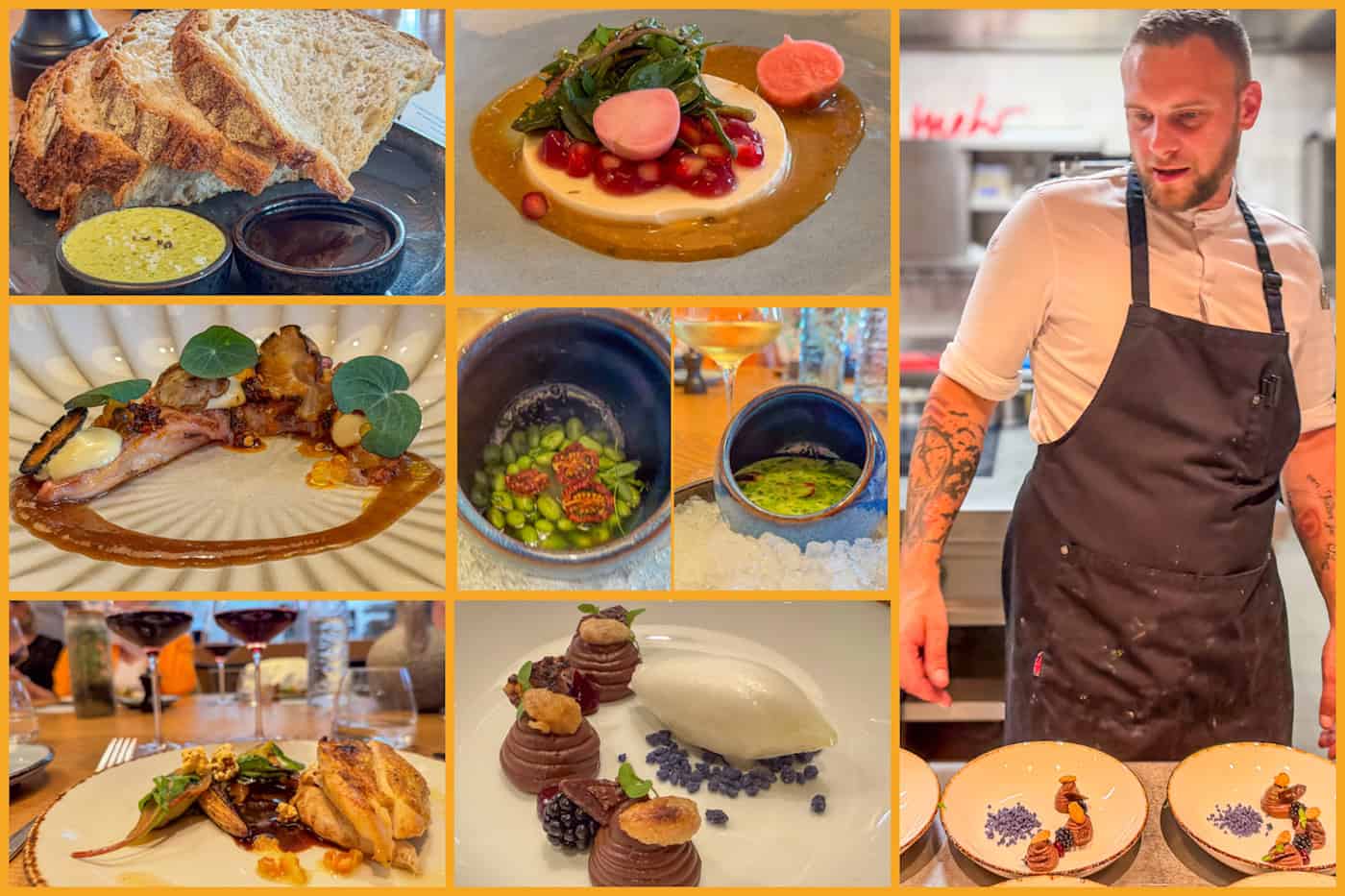
The new concept involves extending the fantastic menus from the “Kochsternstunden” era throughout the entire year. Naturally, these will change with the seasons—though they won’t be the only option, as there’s still the à la carte menu for those who don’t feel like a set menu. The menu has been given a name: Saisonale Strömung. And it’s available as a three- or five-course meal (€45/€75), optionally with a matching wine pairing (which, in turn, can be with or without alcohol—for the same price: €25/€35). So far, so unassuming. We opted for the five-course option, which was a good idea since the three-course version would have meant missing out on two of the most exciting courses.
We kicked off the evening with sourdough bread from Elias Boulanger with pea butter and toasted leek oil (which you can also order on its own as a snack, 8 €), that was crispy on the outside and fluffy on the inside—crust-and-crumb fans could fill up on multiple orders of this and go home satisfied. So: a snack warning—there’s more to come! For example, the combination of summer purslane, buttermilk, pomegranate, radishes, and miso. That’s how it’s simply described on the menu, but the radish, for instance, isn’t just a plain radish—it was smoked in one version and pickled in another. And that goes for nearly all the ingredients: the summer purslane was marinated in lime dressing, the buttermilk was served as panna cotta, pomegranate appeared on the plate as seeds and as a gel—and David Schöbel confidently and simply described the miso sauce as “bold.” Yes, it certainly was. Very robust, in fact—some even said it was too salty. Welcome to the world of umami, welcome to the world of fermentation!
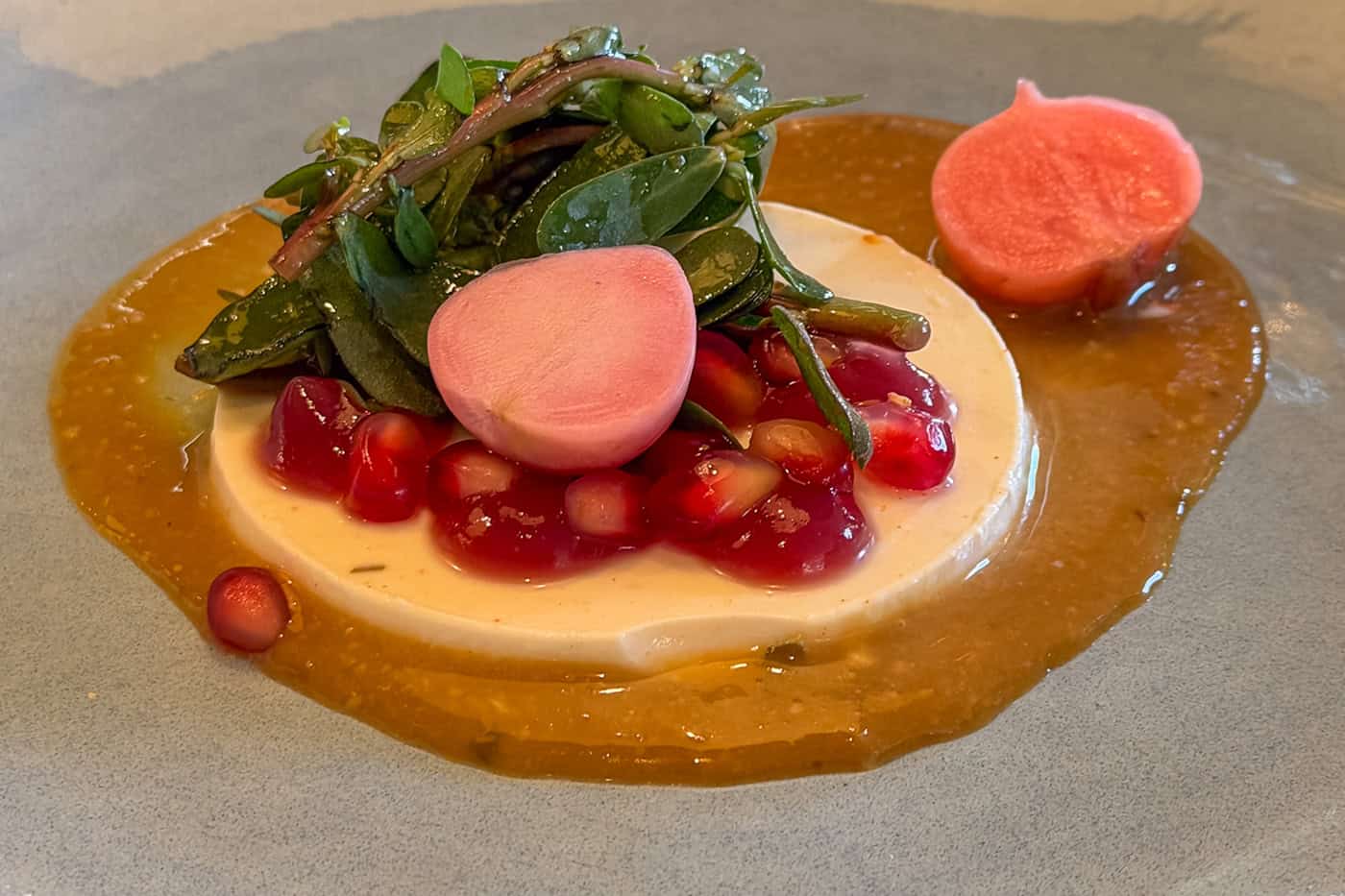
Perhaps it’s time to digress a bit and, in doing so, delve a little deeper into this seemingly unassuming appetizer, which—in the house’s style—is written in all caps, has a nickname, and then lists additional ingredients:
SUMMER POURTAK,
BUTTERMILK, POMEGRANATE, RADISHES & MISO
I’ve already mentioned that David Schöbel essentially said (and I’m paraphrasing here in my own, somewhat more casual words) that the palate must be fully engaged with every course. The full range of flavors—sweet, salty, sour, bitter, and umami—can be divided into two categories: the first four have long been known in this part of the world (broadly speaking: Central Europe), whereas umami is only gradually gaining acceptance. At the same time, the food industry is working hard to ensure that every flavor is toned down toward neutrality. This is particularly evident when it comes to bitterness, as in the case of radicchio, for example. Of course, recognizing bitterness used to be ® more important in human history: since many poisons taste bitter, this taste also served a protective function. Conveniently, bitterness is best detected at the back of the tongue—where the gag reflex is also located. It would be a mistake, however, to try to dissect the diversity of flavors course by course and ingredient by ingredient, because it is only the interplay of the individual components that creates the overall picture—after all, the individual pieces of a mosaic don’t make up the whole charm on their own. The term courage mentioned at the beginning refers precisely to this: that the chef dares to apply his knowledge to the composition and can then only hope that the guests do everything right…
Of course, they don’t. So, if the (lavish—which I generally love) pool of sauce seems too umami-salty, you could simply not even ignore it and push it aside. But good manners! Eat it all or face bad weather! As if Saint Peter, who’s in charge of the weather, had single-handedly chosen me to decide what the weather will be like! As a child, you might believe that and even be proud of it, but as an old man , I do allow myself a tiny bit of self-confidence. And when the attentive server then asks with concern if something wasn’t right, I can say that to me what was left behind was whatever it was—which, of course, implies that others might like it. Tastes just differ, and I certainly don’t have to understand or like everything.
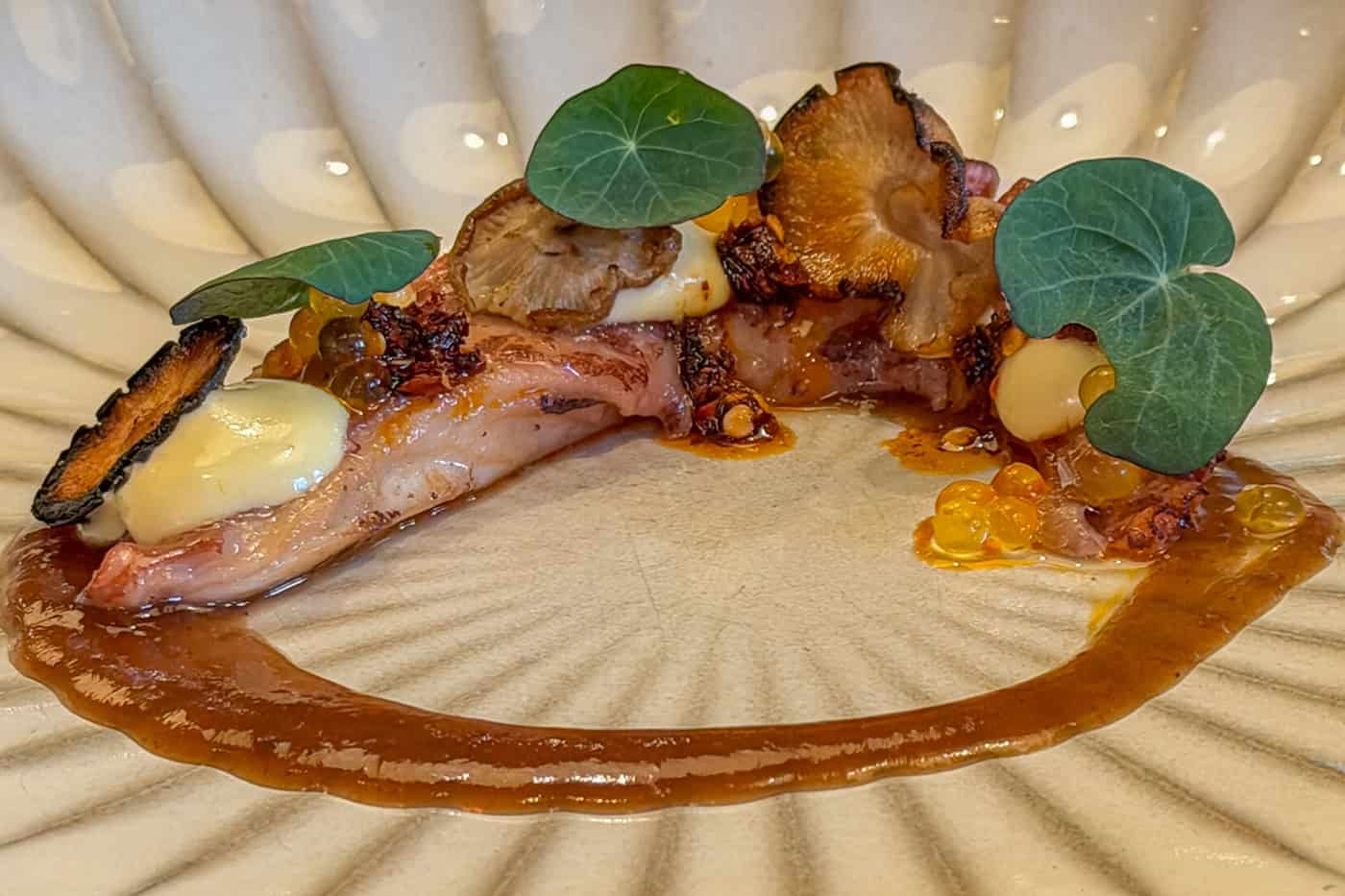
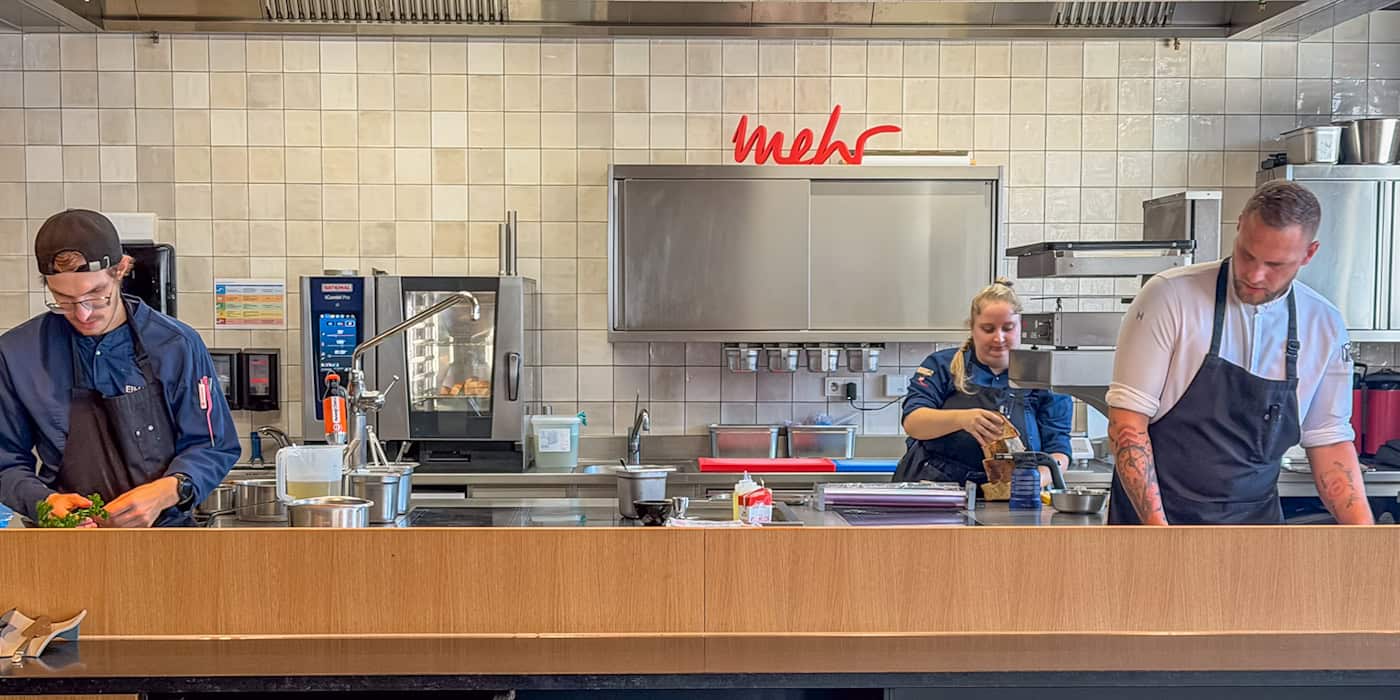
Which brings us to the second course, about which there isn’t much more to say in general. But with Grilled Octopus, Tamarind, Shiitake, Lime & Crispy Chili , the small trio in the open kitchen kicked the “courage rocket” into the next gear and brought some heat to the table. Spiciness hasn’t come up in our discussion so far because spiciness isn’t a flavor at all, but rather a sensation of pain and heat. That can really get us going, though—which is a pretty lame pun on the trigeminal nerve responsible for spiciness. But never mind. Apparently, humanity is divided into two “spiciness” camps: for some, it can’t be spicy enough; for others, even the slightest hint of spiciness is suspect. Finding the golden mean is always a tightrope walk—but David Schöbel and his team have the confidence to navigate this path with precision. For my palate, it had reached just the right level of heat—not too mild, and not so much that nothing was left for the other flavors, which would have been burned away in Dante’s Inferno. The only gripe: the sauce surrounding it was, once again, that not-so-life-affirming brown hue.
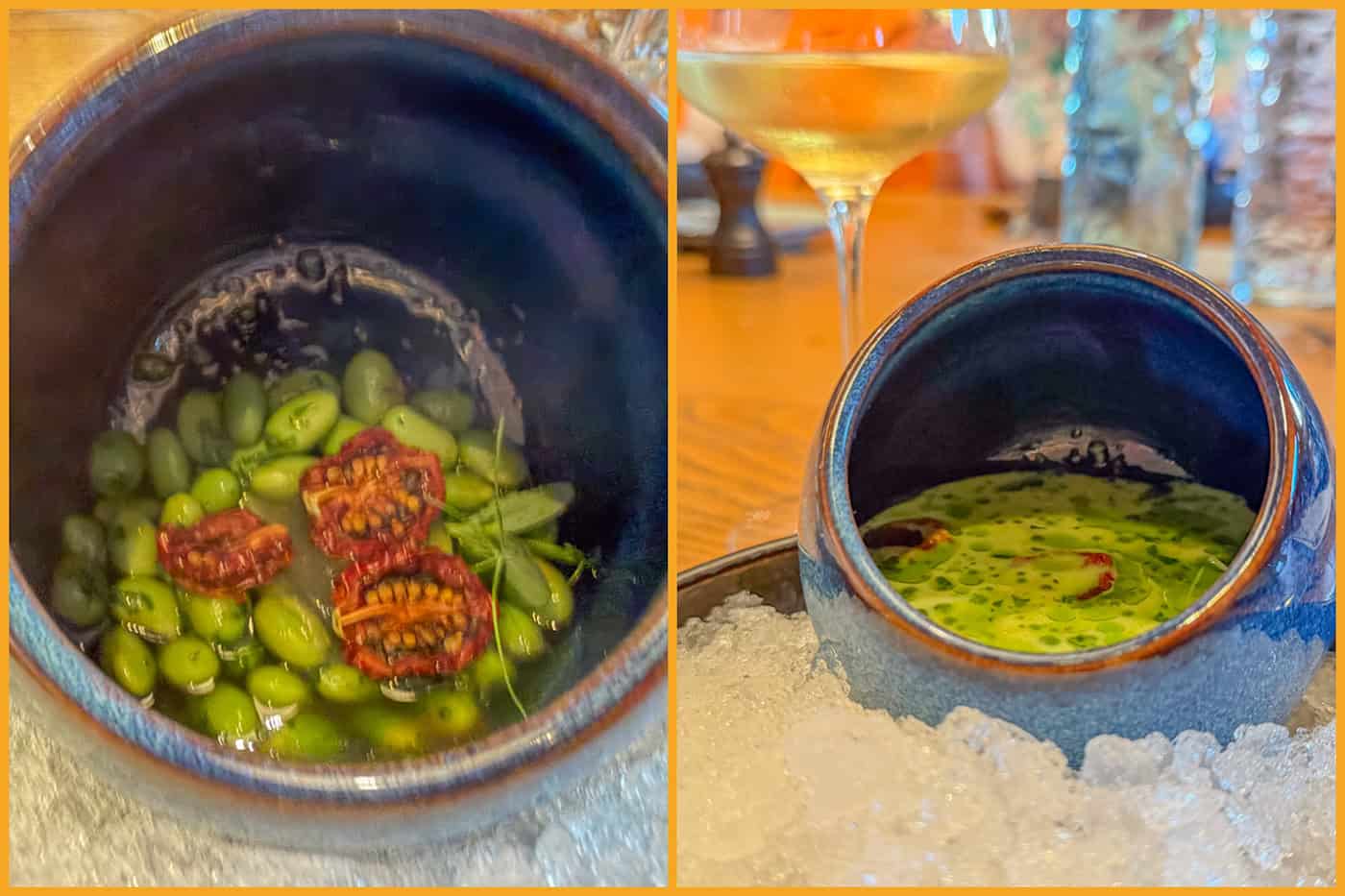
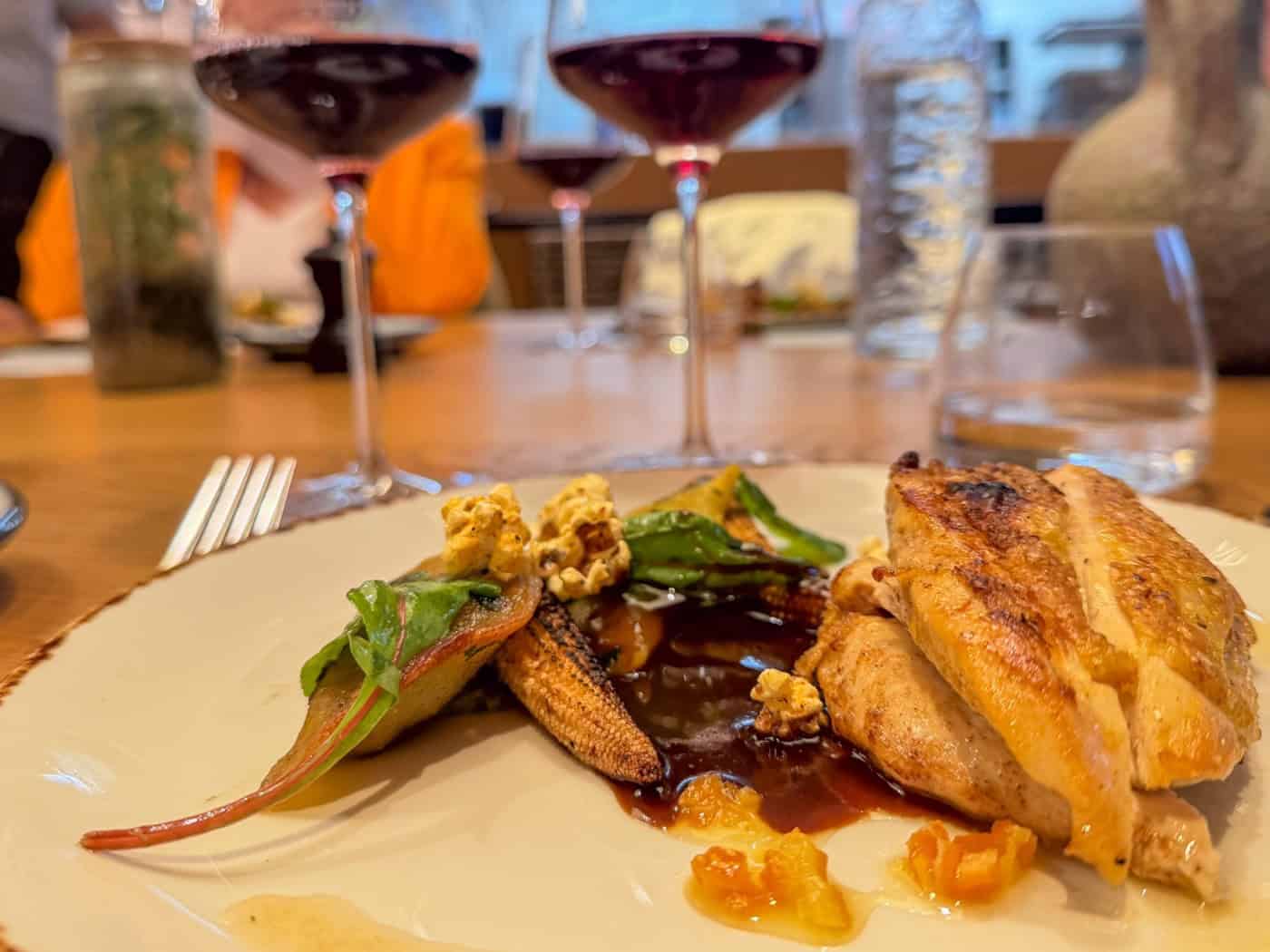
As if someone had heard my thoughts in the kitchen, a wonderful symphony of green with splashes of red followed (the correct name of the dish: Chilled Pea Soup, Edamame, Kaffir Lime, & Dried Tomato). Nothing was too salty, nothing too spicy, and there was hardly anything exotic in it—but it tasted great anyway, and on warm or even hot days, this course is a real hit. As is so often the case when dining out, the main course (Roasted Corn-Fed Chicken, Corn, Swiss Chard, Candied Orange & Hoisin) made the least impression. Admittedly, that’s complaining on a very high level, since the corn-fed chicken was cooked to perfection and the other components also contributed harmonious flavor nuances. However, I had too many questions: What’s the deal with these little corn cobs? Do we really need popcorn (isn’t that just for the big screen, right?)? Why such a token amount of Swiss chard, which is offered far too rarely? Why brown sauce again? Spoiler: I still enjoyed it—quite a bit, actually—but if there’s a favorite course (which people usually ask about), there can also be a “not-that-excited” course. A loving reconciliation (as is so often the case): the dessert—blackberry, lavender, chocolate, non-alcoholic gin & almond.
What’s been overlooked so far: the wine pairings, which are available with and without alcohol (To be precise: the wines on offer are dealcoholized wines, so they may legally contain up to 0.5 percent alcohol by volume—which, of course, is roughly equivalent to the natural alcohol content of ripe bananas or sauerkraut. A special case are the (few) wines with 0.0 percent alcohol by volume—there were two of them, both from Leitz (Rheingau): a Riesling and a Rosé. I’d ordered the “with” versions and briefly tasted the “without” versions of each. As for the non-alcoholic options: they fall short when compared to regular wines. And they’re far better than they were years ago if—for whatever reason—you choose to skip the alcohol. Max Kunschmann, restaurant manager, wine expert, and charming host, had, as expected, selected the wines appropriately; the journey took us through the varietals (Pinot Blanc, Sauvignon Blanc, Goldriesling, Pinot Noir, and Riesling) and wine-growing regions (which were not listed on the menu but were provided verbally).
Arcotel Hafencity/Elbuferei
Leipziger Strasse 29
01097 Dresden
Tel. +49 35 144 81110
elbuferei.de
[Visited on August 20, 2026 (press event by invitation)]
.

