

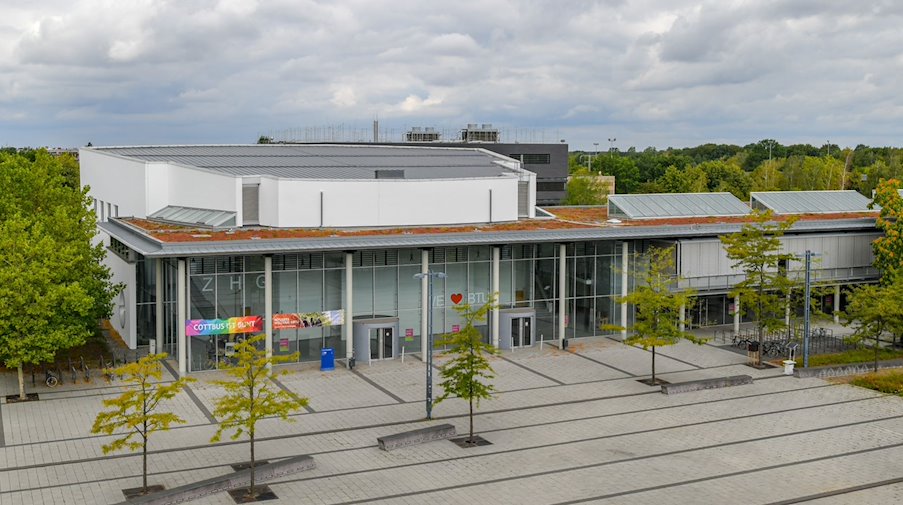
The Brandenburg University of Technology Cottbus-Senftenberg (BTU) is attracting more and more scientists from abroad as a research and teaching institution. Researchers from Sweden, Austria, Africa and Australia, among others, have recently recognized the opportunities in structural change to work on future topics such as energy transition, electric drives or climate neutrality. Such opportunities are also being recognized internationally, BTU President Gesine Grande told the German Press Agency. "This enriches us incredibly as a cosmopolitan, diverse and creative university." For example, a young scientist came directly from India to work on a hydrogen project at the university, said the BTU President. Lusatia, which is moving towards renewable energies with the coal phase-out, is a direct field of application. "With these topics and the great practical relevance, we are succeeding in attracting people here to an extent that would not have been thought possible until recently - people who would like to stay here in the long term," Grande explained. According to the BTU President, an estimated 1000 additional scientists and employees will be hired at the university and at scientific partner institutions within a few years - including the German Aerospace Institute (DLR), the Fraunhofer Institute with various divisions and the Center for Hybrid Electric Systems Cottbus (Chesco). Chesco alone, for example, is expected to employ up to 400 people by 2026. With around 7,600 students, the university in Lusatia is the only technical university in Brandenburg to record more first-year students for the third year in a row. "This is clearly a trend," observed Grande, who finds this fact remarkable with regard to other institutions in Germany. Other universities with a comparable focus on engineering and natural sciences have recorded significant declines in student numbers. In future, university medicine is to form a further focus of teaching. A separate medical university in Cottbus will soon be training doctors and specialists for the development of a sustainable healthcare system. To this end, the Cottbus Carl-Thiem-Klinikum (CTK) is to become a university hospital. Crises such as corona, demographic developments and increasing digitalization require contemporary answers in healthcare, according to the Brandenburg Ministry of Science. BTU sees many attractive opportunities for cooperation in research and will also support university medicine in teaching - especially in the start-up phase. According to Grande, the BTU has particular expertise in the areas of digitalization of the healthcare system and healthcare system research. She cited telemedicine, artificial intelligence and sensor technology as examples, as well as health research itself. According to her, the BTU site in Senftenberg will cooperate very closely with the University Medical Center in terms of teaching and studies. "For natural science subjects such as chemistry, biology and physics, courses and infrastructure will be used by medical students," explained the university president. Interprofessional teaching will be a particular focus. In so-called skills labs, midwives, nurses and physiotherapists will be trained together with medical students during their studies. Copyright 2024, dpa (www.dpa.de). All rights reserved


