

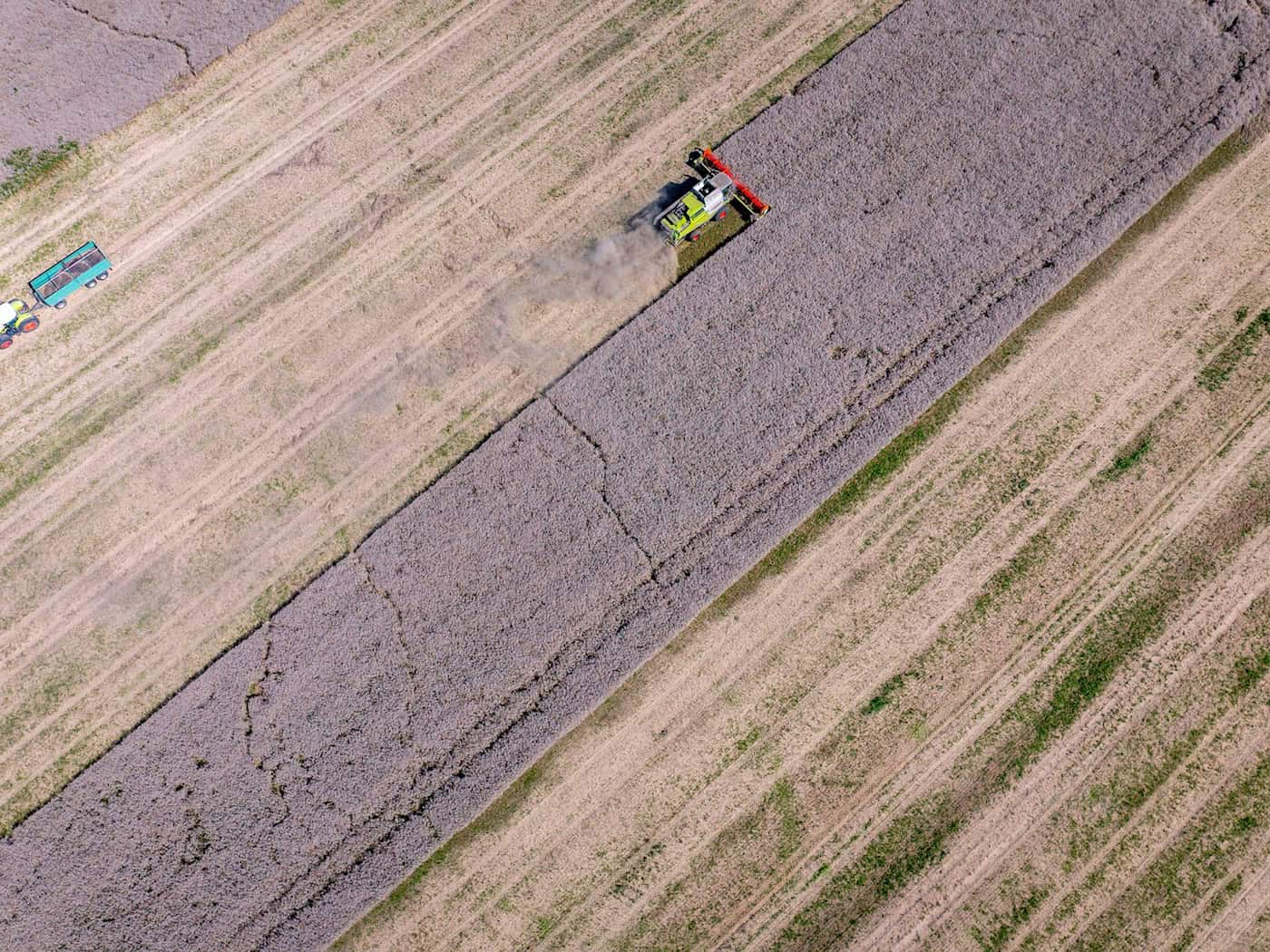
The East German agriculture ministers are calling on the federal government to support them against the cuts to large-scale agricultural operations planned by Brussels. At the Chancellery in Berlin, the ministers from Brandenburg, Mecklenburg-Western Pomerania, Saxony, Saxony-Anhalt, and Thuringia presented a joint list of demands regarding the future structure of the Common Agricultural Policy (CAP) to Minister of State Philipp Amthor (CDU). This is according to a statement released afterward by the heads of the respective ministries. The EU plans to gradually reduce subsidies for agricultural enterprises above a certain size starting in 2028 (degression). In addition, fixed subsidy caps per farm are to be introduced (capping). The ministers fear that this will disadvantage large-scale agriculture in eastern Germany and are calling for a change in course. They want the federal government to advocate for this. Eastern Germany has a higher-than-average number of large agricultural operations. Farms with more than 1,000 hectares are not uncommon. The reason for this lies in East German history: During the GDR era, Agricultural Production Cooperatives (LPGs) were established, into which farmers who had previously been independent were required to contribute their land. After 1989, these cooperatives were often continued as private enterprises, with the extensive land holdings largely retained, as reported by the Federal Ministry of Agriculture. Today’s large-scale farms are considered highly efficient. Brandenburg’s Minister of Agriculture, Hanka Mittelstädt (SPD), explained that in Brandenburg alone, nearly 1,800 farms are affected by the EU plans. According to her, these farms account for 92 percent of the agricultural land in the state. Mecklenburg-Western Pomerania’s Minister Till Backhaus (SPD) spoke of “ideological narrow-mindedness” on the part of the EU. He explained that we cannot allow structures—which have developed over decades and are successful, and which also offer prospects for people in rural areas—to be sacrificed. Saxony’s Minister Georg-Ludwig von Breitenbuch (CDU) expressed concern that the plans from Brussels would weaken farms and, as a result, increasingly attract investors from outside the agricultural sector. Copyright 2026, dpa (www.dpa.de). All rights reservedOver 1,000 hectares is not uncommon
“Ideological Narrow-Mindedness”


