


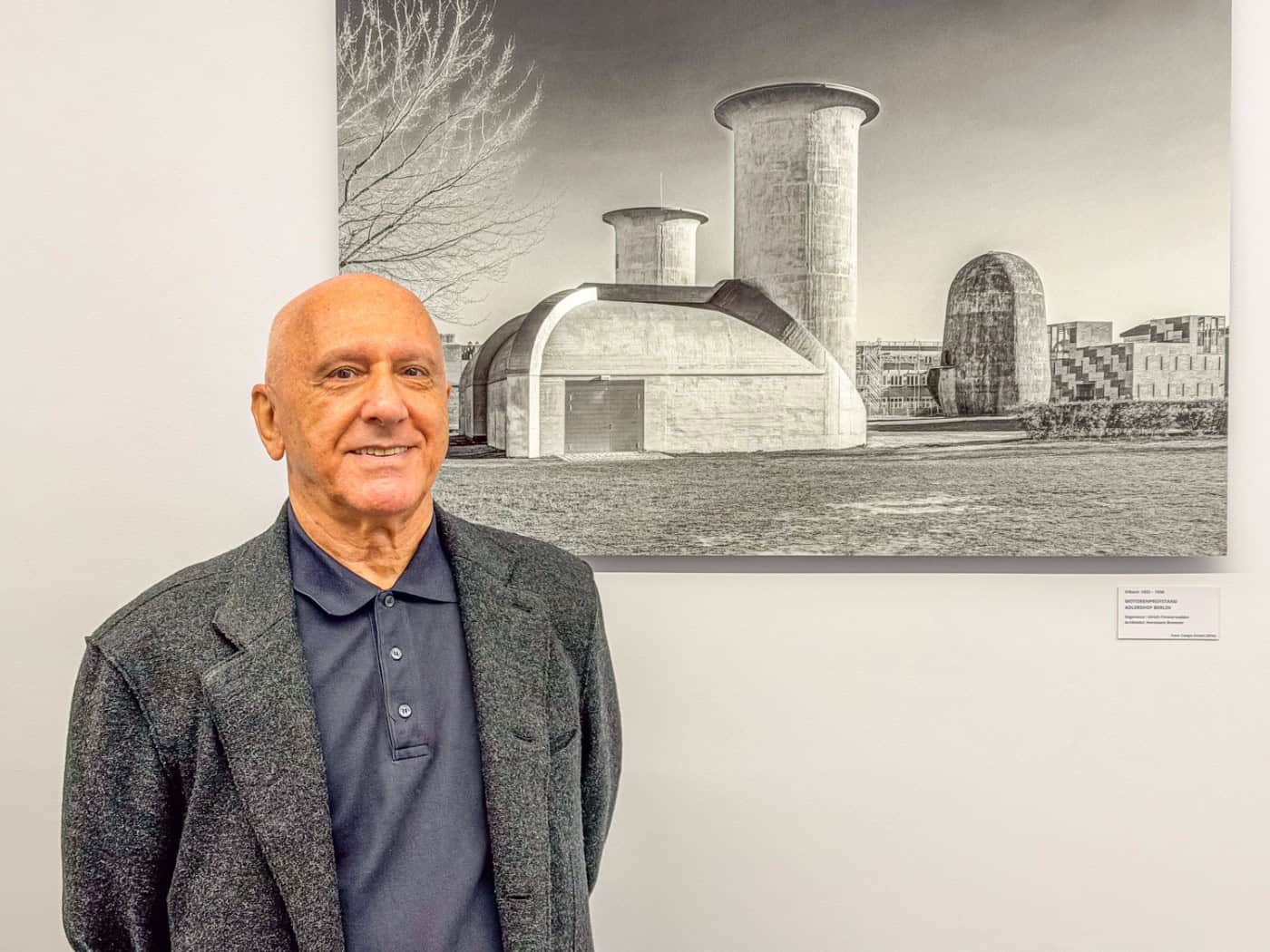
Roughly speaking, there are 130,000 bridges in Germany—and that doesn’t even include the many small footbridges over the Weidigt, Leubnitz, or Kaitzbach (and whatever else they’re called). As a rule, we don’t give these bridges a second thought; at most, we shrug and accept that (yet again) one is too dilapidated to handle the current heavy traffic. Of course, the outrage is always immense—what was the status of the plans to replace the “Blue Wonder” before it all came to such a sudden end? We could spend hours discussing questions like these. In the Beyer Building at TU Dresden—which until 1953 was simply called the “Civil Engineering Building” because civil engineers have been conducting research and teaching there since 1913—a photo exhibition opening this weekend, however, pays tribute to a completely different aspect of bridge construction: Cengiz Dicleli, himself a civil engineer and—in his own words—“an amateur photographer with slightly artistic ambitions,” pays tribute to prominent figures in engineering with around 40 large-format black-and-white photographs.
Cengiz Dicleli was born in Istanbul, where he also earned his high school diploma at the German School. He then came to Germany on a scholarship and studied civil engineering in Berlin. The subject “History of Architecture” or “History of Civil Engineering” did not exist there—as is the case at most universities in Germany. A mistake, in Dicleli’s view: “Civil engineers in Germany are always trained as specialists who are oblivious to history, even though this subject is now required by the framework examination regulations,” he said in his speech at the exhibition opening.
Cengiz Dicleli is particularly fascinated by the civil engineer Ulrich Finsterwalder. “There is hardly a civil engineer to whom the term ‘genius’ applies so well,” Dicleli wrote ten years ago in an article for the Dresden Bridge Construction Symposium. At this point, it becomes clear that it’s not just civil engineers who lack a bit (or even a lot) of architectural history in their consciousness—because let’s be honest: when you hear the name Finsterwalder, who thinks of the genius, and who is more likely to spontaneously think of the Finsterwalder Singers’ Festival? Exactly. Things may be different for Dresden civil engineers, as they’ve been earning academic credit—outside the narrow confines of the curriculum—for years for their papers on figures well-known at least within the engineering bubble.
The Courage to Progress
One (perhaps even *the*) champion of the historical aspect among Dresden’s civil engineers is Manfred Curbach. He is now a senior professor, having previously served for many years as director of the Institute for Solid Construction. In his introductory speech at the exhibition opening, he spoke of “courage in concrete.” Courage that was needed a hundred years ago to push through new ideas—and apparently, that is still the case today. Practitioners in the field, one gets the impression, tend to be very conservative in their thinking and actions. But research findings are challenging this: The entrance gate to the campus, with its striking tower for the observatory, was designed by architect Martin Dülfer using a technology that was new at the time. Until the turn of the 20th century, buildings were typically constructed by laying stone upon stone and joining wooden beams to wooden beams. From the outside, the Beyer Building looked (and still looks) exactly the same—but its inner workings reflected the revolution in construction at the time: reinforced concrete. Manfred Curbach summarized the thoughts of the skeptics of that era as follows: “Stone upon stone—everyone understood that. But that a gray slurry in a wooden box was suddenly supposed to bear enormous loads? To some, that seemed like magic. Or like quackery.” To plan and build this way required courage, Curbach concluded.
Without courage, even great structures remain unspectacular. Or to put it another way: What particularly distinguished Ulrich Finsterwalder was “his view of theory and practice as a consistent unity,” Dicleli wrote ten years ago in a message to the guests at the bridge-building symposium. “Coupled with innovative spirit and the courage to take risks, this attitude enabled him, together with his company (Dyckerhoff & Widmann), not only to survive two world wars and a global economic crisis, but also to maintain a leading international position in structural engineering for decades.”
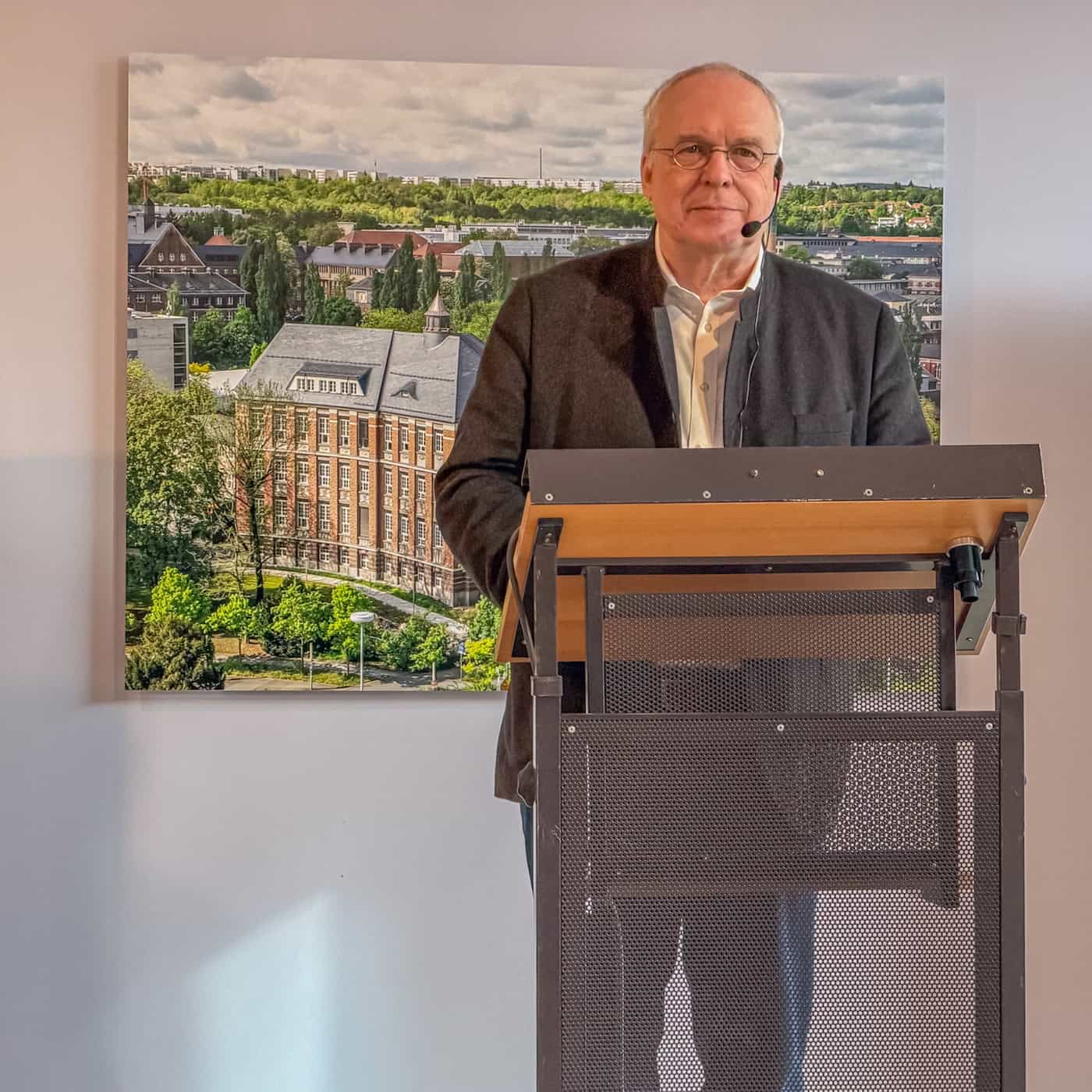
It wasn’t just earlier generations who occasionally needed courage; it wasn’t just they who had—pardon the expression—crazy ideas. The idea—which was largely driven forward in Dresden and here by the civil engineers at Manfred Curbach’s firm—of what is now known as carbon concrete, which served as the structurally and visually crucial finishing touch in the renovation of the Beyer Building, for example, was no different in the early years of research. Back then, people still referred to it as “textile concrete”—and for skeptics, the association was more with old rags than with high-performance technical materials. Even among the skeptics within the company itself, a few arguments have lost their weight regarding the renovation of the reinforced concrete structure’s slabs—some of which are only eight centimeters thick—using carbon concrete: Extremely thin layers of concrete, reinforced with carbon fiber mats, were placed beneath the slabs. Curbach emphasized two effects at the opening: “The appearance remained almost unchanged, but the load-bearing capacity increased!” He declined to answer the rhetorical question of whether courage was needed again today to achieve this—“I’m biased on that point.”
Perseverance Leads to Success
The fact that the photographs are now on permanent display in the Beyer Building is likely also thanks to the little sister of courage: perseverance in pushing through sensible ideas. After all, the newly renovated Bayer Building—as a place of research and teaching, that is, a place where work is done—has not only been constructed with carbon-fiber-reinforced concrete but is also subject to strict rules: no nails! Anyone who wants to make notes or even project an image onto the wall is well-served by a projector, which does the job wirelessly. And now, here are these 40 (and a few more about the building and the ancestral gallery) photos! You can imagine how much energy and perseverance the two curators (Manfred Curbach and Dean Birgit Beckmann) have poured into this project.
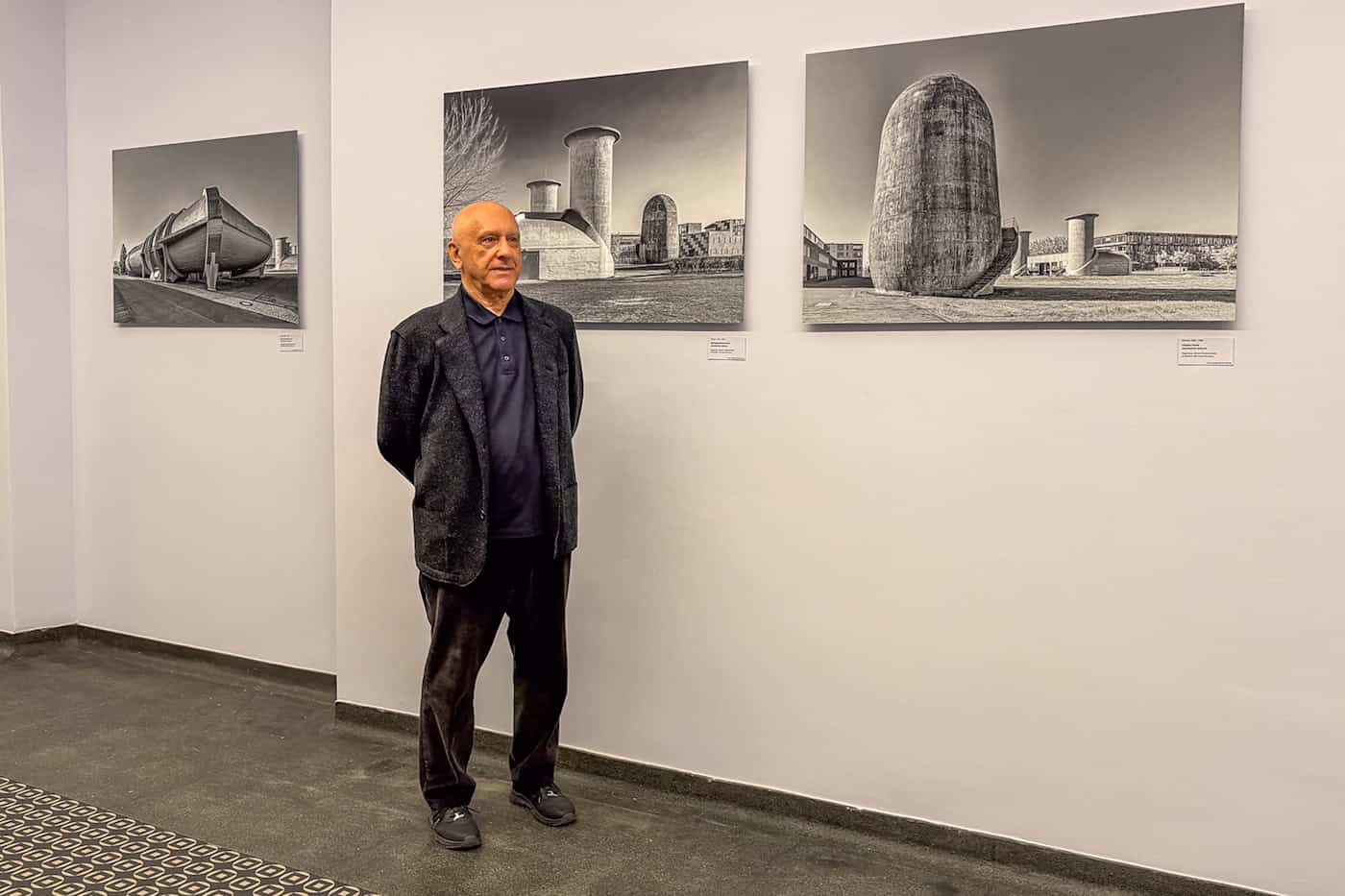
But it was worth it. Cengiz Dicleli has a truly keen photographer’s eye. And he takes the time to carefully edit his images. For instance, he decided that black-and-white photography is best suited for a striking portrayal of exposed-concrete structures. He also retouched the images—for example, removing distracting traffic signs and, at times, people as well. Is that allowed? It is, because these images are, after all, more than just amateur snapshots taken without much thought. One has to agree with Manfred Curbach: they are “works of civil engineering art, captured through the artist’s eye.”
The prints have been developed to an excellent standard—it’s a relief that there are still specialized labs that understand the nuances of the gray scale. The consistent captions are brief but sufficient: where the subject is located, who the people behind it are, and when it was taken. It’s just a shame that at some point on the second floor, the captions disappeared entirely—but exhibition openings are probably like Christmas: the date is set, but then suddenly everything happens very quickly…
Bridges and more. Buildings by Finsterwalder & Co.
Civil engineering, photographed by Cengiz Dicleli
Beyer Building, 1st and 2nd floors
George-Bähr-Str. 1, 01069 Dresden