


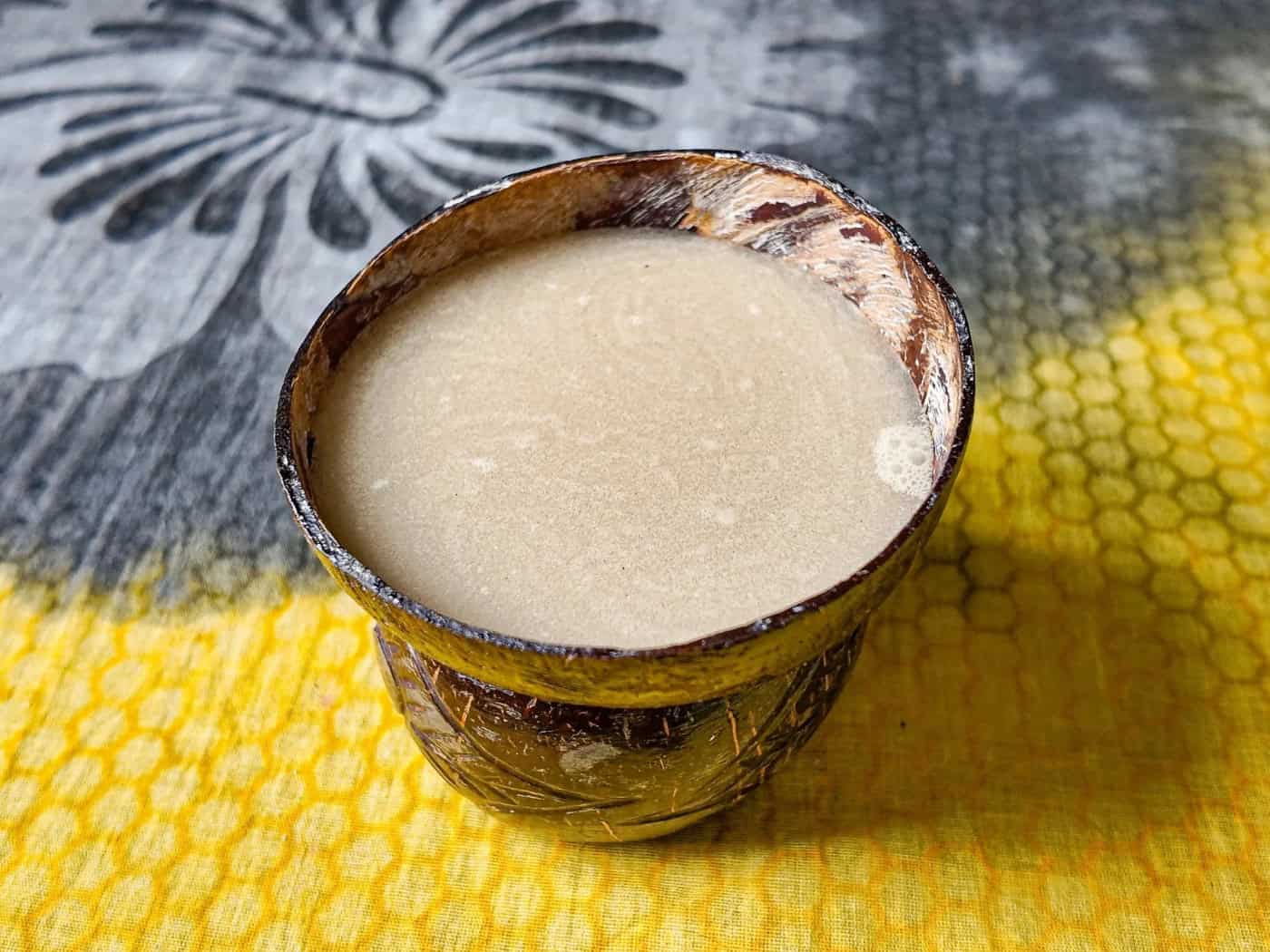
A drink that relaxes, changes the senses and calms the body - and is still drunk in large groups to settle disputes or invoke the gods. Kava, made from the root of the Piper methysticum plant, has been more than just a ritual drink in the Pacific for centuries. It is ritual, politics and community in one cup. And it was the focus of a study by the Max Planck Institute for Evolutionary Anthropology in Leipzig.
The question behind it is fundamental: did mind-altering substances, i.e. substances that influence the state of mind, help humans to build large, organized societies? This idea is called the "Drunk Hypothesis". It states that intoxication strengthens social bonds, increases the willingness to cooperate and thus favors the rise of complex communities.
Where there was no alcohol, there was kava
Until now, this theory has mainly revolved around alcohol. But in Oceania, the island regions of the Pacific, alcohol was largely unknown before European colonization. Instead, many societies there drank kava. "After we were recently able to show that alcohol consumption could indeed have a positive effect on the increase in political complexity on a global scale, it was a logical step to investigate other mind-altering substances as well," says Václav Hrnčíř from the Max Planck Institute in Leipzig, who led the study. §The Oceania region is a good model case for this because alcohol was unknown there until European contact."
Kava plays an important role in many oceanic cultures. In Fiji, for example, it is drunk to communicate with ancestral spirits, welcome guests or resolve conflicts. Strict rules determine who sits where and who is allowed to drink first, depending on social rank. Those who take part in the ceremonies and consume a lot of kava can gain prestige within the community.
The data speaks a different language
The research team analyzed data from 83 societies whose languages belong to the Austronesian language family. They compared where kava was drunk with the respective degree of political centralization and social stratification, i.e. how strongly power and status were organized in a society. Using a family tree of related languages, the researchers simulated how kava consumption and social structures could have developed together over time. However, the models found no evidence that kava drinking and social complexity co-evolved or reinforced each other. "Consequently, kava drinking was not a major factor in the rise of cultural complexity in Oceania," says Russell Gray, lead author of the study.
The study belongs to a field of research that investigates cultural developments using methods originally derived from evolutionary biology. Researchers compare societies on the basis of linguistic relationships, historical data and cultural characteristics. The aim is to better understand how social structures, rituals or political systems have developed over long periods of time and which factors may have actually played a role in this.
The results of the Leipzig study indicate that mind-altering substances do not automatically contribute to the emergence of complex societies. Apparently, despite its important cultural role, kava did not play a decisive role in the development of political hierarchies in Oceania.

