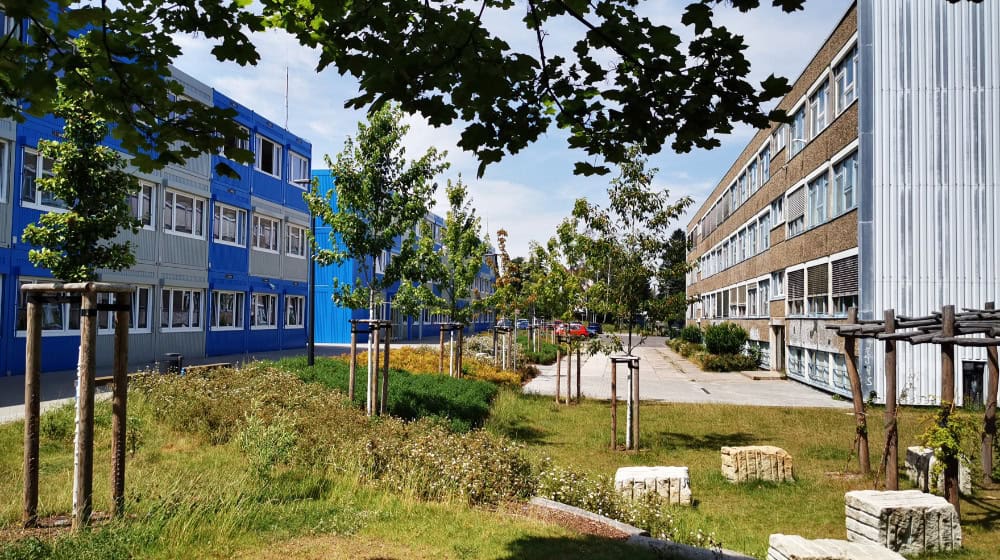
In the current school year 2024/25, around 830 students in grades 1 to 10 from the entire Dresden city area and neighboring communities are studying at the Dresden University School. Innovative teaching-learning formats and a contemporary school organization are being tested and researched in the school trial of the Technische Universität Dresden (TUD) and the city of Dresden. The focus of school development is now moving away from the organization of teaching in the younger grades towards the development of structures in the final grades. For the second time in the school's young history, final examinations will be held in the beginning school year, and for the first time, the young people in the qualification level will also be preparing for the Realschule examination. The integration of the Ukrainian pupils and teachers into the school community is also progressing.
Strong performance in the school trial despite scarce resources
As a public school trial, the Dresden University School has been testing and researching how a school of the future can function with contemporary teaching and learning formats for over 15 years under the scientific supervision of the TUD. Scientific Director Prof. Anke Langner is optimistic at the start of the second third of the project: "The school is growing and developing. The results of the first graduates show what the concept of a "school for all" can achieve: actually more than a mainstream school - with the same available resources. The project was launched in the knowledge that we would have to prove ourselves, even under adverse conditions, to build and shape the school of the future. We have done this and yet we are also surprised that we still have to do this even after five years of solid work. After all, the struggle for the very concrete basic equipment of rooms and the provision of a school building that is appropriate and necessary for the number of pupils costs the school community a great deal of energy. We would much rather devote this energy directly to the pupils and to working with other schools that want to join us on the journey of creating a school for the pupils."
For Headmistress Maxi Heß, the school community is starting a new school year with good groundwork, which will be no less exciting than the other years: "Especially because we will be trying out new structures again. We are pleased that every year we succeed in making the necessary changes quickly and consistently so that - and this is always the focus - the individual learning of the pupils can be supported in the best possible way. The motivation for change and further development is unbroken. The school trial is entering its second third and we have not only grown, but perhaps also grown up a little. In addition to further development processes, we can now also focus on the constant adaptation processes." In concrete terms, this means a changed daily structure and an adapted time structure in the new school year, with which the school is responding to the need for a good feedback culture and successful process support.