Logo Die Sachsen News
News / Environment

What's in the air around an airport

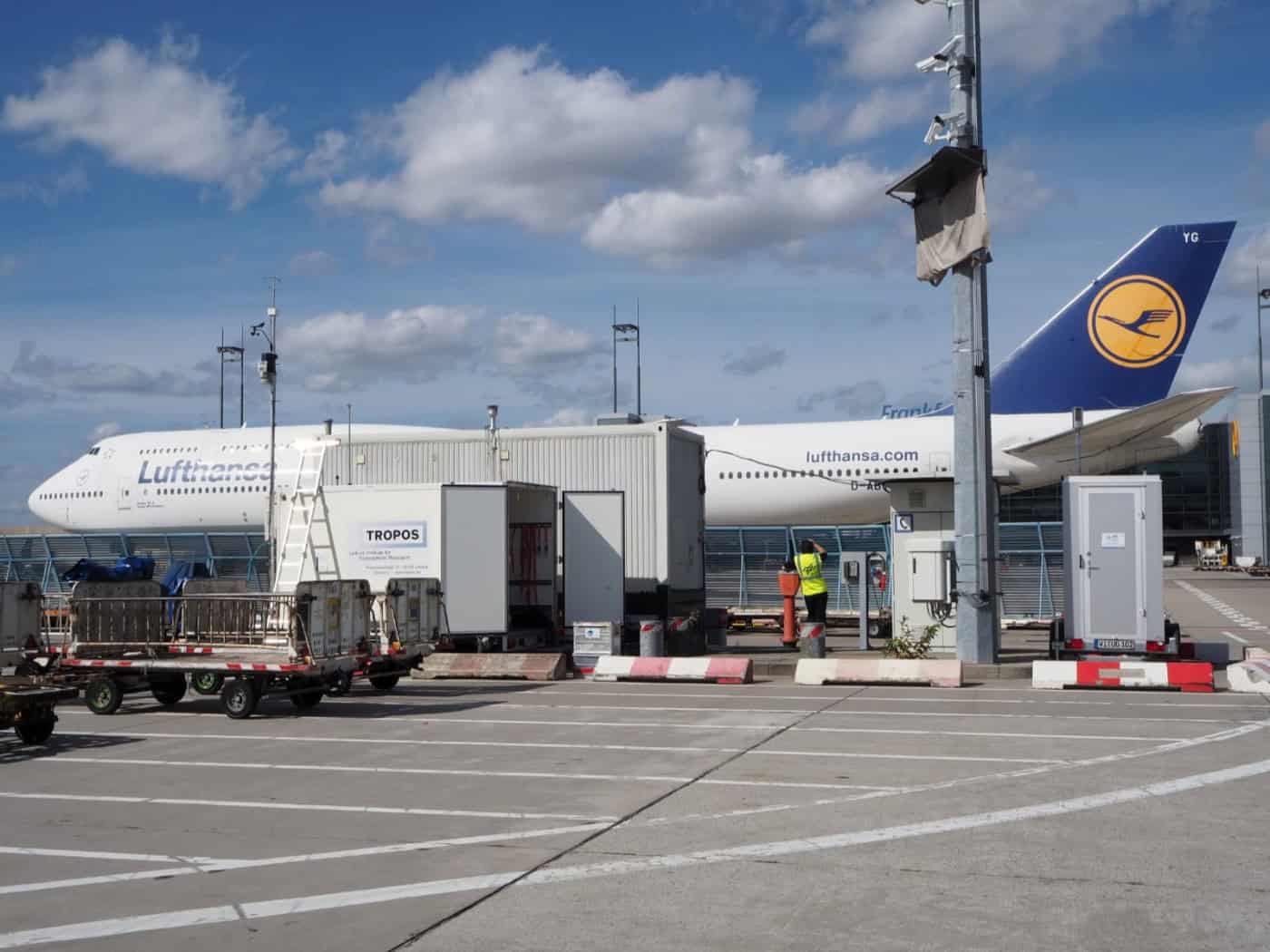
Right in the middle of the action: On the apron in front of Terminal 2, the TROPOS Institute in Leipzig recorded the tiny particles directly where the engines are running.
TROPOS researchers measure ultrafine particles on the apron in front of Terminal 2 at Frankfurt Airport © Philipp Oehlke/TROPOS
From: Wissensland
Tiny, invisible, and everywhere: ultrafine particles linked to aircraft emissions can still be detected up to 15 kilometers away from Frankfurt Airport. Researchers at the Leibniz Institute for Tropospheric Research have now published new measurement data showing how strongly air traffic influences concentrations of these particles around the airport.

Every time an airplane takes off or lands, millions of tiny particles are released into the air. They are so small that they remain invisible to the naked eye. A human hair is about 70 micrometers thick — ultrafine particles are many times smaller. Experts call them ultrafine particles, or UFPs for short. Their possible health effects have been the subject of intensive research for years. Researchers at the Leibniz Institute for Tropospheric Research have now published new measurement results from around Frankfurt Airport.

On behalf of the Forum Airport and Region (FFR), scientists examined air quality at 14 measuring sites around the airport. The measurements show that concentrations of ultrafine particles on the airport grounds are significantly higher than in the surrounding urban background. For the smallest particles, concentrations were in some cases up to 30 times higher. Particularly affected was the size range between 10 and 20 nanometers. According to the researchers, these especially small particles can largely be linked to airport operations. Their influence decreases with increasing distance from the airport. 

More from this category

Other pollutants do not show a conspicuous picture

“This is where our measurements ended. However, the airport’s contribution at this distance was only around 10 percent on the annual average,” says Dr. Markus Hermann from TROPOS, who led the study. “A relevant contribution from the airport beyond this distance is therefore unlikely.” At a distance of around 15 kilometers, most ultrafine particles already originate from other sources such as road traffic, industry, or heating systems.

In addition to ultrafine particles, the researchers also examined other air pollutants including soot, sulfate, nitrate, and polycyclic aromatic hydrocarbons (PAHs). Some of these substances are considered harmful to health or carcinogenic. Here, however, the findings looked different. “The airport acts only as a local source here. The emissions from the airport cannot be clearly distinguished from urban sources at greater distances,” explains Prof. Dr. Alexander Vogel from Goethe University Frankfurt, deputy head of the study. In other words, for these pollutants the pollution levels around the airport do not differ significantly from those found in other large cities.

Study continues

The researchers did not rely only on stationary measuring instruments. Drones were also used to investigate how particles spread at different altitudes, while mobile measurements around the airport provided additional data on how the particles disperse across the region.

Ultrafine particles differ from conventional particulate matter mainly because of their extremely small size. While air pollution is often measured by mass, the number of ultrafine particles is considered especially important. Experts have therefore debated for years whether standard air-quality measurements adequately capture these particles. Airports are regarded as one of the major potential sources of ultrafine particles. The study will continue until the end of 2026. Researchers then plan to use modeling to calculate how ultrafine particle pollution is distributed across the entire study region..


Publication:
The report on the study is available here.

The translations are automated with the help of AI. We look forward to your feedback and your help in improving our multilingual service. Write to us at: language@diesachsen.com.
Wissensland
Article from

Wissensland

Wissensland is responsible for the content itself. The platform's code of conduct applies. The platform checks and treats content in accordance with the legal requirements, in particular the NetzDG.

METIS