


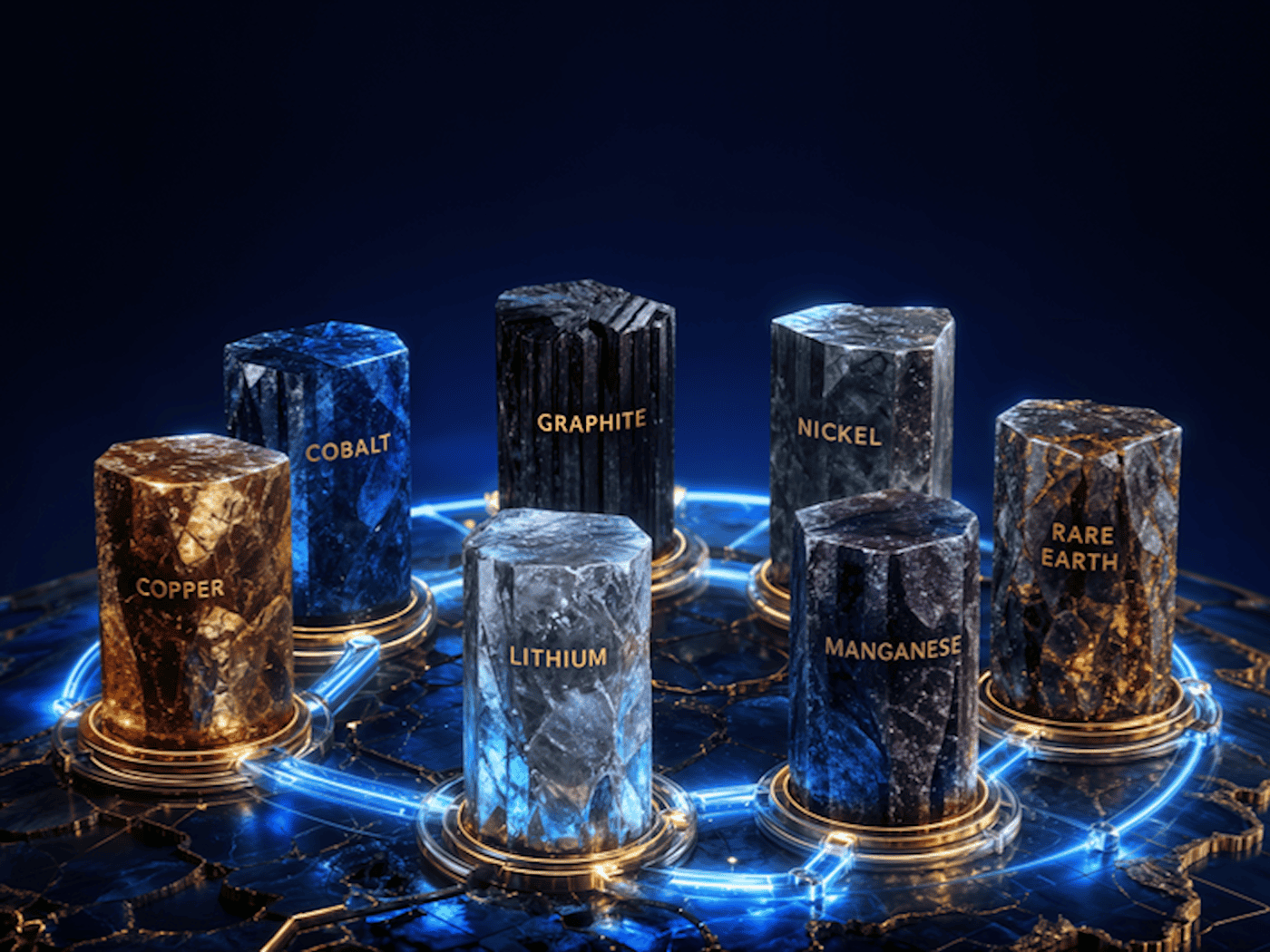
No battery without cobalt, no electric car without lithium, no smartphone without rare earths. At the same time, competition for these raw materials is growing worldwide. Many supply chains are controlled by just a few countries, while Germany and Europe are heavily dependent on imports. Anyone who holds a modern device in their hand is therefore always holding a piece of raw materials policy. This is set to change. The Helmholtz-Zentrum Dresden-Rossendorf (HZDR) is receiving almost 20 million euros from the federal government to conduct research on eight projects aimed at making Germany more independent in its supply of raw materials.
Why Germany must act now
The European Union has passed a law aimed at securing the supply of important raw materials. Metals such as lithium, cobalt and rare earths are considered "critical" because they are indispensable for energy transition technologies and at the same time are rarely mined in Europe. Germany has responded to this with the EGARoh and EGARoh_Junior funding programs. EGARoh stands for new ways of exploring, extracting and processing raw materials domestically. EGARoh_Junior supports young researchers who are setting up junior research groups.
When Germany stopped mining ore in the early 1990s, many experts and professions were lost. "In the EGARoh-Connect project, we summarize all the results from the individual projects and junior research groups in order to make them accessible and understandable to the public," explains project coordinator Dr. Nicole Körtge from the Helmholtz Institute Freiberg for Resource Technology (HIF). The team also derives recommendations for action for political decision-makers.
What the researchers in Saxony are actually doing
Five projects are based at the HIF in Freiberg. They are pursuing very different approaches. It is not simply a matter of finding new deposits. The researchers are also developing digital tools, energy-efficient processing methods and new methods to extract raw materials with less energy, less water and higher yields.
The DigIT project is developing digital tools that can be used to quickly evaluate geological data from old mines. This sounds technical, but in simple terms it means that researchers can find out more quickly where worthwhile raw material deposits are located. The NahGOLD project, on the other hand, focuses on gold and metals such as zinc, bismuth and tellurium, which often occur together. Until now, the high zinc content in such ores was a technical problem that made it difficult to extract the other metals. New processes aim to change this.
Three other projects are working on how raw materials can be processed in a more energy-efficient and resource-saving way. They combine methods from materials science with machine learning, i.e. computers that learn independently from data.
Three new junior research groups, global partners
Three junior research groups will receive a total of ten million euros over five years. They are cooperating with partners from North and South America, Africa and Australia. One group is researching how rare earths can be extracted from complex ores that occur in Europe, Canada and South Africa. Another is developing methods to extract copper more efficiently, and with less water. This is important because many copper mines are located in regions where water is scarce. There, water is repeatedly used in mining, which changes the quality of the water and makes copper extraction more difficult.
The projects show that raw material security today means far more than just opening up new mines. What is needed are technologies that make raw materials more efficient, more sustainable and less dependent on global supply chains.

