


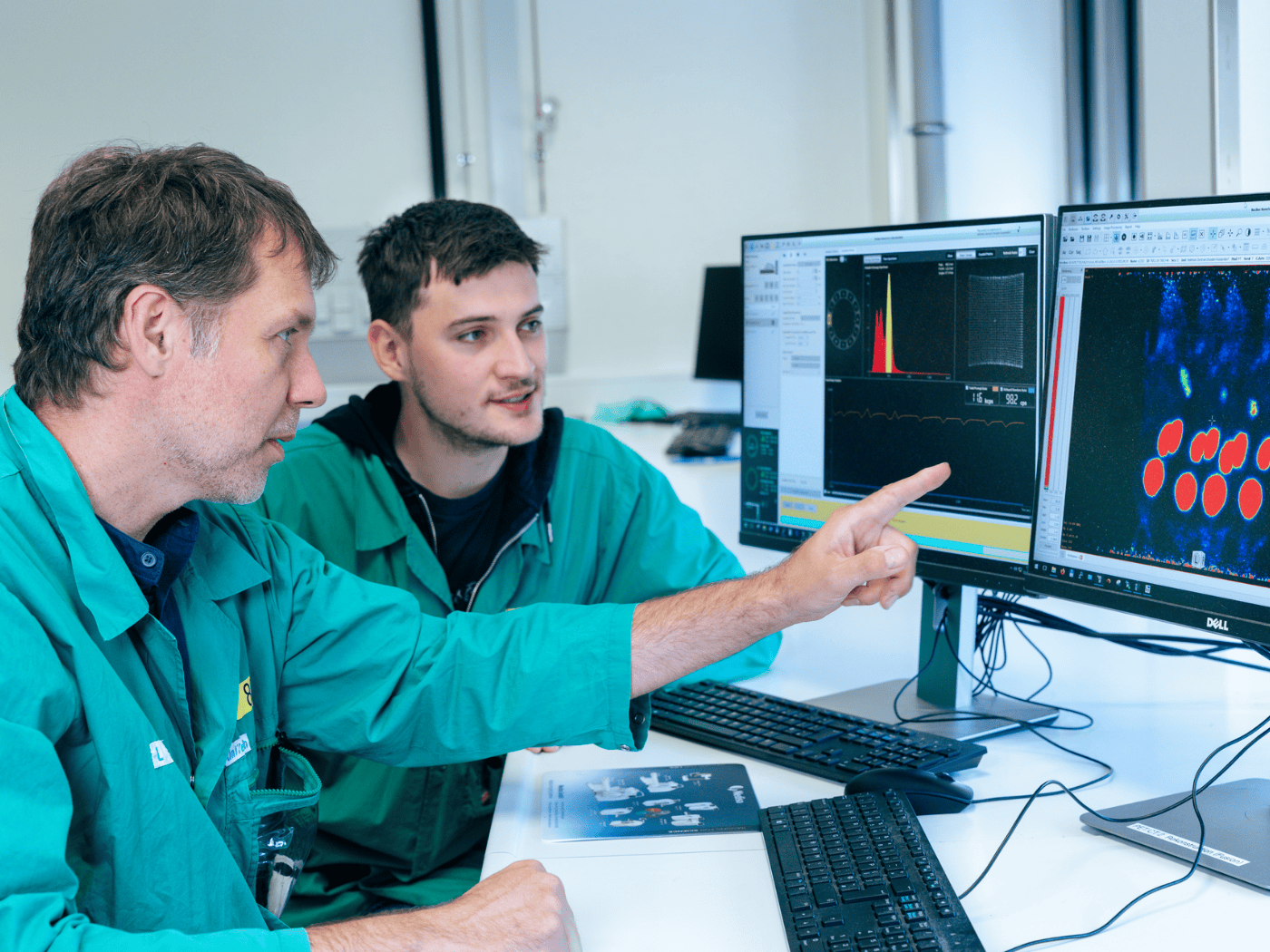
To ensure that radiation therapy is as precise as possible, doctors need to know how the medication is distributed throughout the body. Researchers at the Helmholtz-Zentrum Dresden-Rossendorf (HZDR) have developed a new approach to this end. It combines two imaging techniques and could make the treatment of advanced prostate cancer more precise in the future.
For some men with advanced prostate cancer, hormone therapy eventually stops working. In such cases, a treatment known as targeted alpha therapy can help. In this approach, radioactive molecules deliver radiation directly to cancer cells, destroying them from within. To plan the treatment as precisely as possible, doctors need to know in advance how much of the drug reaches the tumor and how long it remains there and in other organs.
A second imaging technique to complement PET
Until now, this has mostly been investigated using positron emission tomography (PET). While PET provides very precise images, it can only track the drug for a few hours. The Dresden research team therefore combined PET with a second imaging technique, single-photon emission computed tomography (SPECT). While PET provides particularly detailed images, SPECT can visualize the drug in the body for a significantly longer period of time.
The researchers developed molecules that have the exact same chemical structure as the eventual therapeutic drug but can be labeled with different radioactive tracers for PET or SPECT. This allowed them to track the drug’s path over a significantly longer period of time.
“With our radiohybrid approach, we can – for the first time – label a single molecule with two different diagnostic radionuclides and observe its behavior in the body over the long term, without altering the molecule itself,” says study leader Dr. Constantin Mamat of the HZDR.
Planning radiation therapy more individually
Experiments with human prostate cancer cells and mice showed that both variants reliably reached the tumor. Nevertheless, the team discovered a surprising difference: one of the two labels remained in the blood longer. Why this is the case is still unclear.
For the researchers, this is an important clue. Apparently, even very small changes can influence how a drug is distributed in the body. That is why they now want to investigate both methods more closely.
The results of the cell and animal experiments show that the new approach works in principle. If it becomes possible in the future to track more precisely how a drug is distributed in the body, the radiation dose can also be better tailored to individual patients. This would allow the tumor to be treated as effectively as possible while better sparing healthy tissue. As a next step, the Dresden research team plans to gradually develop the most promising compound for clinical trials.
Originalpublikation:
T. Krönke, M. Ullrich, M. K. Blei, K. Zarschler, J. Schädlich, S. A. Brühlmann, K. Kopka, J. Pietzsch, S. Stadlbauer, C. Mamat: Diagnostic Twins: Exploring the Radiohybrid Concept with Iodine-123 and Lanthanum-133 for PSMA-Targeted SPECT and PET Imaging, in Journal of Medicinal Chemistry, 2026.

