


Researchers develop more affordable monitoring system for bridges
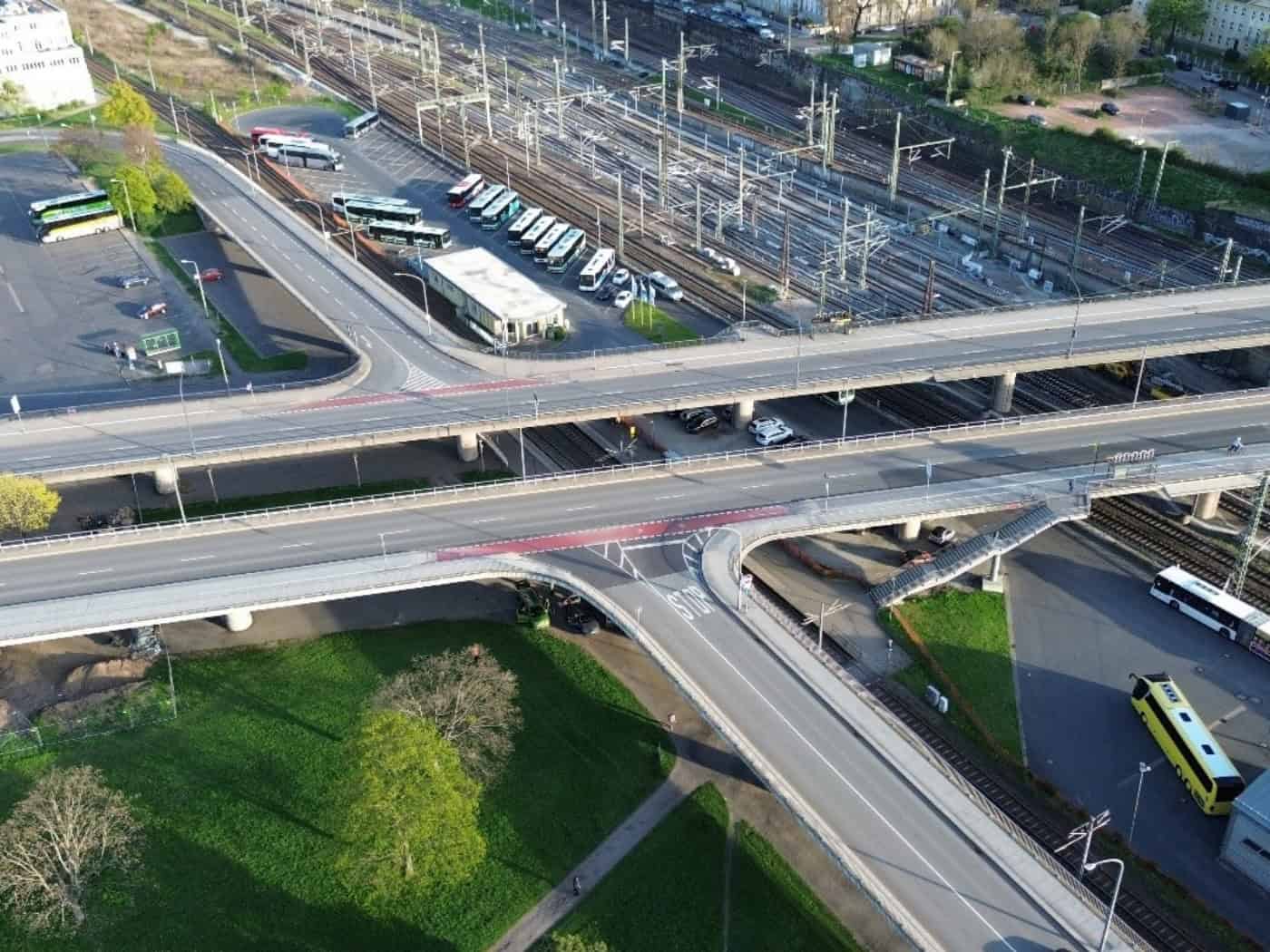
The bridges we cross carry our trust. Yet many of them are in poor condition. In 2022, the Federal Ministry of Digital and Transport classified 8,000 highway bridges as requiring renovation.
Researchers at the Fraunhofer Institute for Ceramic Technologies and Systems (Fraunhofer IKTS) in Dresden want to help detect damage earlier—with a system that literally listens to bridges. The measurement system is called COMOBASE. It uses so-called acoustic emissions to detect damage inside structures.
Acoustic emission measurement itself is not new. It has been established for a long time. What is new is that the Fraunhofer team aims to make the necessary measurement technology significantly simpler and more cost-effective.
When Cracks Make Noise
If a crack forms in a bridge or a load-bearing steel element inside the structure fails, tiny acoustic signals are generated. Sound waves are produced that propagate through the material. Sensors on the bridge pick up these sounds.
"You can imagine it like a taut guitar string snapping—every instance of damage produces a characteristic sound that we can detect with our technology and locate spatially," explains Dr. Kilian Tschöke, a researcher at Fraunhofer IKTS. The system operates around the clock. Like a long-term stethoscope permanently attached to the bridge.
While many bridges today are primarily monitored through regular inspections, modern monitoring systems continuously collect measurement data. COMOBASE is designed to simplify this continuous monitoring. The sensors detect particularly low sound frequencies that can propagate well even through massive structures.
Tailor-made instead of expensive
The key difference from previous technology is the price. Conventional measurement systems are often expensive because they are built for many different applications. The Dresden team is taking a different approach.
"In most cases, an application requires only a small percentage of these expensive all-purpose solutions. We therefore do not develop our monitoring technology using a one-size-fits-all approach, but rather tailor it precisely for use on the specific structures," says Dr. Lars Schubert, department head at Fraunhofer IKTS.
This focus allows for leaner hardware and software designs—and thus significantly lower costs. Multiple sensors can collect data simultaneously and help to more precisely locate damage within a structure.
Initial tests on a real bridge in Dresden
COMOBASE is already undergoing field testing—in parallel with established systems—on the bridge on Budapester Straße in Dresden. Defects were recently discovered in the structure that necessitate closures. The test results are promising. “Our validations confirm that we can achieve the same level of accuracy with significantly reduced system complexity,” says Schubert.
The earlier damage is detected, the more precisely repairs and renovations can be planned. This can help prevent costly consequential damage or unexpected closures.
Next, the researchers plan to further develop other measurement technologies for infrastructure monitoring. An application center for testing and monitoring procedures is also being established at the Dresden-Klotzsche site. This will be a place where new solutions for bridges, wind turbines, and other structures will be developed in the future.

