

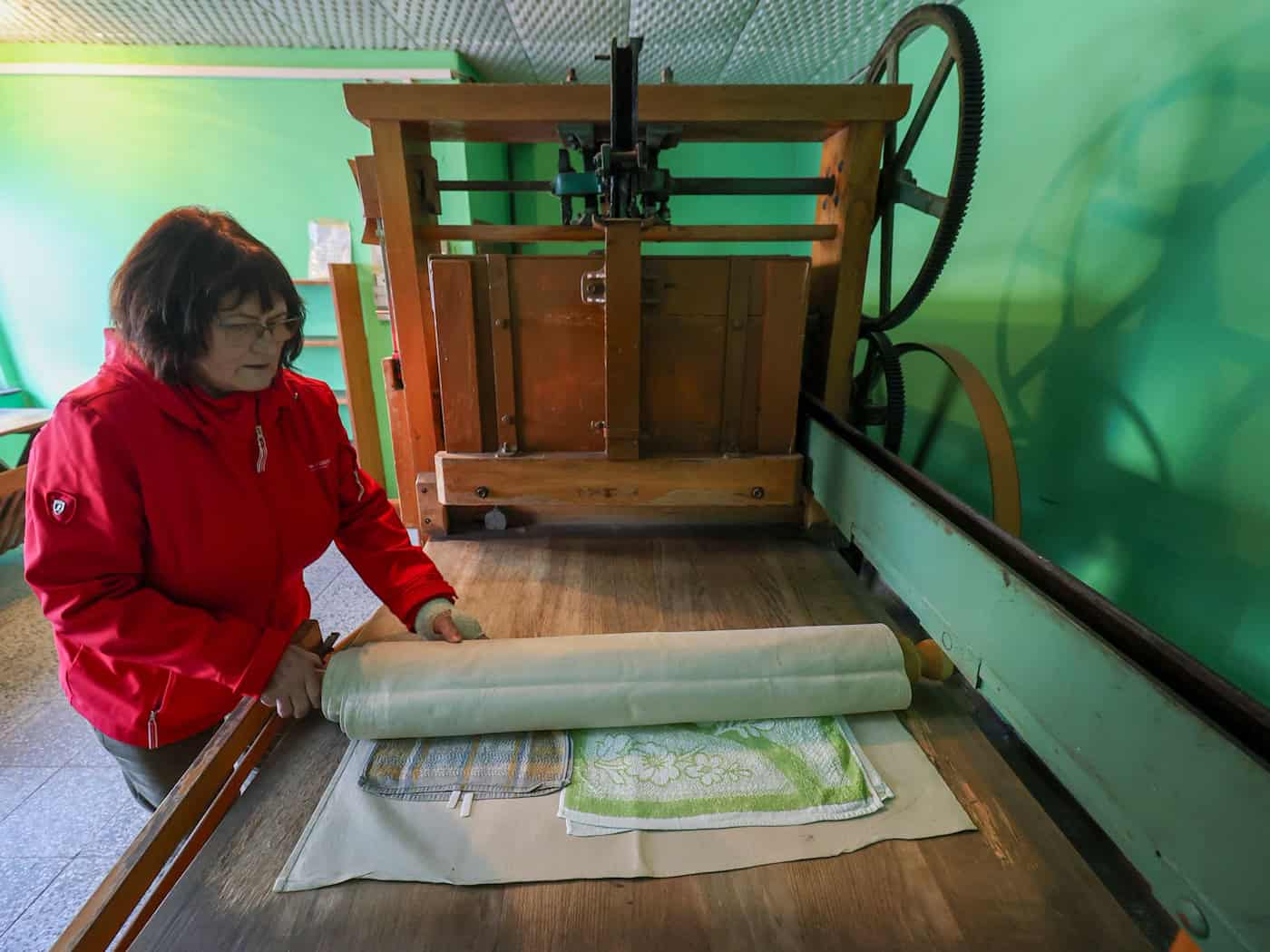
It rumbles and rattles and smells like childhood. Anyone who enters the laundry mangle room in Heinrichsort feels transported back in time. The district of Lichtenstein in the Zwickau district is home to something that has become a curiosity today: a cold ironer. However, some people still swear by the stone-filled monster to smooth out freshly washed laundry. "The catchment area of people who iron laundry here stretches as far as Chemnitz," says local manager Annett Richter. Bed sheets, tablecloths and towels are wrapped on so-called docks or rolling pins and then rolled over three times with the heavy crate. "This presses the items of laundry firmly together and makes them smooth," explains Richter. Important: buttons or zippers could be damaged by the pressure. The cold ironer has been in the municipal building in Heinrichsort since the late 1960s. "And it will probably continue to run until no one can repair it," says Richter. So far, her husband Michael has managed to find belts and other accessories to maintain the historic piece. According to the State Office for the Preservation of Historical Monuments, 64 rotary ironers in 47 locations are currently listed as cultural monuments in Bavaria. To date, only a few laundry mangles have survived, even though they originally existed in many villages. Until the 1990s, private and public ironing rooms were still in operation in many places for a fee for the population - according to the state office, every single ironer is now a rarity. Tobias Neubert also remembers going to the public ironer with his mother or grandmother and a handcart full of laundry. In his childhood, this was a normal part of everyday life. Women often handed in their laundry in baskets and two women operated the heavy equipment - "like a kind of service", says Neubert. Today, the 62-year-old is involved in the Laundry Ironing Museum in Halsbrücke in the district of Central Saxony. Neubert has collected 15 large and around 20 smaller ironers since the end of the 1980s - the largest exhibition of its kind ever, according to him. "In the past, much coarser fabrics were often used in the household," he explains. These were not as easy to iron smooth as they are today. The A9 highway through central Germany once marked a kind of everyday border: "Ironing was done on one side and ironing on the other." This had to do with a manufacturer of ironers east of the highway. In West Germany, ironing disappeared more quickly anyway. The development of the different designs is well documented in Neubert's museum. Initially, cold ironers were common - heavy, hand-operated machines that worked solely with pressure. Later, an electric drive was often added, as were hot ironers with heated rollers. The oldest ironer in Halsbrücke is over 200 years old. According to the State Office for the Preservation of Historical Monuments, most of the ironers listed as cultural monuments date from the 19th and early 20th centuries. The oldest examples are probably preserved in the museum in Halsbrücke. In Berggießhübel (district of Sächsische Schweiz-Osterzgebirge), there is also a Kastenmangel, which is one of the oldest preserved installations in the Free State. "Saxony was once also home to numerous ironer factories." Over the years, Tobias Neubert has painstakingly restored many ironers. He describes ironers from GDR consumer goods production as special finds. Many of these appliances were simply constructed. "Often very primitive - built only on command." Today, these models in particular have their appeal - "a nice curiosity that I can show off". Because technically they even lagged behind the state of the art around 1900. Sometimes there was a lack of basic details, "sometimes a sensible switch". With a twinkle in his eye, Neubert therefore calls them "the communists' last revenge". Despite all the effort, even Neubert's 92-year-old mother still keeps on mangling. She collects the appropriate laundry in a basket for weeks. In a basement building of the Chemnitz housing cooperative "Pfarrhübel" there is also such an "old diva", which is looked after by retiree Florian Gebhardt. That's what he calls the electrically operated cold ironer from 1926 - a 100-year-old piece of technology. "On warm summer days, the wood creaks and crunches, but it still works," he says. Beghardt has lived in the residential area for 45 years and the Kaltmangel has always been part of it. It is now still used by four couples. "The mangled linen tablecloths have an incomparable matt sheen. Only the cold ironer can achieve that." No wonder, because 1.5 tons of concrete and stones act on the laundry. Younger generations would hardly put up with such an effort because of a few folds in the laundry. But Annett Richter from Heinrichsort thinks: "Sometimes it's worth not giving up on something too quickly, but rather repairing and restoring it." Older people in particular are used to running their household in this way. Richter adds: "Freshly washed and pressed smooth, the laundry is then put in the cupboard - often with a fragrant bar of soap. Mangled tablecloths are then put on for festive occasions or special coffee parties. Copyright 2026, dpa (www.dpa.de). All rights reservedOne-of-a-kind everyday appliance has rarity value today
Oldest rotary ironers are over 200 years old
"The communists' last revenge"
Retired man looks after "old diva" in Chemnitz


