


Cost Overrun: Cuts to the Leipzig-Chemnitz Rail Line
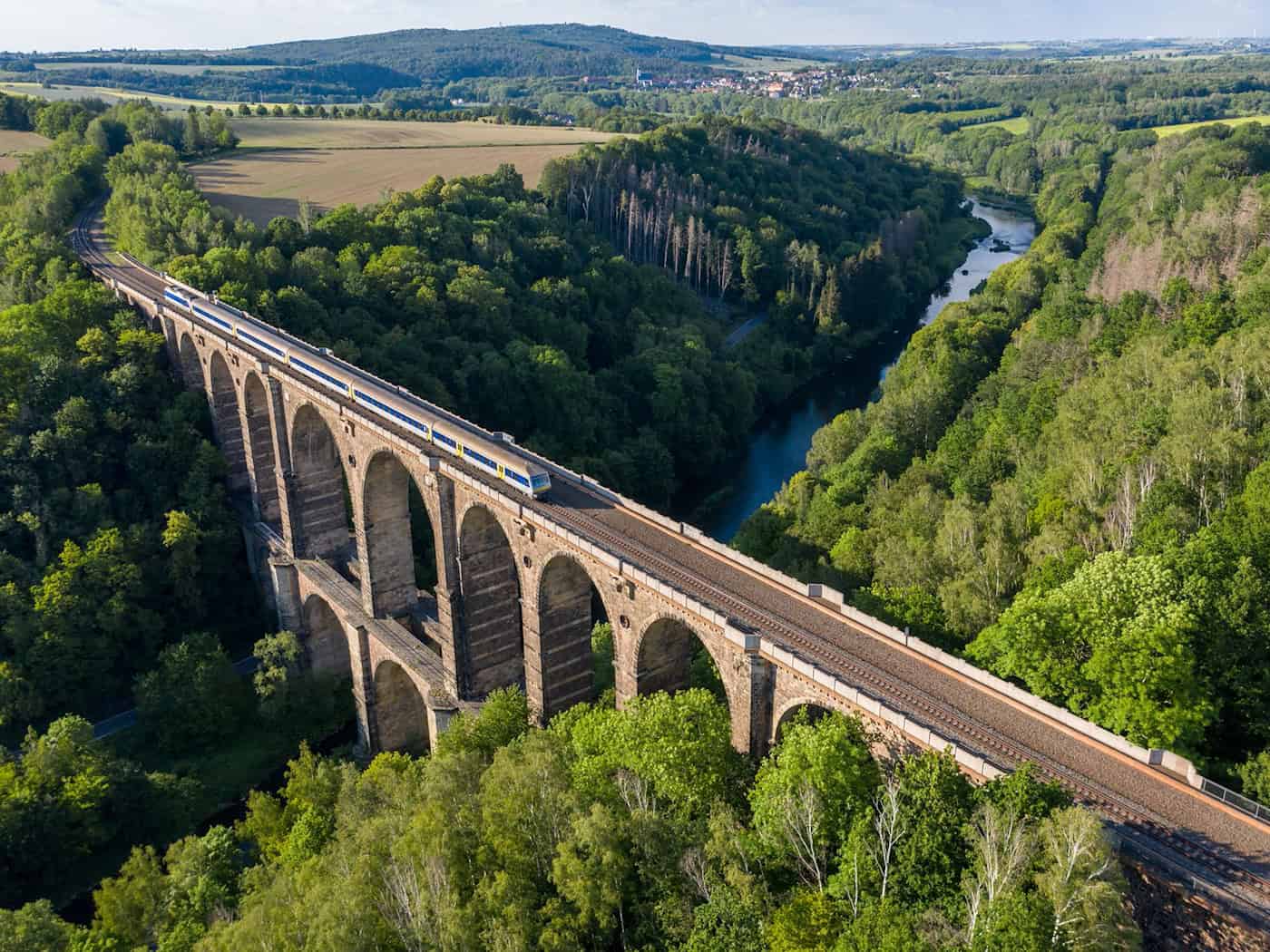
According to a new feasibility study, the expansion of the Chemnitz-Leipzig rail line is to be scaled back in light of skyrocketing costs. According to the study, a second track is now planned for only about 24 of the 44 kilometers in the northern section between Leipzig and Geithain, as reported by Deutsche Bahn AG and the Ministry of Infrastructure. Electrification is to be completely transferred to a different funding program. The state would then have to contribute at least 15 million euros toward this. The fight to expand the rail line has been going on for years. As a result of reparations following World War II, it is now single-track and lacks overhead wires. Consequently, it cannot be used for long-distance service and is reaching its capacity limits. According to reports, it is currently operating at 140 percent capacity. As a result, even isolated disruptions regularly have major repercussions. The line is not only used by many commuters but also serves as the connection for the Chemnitz industrial region to the Leipzig rail hub, including long-distance rail service. However, the costs for the expansion have skyrocketed. A current forecast puts the figure at around 1.32 billion euros—for the northern section alone. However, only just under 500 million euros in federal funds for structural change in coal-mining regions are available for that section. The cost explosion is primarily attributed to delays and massive price increases resulting from the COVID-19 pandemic and Russia’s war of aggression against Ukraine. According to reports, the starting point for the new feasibility study commissioned by Deutsche Bahn was the target of 75 trains per day: 72 for commuter service and three for long-distance service. Currently, there are about 60 trains, it was reported. The primary goal is to achieve half-hourly service during peak hours. To save money, double-tracking will now only be expanded where it is absolutely necessary. But even that, at around 531 million euros, exceeds the previous budget. Saxony’s Transportation Minister Regina Kraushaar (CDU) is counting on an additional federal grant—either from the special fund or from funds still available for coal industry restructuring. Added to this is another 149 million euros for the electrification of the section. This is now to be funded through a different source: the Municipal Transportation Financing Act. Kraushaar said she is hoping for the highest possible funding rate of 90 percent. Despite the cutbacks, Chemnitz Mayor Sven Schulze (SPD) emphasized that this plan represents a significant improvement over the current situation. The travel time between the two major cities would also be reduced by about 10 minutes. This would be accompanied by greater punctuality and reliability. Planning for the second section, Chemnitz-Geithain—the southern section—is already further along and is not directly affected by the new feasibility study. According to current information, it will cost 306 million euros, be financed by federal and state funds, and be completed between 2032 and 2035. With the exception of two smaller sections on bridges, the 37-kilometer stretch is to be fully double-tracked and electrified. The goal is to complete the full expansion of the Leipzig-Chemnitz line, including both the northern and southern sections, over the course of the 2030s, Kraushaar said. Rail passengers must, however, prepare for significant disruptions over an extended period. This is because a total closure is planned during construction to speed up the work. For travelers, this means taking the bus instead of the train. Copyright 2026, dpa (www.dpa.de). All rights reservedCosts for the northern section have climbed to over 1.3 billion euros
Kraushaar Calls for Additional Federal Funding
Buses Instead of Trains: Total Closure During Construction

